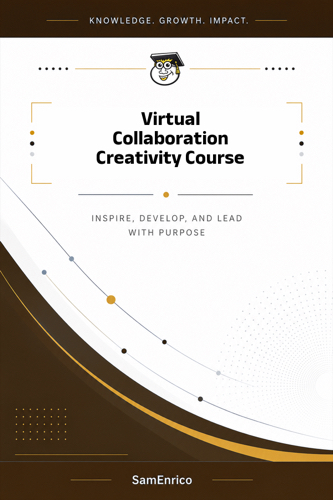
Virtual Collaboration Creativity Course eBook
Adapts in-person creative techniques to Zoom, Miro
by Tovar Flo
Adapts in-person creative techniques to Zoom, Miro, and distributed team environments.
Formats
Free sample
Chapter 1: The Translation Error--–- It was 10:02 on a Tuesday morning when the sticky notes started falling off the screen.Not literally, of course. Digital sticky notes do not fall. They simply sit there, pixelated and inert, waiting for someone to drag them into an affinity cluster that will never come. But metaphorically, the notes were everywhere—thirty-seven of them, scattered across a Miro board that looked like a refrigerator door after a tornado. The facilitator, a well-meaning director of innovation named Priya, had done everything right by the old playbook.
She had set a timer. She had encouraged wild ideas. She had said the magic words: “No judgment, just volume.”And yet, forty-five minutes later, the team had produced exactly one idea worth pursuing. The rest were variations on a theme first voiced by the loudest person in the room, a senior vice president whose opening statement—“What if we just did what we always do, but faster?”—had somehow set the tone for the entire session.Priya closed her laptop and wondered if she had lost her touch.She had not lost her touch. She had lost her medium.This is a book about that loss and, more importantly, about the recovery.
It is about why the most creative people you know suddenly feel uncreative on Zoom. It is about why the techniques that worked like magic in a conference room turn to lead in a browser window. And it is about what you can do about it, starting right now, without buying new software or begging your IT department for permission.The title of this book is The Virtual Collaboration Creativity Course, but its real subject is translation. You are about to learn how to translate in-person creative techniques into a language that distributed teams actually speak. The grammar of that language has three rules—Presence, Pace, Persistence—and once you internalize them, you will never run a bad virtual brainstorm again.But first, you need to understand why everything you thought you knew about creative facilitation is about to become wrong, then right again, in a different way.The Cathedral and the Bazaar Let me tell you a story about two kinds of creativity.The first kind is the cathedral.
Imagine a room full of people around a wooden table. Sunlight streams through a window. Someone has a marker and a large sheet of paper. The facilitator calls out a prompt, and voices overlap, build, diverge, converge. Ideas bounce off the walls.
Someone laughs. Someone else leans forward and says, “Wait, what if we combined your idea with hers?” Energy is visible, palpable, almost musical. This is the cathedral model of creativity: high-bandwidth, synchronous, emotionally resonant, and deeply human.The second kind is the bazaar. Imagine an online forum where people post ideas at all hours of the day and night. A designer in Berlin uploads a sketch.
A developer in São Paulo adds a comment twelve hours later. A product manager in San Francisco synthesizes both contributions into a proposal the following morning. No one ever meets in real time. The conversation stretches across days and time zones. This is the bazaar model of creativity: low-bandwidth, asynchronous, text-driven, and relentlessly persistent.Here is the problem that has wrecked a thousand virtual creative sessions.
Most facilitators try to run the cathedral inside the bazaar. They schedule a one-hour Zoom call. They expect the same energy, the same overlap, the same musicality. And when it does not arrive—when the latency creates awkward pauses, when the lack of eye contact flattens emotion, when the shared screen becomes a bottleneck—they blame themselves or their team or the technology.The technology is not the problem. The translation is the problem.You cannot run the cathedral on Zoom.
Not because Zoom is bad, but because the cathedral depends on physical properties that do not exist in digital space: sub-200-millisecond response times, peripheral vision, ambient sound, the ability to point at something without clicking, the ability to read a room without a grid of sixteen identical faces. These are not minor features. They are the operating system of in-person creativity.But here is the good news, and it is genuinely good. You can run the bazaar brilliantly. The bazaar has its own superpowers: persistence, scalability, documentation, equal access.
The bazaar does not care if you are the senior vice president or the intern. The bazaar gives everyone the same size text box. The bazaar remembers everything.The difference between a failed virtual session and a brilliant one is not effort. It is translation. You must stop trying to simulate the cathedral and start designing for the bazaar.The Three Failures To translate effectively, you need to understand what, exactly, breaks when you move creativity online.
The research literature identifies dozens of factors, but in my experience facilitating hundreds of virtual sessions across five continents, three failures account for 90 percent of the pain.Failure One: The Latency Trap Human conversation is a marvel of temporal precision. When two people talk in person, the gap between the end of one utterance and the beginning of the next is typically 0 to 200 milliseconds. We perceive this gap as fluid, natural, even intimate. The brain processes these micro-timing cues automatically, using them to predict when it is safe to speak, when someone is about to finish, when an interruption is welcome or hostile.Zoom adds a fixed delay of 200 to 300 milliseconds to every exchange. That is the round-trip time for audio to travel from your computer to Zoom’s server and back to the other participants.
Two hundred milliseconds does not sound like much. It is less than the time it takes to snap your fingers. But it is exactly the amount of time that separates “fluid conversation” from “awkward pause.”Here is what happens in that gap. You finish speaking. The other person hears you 150 milliseconds later.
They begin to respond after another 100 milliseconds of cognitive processing. Their voice reaches you 150 milliseconds after that. Total elapsed time: 400 milliseconds. In a physical room, that same exchange would have taken 200 milliseconds. The extra 200 milliseconds is just enough for your brain to register a pause, interpret it as confusion or disinterest, and fill the silence with another utterance.This is why virtual conversations feel so stilted.
The latency trap turns “Yes, and...” into “Yes, but...” It turns building into interrupting. It turns flow into friction. And there is no technical fix because the speed of light is not getting any faster. The only fix is to change the structure of the conversation itself—specifically, to reduce the number of rapid verbal exchanges and replace them with written, asynchronous contributions.Failure Two: The Absence of the Hallway In physical offices, a massive amount of creative work happens outside of scheduled meetings. It happens in the hallway, at the coffee machine, in the elevator, walking to lunch.
These are what organizational psychologists call “informal social collisions”—unplanned encounters that generate unexpected connections, transfer knowledge across silos, and spark creative insights.The hallway is powerful precisely because it is unscheduled. You cannot force a collision by putting it on a calendar. The moment you schedule a “virtual coffee break,” it…
This is the end of the free sample. Get the eBook to keep going. Buy now
About this book
Details
- Author
- Tovar Flo
- Publisher
- SamEnrico
- Language
- English
- Genre
- Non-Fiction, Self-Help, Virtual Teams
- Released
- 2026-06-10
- Pages (approx.)
- 130
- Available as
- eBook, Audiobook

Read better in the ZLOADR app
Your eBooks on your phone or tablet. Sign in with your SamEnrico account and start reading.
More by Tovar Flo
 Russian Brain Drain ForecastTovar Flo$11.99
 Social Support Weight LossTovar Flo$11.99
 The Single Parent Sleep GuideTovar Flo$11.99
 Innocence Project Maine CasesTovar Flo$11.99
 White Gold & Red Tape: The Untold War on Miami's Cocaine CowboysTovar Flo$11.99
 The Silk Road in the Sky: Ancient Wings Over Southeast AsiaTovar Flo$11.99
 Understanding Chromosome 3, Monosomy 3p25Tovar Flo$17.99
 Leasing CoordinatorTovar Flo$11.99
 How to Become a Cabinet AssemblerTovar Flo$11.99
 Quarterly Estimated Tax GuideTovar Flo$12.99
 Facebook Group Validation MethodTovar Flo$12.99