
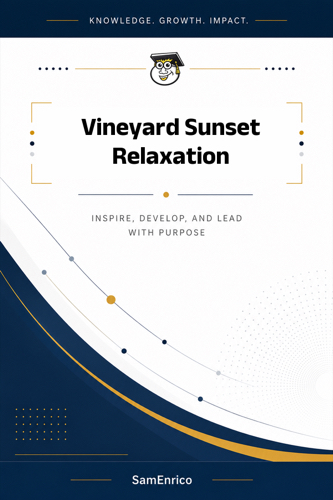
Vineyard Sunset Relaxation eBook
Walk through grapevines at golden hour and taste t
Walk through grapevines at golden hour and taste the sweetness of calm evening air.
Formats
Free sample
Chapter 1: The Doorway Between--–- The sky is doing something remarkable, and you are not looking at it.You are reading this sentence instead, which means your eyes are pointed at a page or a screen, not at the western horizon where the light is currently transforming from the harsh white of midday into something softer, warmer, and chemically different. That transformation happens whether you watch it or not. The sun lowers itself behind hills, trees, or buildings. Shadows lengthen. The color temperature of the air shifts from cool blue to amber to rose to violet.
And somewhere, not far from wherever you are sitting, a grapevine is closing its stomata—microscopic pores on the undersides of leaves—as if the plant itself is exhaling a long, slow breath of relief.You are not a grapevine. But you have stomata too, metaphorically speaking. You have pores that have been open all day, taking in the noise, the demands, the notifications, the decisions, the small insults and larger anxieties of modern life. By late afternoon, most people are walking around with their attention systems raw and overworked, like a muscle that has been lifting weights without rest since 7 AM. You know this feeling.
It is the 4 PM fog. The 5 PM irritability. The 6 PM collapse onto a couch with a screen in your hand and no memory of how you got there.This book is not about wine. It is not about vineyards in the sense of tasting rooms, tour buses, or expensive bottles. It is about something older and stranger: the specific, measurable, and ancient healing that occurs when a human being walks slowly through rows of grapevines during the forty-five minutes before sunset, breathes the cooling air, and does nothing else.That sounds simple.
It is simple. But simple is not the same as easy.Because you have been taught, probably since childhood, that time is money, that rest is laziness, that the evening hours are for productivity or obligation or numbing out in front of a screen. You have been trained to see the hour before sunset as a gap to be filled, not a gift to be received. This book exists to reverse that training.The science of why a vineyard at sunset works as a relaxation tool is surprisingly robust. It draws from Attention Restoration Theory, environmental psychology, chronobiology, olfactory neuroscience, and the emerging field of nature-based therapeutics.
But you do not need a degree in any of those fields to feel the effect. You just need to show up, slow down, and pay attention.This chapter is an invitation. It is also a warning: once you learn to taste the sweetness of evening air, you will never be able to unlearn it. Ordinary evenings will start to feel incomplete without this practice. That is not a problem.
That is the point.The Problem You Did Not Know You Had Let us name the enemy. It is not stress, exactly. Stress is a normal biological response to challenge. The enemy is something else: the chronic, low-grade, never-ending activation of your sympathetic nervous system that has become so normalized you no longer recognize it as abnormal.Here is a test. Right now, before you read another sentence, take one normal breath.
Do not change it. Just notice it. Is it shallow? Does it live high in your chest rather than low in your belly? Are your shoulders slightly raised?
Is your jaw subtly clenched? If so, you are in a state of low-grade fight-or-flight. That is not your fault. That is the baseline of modern life.Your nervous system evolved to handle short bursts of threat—a predator, a storm, a conflict—followed by long periods of rest and recovery. But modern life has reversed that ratio.
The threats are now constant and low-grade: emails, deadlines, social comparison, news cycles, traffic, digital notifications, the endless hum of obligation. Your body cannot tell the difference between a saber-toothed tiger and a passive-aggressive Slack message. It responds to both with cortisol, adrenaline, and a cascade of stress hormones.By late afternoon, most people have been marinating in this soup for nine or ten hours. The result is the phenomenon that researchers call the "afternoon cortisol spike," though you probably call it the 5 PM crash. Your body is trying to wind down, but your mind is still racing.
You want to relax, but you do not know how. You reach for wine, for a screen, for food, for anything that will turn off the noise. But those solutions are not solutions. They are sedatives. They numb the problem without addressing its root.The root is this: your attention has been depleted.Attention Restoration Theory, developed by psychologists Rachel and Stephen Kaplan in the 1980s, offers a framework for understanding what is happening.
Your brain has two types of attention. Directed attention is the effortful, focused kind you use to work, read, drive in traffic, or resist a distraction. It is finite and exhaustible, like a battery. Soft fascination is the effortless kind that happens when you watch clouds move, leaves rustle, or water flow. It does not deplete attention.
It restores it.Most modern environments—offices, cities, screens—demand directed attention constantly. Even your "relaxation" often requires directed attention: choosing a show, scrolling through options, reading captions, responding to comments. You are never truly off.A vineyard at sunset, by contrast, is a machine for soft fascination. The rows of vines create a natural labyrinth that gently guides the eye without demanding decision-making. The changing light is slow enough to be watched but not so fast that it requires tracking.
The sounds—birds, insects, wind—are rhythmic but unpredictable. The scents are complex but not overwhelming. Everything about a vineyard at golden hour is calibrated, by evolution and by human cultivation, to restore what the modern world has depleted.This is not poetry. This is physiology.The Biology of Golden Hour Let us get specific about what happens to your body when you walk through grapevines at sunset.First, light. The low-angle sun of golden hour is rich in red and amber wavelengths and poor in blue wavelengths.
Blue light, the kind that dominates midday and screens, suppresses melatonin production and keeps your circadian rhythm in daytime mode. Red and amber light do the opposite. They signal to your suprachiasmatic nucleus—the master clock in your brain—that the day is ending and rest is approaching. This does not directly "trigger" melatonin release, as some sources oversimplify. But it creates the conditions for melatonin to rise naturally over the next hour.
You are not flipping a switch. You are opening a door.Second, temperature. As the sun lowers, the air begins to cool. The temperature drop is usually subtle—one to three degrees—but your body detects it through thermoreceptors in your skin. That cooling sensation is interpreted by your brain as a signal of safety and approaching rest.
Warmth can be alerting. Coolness, especially the coolness of evening air, is deeply settling. It tells your autonomic nervous system: no threat here. The day is ending. You can let go.Third, scent.
The olfactory nerve is the only sensory pathway that reaches the brain without first passing through the thalamus. Smell goes…
This is the end of the free sample. Get the eBook to keep going. Buy now
About this book
Details
- Author
- Shifflett Toby
- Publisher
- SamEnrico
- Language
- English
- Genre
- Non-Fiction, Self-Help
- Released
- 2026-06-08
- Pages (approx.)
- 139
- Available as
- eBook, Audiobook

Read better in the ZLOADR app
Your eBooks on your phone or tablet. Sign in with your SamEnrico account and start reading.
More by Shifflett Toby
 Abandoned Cart RecoveryShifflett Toby$12.99
 Flow in FirefightingShifflett Toby$11.99
 The Focus Habit HandbookShifflett Toby$11.99
 Positive Self Talk WorkbookShifflett Toby$11.99
 Virtual Event CommunicationShifflett Toby$11.99
 The Senior Advance DirectiveShifflett Toby$11.99
 Mountain Lake Serenity GuideShifflett Toby$11.99
 Self Hypnosis for Achilles TendonitisShifflett Toby$11.99
 The Last Letter of the Titanic’s Unsung Hero: A Forgotten Story of CourageShifflett Toby$11.99
 The Last Broadcast: The Fall of Saigon in Real TimeShifflett Toby$11.99
 How to Produce Detergent and SOAPShifflett Toby$11.99
 A Collector's Handbook to the Wolseley 1500Shifflett Toby$11.99
You may also like
 Hong Kong Handover 1997Dunn Johnnie$11.99
 Zumba For Postnatal Recovery CourseNeal Christian$11.99
 Zumba for BeginnersLadner Nikia$11.99
 YouTube Comment Mining GuideHumes Pandora$12.99
 Worry Box MeditationCarlin Rudy$11.99
 Workplace Stress MeditationNguyen Lynn$11.99
 Workplace Stress and Sleep RepairHawley Ivory$11.99
 Workplace Perfectionism CureDelaney Jeffry$11.99
 Workplace Injustice Anger GuideWallen Isabelle$11.99
 Work Addiction and Burnout LinkGreenwood Ester$11.99
 Women in Yoga and WellnessBeattie Galina$11.99
 Women in Stand Up ComedyChun Evangeline$11.99