
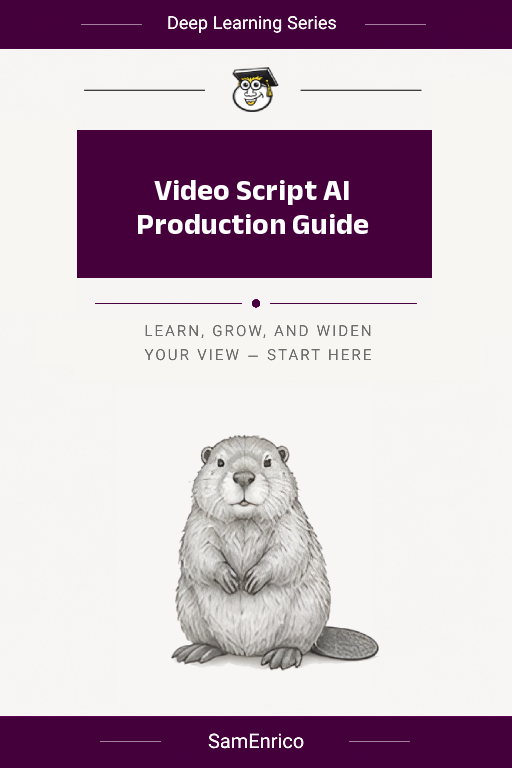
Non-FictionAI OperatorVideo Marketing
Video Script AI Production Guide eBook
Generate engaging video scripts for YouTube TikTok
Generate engaging video scripts for YouTube TikTok and Instagram Reels using prompt engineering.
Formats
Free sample
Chapter 1: The Director’s Gambit--The year is 2023. A creator sits in a coffee shop, staring at a blinking cursor on a blank document. She has an idea for a Tik Tok video that could reach two million people, but she has spent forty-five minutes trying to write the first three seconds. She deletes seventeen versions of the hook. She watches her competitor’s video hit one million views while she is still stuck on the word “so.” This creator is not struggling because she lacks creativity.
She is struggling because she is using the wrong toolkit for the wrong era. Traditional scriptwriting was designed for a world of movie theaters, prime-time television slots, and captive audiences who had already committed their attention. That world no longer exists.Welcome to the short-form video revolution. On Tik Tok, Instagram Reels, and You Tube Shorts, users swipe past content every 1.2 seconds on average. The decision to watch or abandon a video happens before the conscious brain can fully engage.
In this environment, a beautifully written three-act structure with rich character development is not an asset. It is a liability. The platforms have rewired human attention, and scriptwriting has not caught up—until now. This book exists because artificial intelligence, specifically large language models, offers a fundamentally different way to generate video scripts. But most creators are using AI wrong.
They type “write a script for a Tik Tok about productivity” into Chat GPT and receive generic, forgettable, algorithmically invisible garbage. Then they declare that AI cannot write good scripts. They are correct about the output but incorrect about the cause. The problem is not the AI. The problem is the prompt.This chapter introduces the core transformation required to succeed in the AI-driven video era: the shift from Writer to Director.
A writer crafts every word manually, suffering over syntax and structure alone. A director guides a team of talented but literal-minded performers, providing constraints, emotional direction, and creative boundaries. When you use AI for scriptwriting, you are not the writer. You are the director. And the AI is your brilliant, fast, utterly literal intern who needs precise instructions to deliver gold.
This single mental shift separates creators who produce thirty scripts a week from those who spend forty-five minutes on one hook.We will explore why traditional scriptwriting fails on short-form platforms, how the 4 Pillars of Viral AI Scripts replace outdated screenwriting rules, and why the Director’s Mindset will become your most valuable creative asset. By the end of this chapter, you will understand why a fifteen-second script follows different rules than a sixty-second narrative, and you will have a framework that will guide every prompt you write for the rest of this book. Let us begin.The Collapse of Traditional Screenwriting For nearly a century, screenwriters learned a set of almost sacred rules. Establish the setting. Introduce the protagonist.
Build tension slowly. Pay off the setup twenty minutes later. Respect the three-act structure. These rules worked brilliantly for feature films, hour-long dramas, and even the ten-minute You Tube essays that dominated the platform’s early years. But short-form video has obliterated every single one of these assumptions.Consider the math.
A typical Hollywood movie has a two-hour runtime. The first ten minutes are considered the “hook,” during which the audience decides whether to commit. That means filmmakers have six hundred seconds to earn attention. A Tik Tok video has an average view duration of between eight and fifteen seconds. The actual hook—the moment when a user decides to keep watching or swipe away—occurs in the first three seconds, often the first one and a half seconds.
You do not have six hundred seconds. You do not have sixty seconds. You have approximately the time it takes to blink twice.This compression destroys the economic model of traditional screenwriting. In a movie, the audience has already paid for the ticket or clicked play on a streaming service. The cost of abandoning the film is moderate.
In short-form video, the user loses nothing by swiping. The algorithm immediately serves another piece of content. The cost of abandonment is zero. Therefore, your script must earn retention every single second, not just once at the beginning.Traditional screenwriting also assumes a linear, uninterrupted viewing experience. The audience sits in a dark room or watches on a couch with reasonable focus.
Short-form video competes against notifications, group chats, physical movement, and the user’s own thumb hovering over the swipe zone. Your script is not being watched in a vacuum. It is being watched while someone waits for a bus, eats lunch, or pretends to listen to a coworker. This means retention requires active attention management, not just good storytelling.Perhaps most damaging is the traditional writer’s relationship with editing. A screenwriter writes a draft, revises, sends to colleagues, revises again, and eventually hands off to a director.
The process is slow, linear, and human-powered. In the AI era, you can generate fifty variations of a script in the time it once took to write one sentence. But most creators use this speed incorrectly. They generate one script, tweak it manually, and call it done. That is like owning a Ferrari and driving it only to the mailbox.
The Director’s Mindset embraces speed as a creative tool, not a threat to craftsmanship.Traditional screenwriting also ignored the algorithmic layer. A movie’s success depends on ticket sales and critical reception. A short-form video’s success depends on four algorithmic signals: watch time, completion rate, rewatches, and engagement (likes, comments, shares, saves). Your script must actively engineer these behaviors. A beautiful monologue that nobody finishes is a failure.
A rough, controversial, imperfect script that triggers two hundred comments is a viral success. The metrics have changed. The scriptwriting must change with them.Finally, traditional screenwriting treats the writer as a solitary genius. The Director’s Mindset treats the writer as an orchestra conductor. You do not need to play every instrument.
You need to know which instrument should play, when, and at what volume. The AI can generate hooks, structure beats, rewrite for different platforms, localize cultural references, and produce variations faster than any human. Your job is not to do the AI’s work. Your job is to direct the AI to do its best work. This requires a completely different skill set: prompt engineering, constraint design, tone setting, and evaluation.
None of these skills appear in traditional screenwriting guides. They will appear in every chapter of this book.The 4 Pillars of Viral AI Scripts After analyzing thousands of viral videos across Tik Tok, You Tube Shorts, and Instagram Reels, and after deconstructing the prompt patterns used by successful AI-powered creators, this book organizes all effective short-form scripts around four foundational pillars. These pillars replace the outdated three-act structure. They are not theoretical. They are engineering constraints that you will build directly into your prompts.Pillar One: The Hook (Zero to Three Seconds)The hook is the single most important element of any short-form script.
If the hook fails, nothing else matters. A successful hook does not summarize the video. It does not introduce the topic politely. It does not say…
This is the end of the free sample. Get the eBook to keep going. Buy now
About this book
Details
- Author
- Peterman Majorie
- Publisher
- SamEnrico
- Language
- English
- Genre
- Non-Fiction, AI Operator, Video Marketing
- Released
- 2026-05-29
- Pages (approx.)
- 131
- Available as
- eBook, Audiobook

Read better in the ZLOADR app
Your eBooks on your phone or tablet. Sign in with your SamEnrico account and start reading.
More by Peterman Majorie
 Urban Vs Rural Wellness HabitsPeterman Majorie$11.99
 Wake Windows for BabiesPeterman Majorie$11.99
 Divorce and Teen Self EsteemPeterman Majorie$11.99
 Asking for a Raise ConfidentlyPeterman Majorie$11.99
 The Costa Rican Retirement Talent ShiftPeterman Majorie$11.99
 Pillars of the Forgotten: The Last Apothecary of ConstantinoplePeterman Majorie$11.99
 Understanding Microcephaly Immunodeficiency LymphoreticulomaPeterman Majorie$17.99
 Wordpress SpecialistPeterman Majorie$11.99
 Sustainable Agriculture InvestmentPeterman Majorie$12.99
 How to Start a Building Boards Made of Asbestos Cement Business (Beginners Guide)Peterman Majorie$11.99
You may also like
 Hong Kong Handover 1997Dunn Johnnie$11.99
 Zumba For Postnatal Recovery CourseNeal Christian$11.99
 Zumba for BeginnersLadner Nikia$11.99
 YouTube Comment Mining GuideHumes Pandora$12.99
 Worry Box MeditationCarlin Rudy$11.99
 Workplace Stress MeditationNguyen Lynn$11.99
 Workplace Stress and Sleep RepairHawley Ivory$11.99
 Workplace Perfectionism CureDelaney Jeffry$11.99
 Workplace Injustice Anger GuideWallen Isabelle$11.99
 Work Addiction and Burnout LinkGreenwood Ester$11.99
 Women in Yoga and WellnessBeattie Galina$11.99
 Women in Stand Up ComedyChun Evangeline$11.99