
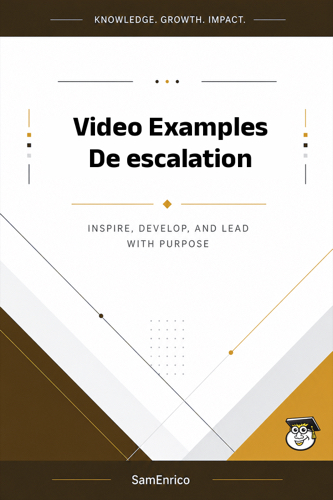
Video Examples De escalation eBook
Watch real-world examples of successful and failed
Watch real-world examples of successful and failed anger diffusion techniques.
Formats
Free sample
Chapter 1: The Nuclear Emotion...--–- It begins with a word. Not a punch, not a weapon, not a shove. Just a word, spoken in a certain tone, at a certain volume, aimed at a certain wound. And in that instant, a human being who moments before was capable of reason, capable of empathy, capable of walking away—transforms. The jaw tightens.
The feet widen. The chin rises. The eyes narrow. These micro-movements take less than two seconds. They are invisible to the untrained observer.
And they are the difference between a resolved conflict and a funeral.This is not a metaphor. This is neurology.Every day, millions of videos are uploaded to the internet showing conflicts that spiral from nothing into catastrophe. A dispute over a parking space becomes a shooting. A traffic stop becomes a death. An argument between neighbors becomes a SWAT callout.
To the casual viewer, these incidents seem inexplicable—why would someone risk their life over a parking space? Why would an otherwise reasonable person charge at an officer with a knife because they were told to "calm down"? The answer, hidden in plain sight within those videos, is a force more powerful than fear, more immediate than pain, and more volatile than anger. That force is humiliation.Amanda Ripley, in her groundbreaking book High Conflict, calls humiliation the "nuclear bomb of emotions." Unlike anger, which seeks to dominate, or fear, which seeks to flee, humiliation seeks to annihilate—not necessarily the other person, but the self that was just insulted. When a person experiences profound disrespect, their brain does not process it as a social slight.
It processes it as a physical attack, activating the same neural pathways as a punch to the face. And just as a cornered animal will fight to the death when escape is impossible, a humiliated person will escalate a conflict past all reason, all self-interest, and all survival instinct—because in that moment, death feels preferable to shame.This chapter is about that moment. It is about watching it happen in real time, frame by frame, and learning to see what the untrained eye misses. It is about understanding that most conflicts do not escalate over the original issue—a parking spot, a noise complaint, a broken tail light, a spilled drink—but over perceived disrespect injected somewhere along the way. And it is about the hardest lesson in de-escalation: the requirement that the professional absorb insult without retaliation, not because it is fair, but because physics does not care about fairness.Primary Audience: All readers (foundational theory)Key Takeaway: De-escalation requires the professional to absorb insult without retaliation.
Your ego is a liability in a crisis.The Anatomy of a Trigger Before we examine the video evidence, we must understand what happens inside the human brain when humiliation strikes. This chapter will reference the brain's response to disrespect, but it will not dive deep into amygdala and prefrontal cortex anatomy—that is reserved for Chapter 7. Here, we focus on observable behavior: what humiliation looks like from the outside.Psychologists have identified a predictable sequence of physical responses to perceived public disrespect. The sequence unfolds in less than three seconds:First, the eyes narrow. This is not a squint of concentration but a protective reflex—the body preparing for impact.
The narrowing reduces peripheral vision, focusing attention on the perceived threat. It is the same response you would have if someone raised a fist to your face.Second, the jaw clenches. This is not a sign of anger per se but a subconscious bracing of the skull's weakest point. The temporomandibular joint is vulnerable to impact; clenching protects it. Your body is preparing to be hit.Third, the feet widen and the center of gravity drops.
The body is preparing to either strike or absorb a strike. A wider stance provides stability. A lower center of gravity makes it harder to be knocked over. These are the same adjustments a boxer makes before a punch.Fourth, the chin rises slightly. This is the most telling sign—not submission but defiance.
Raising the chin exposes the throat, which seems counterintuitive for self-protection. But the chin raise is not about physical defense; it is about social signaling. It says, "I will not look away. I will not bow. I am not afraid of you."Fifth, the voice drops in pitch and increases in volume.
The body is flooding with cortisol and adrenaline. The vocal cords thicken. The diaphragm engages. The result is a voice that sounds deeper, louder, and more threatening. This is not a choice; it is physiology.At this point, the person has entered what conflict specialists call the "Red Zone"—a physiological state where logical reasoning becomes difficult, empathy disappears, and the only available responses are fight, flight, or freeze.
In the Red Zone, a person cannot hear commands, cannot process long sentences, and cannot consider consequences. They can only react.The critical insight—and the one that separates effective de-escalation from catastrophic failure—is that the Red Zone is not entered because of the original issue. It is entered because of something that happened in the previous thirty seconds. Almost always, that something is a perceived humiliation.Case Study One: The El Paso Incident On a summer evening in El Paso, Texas, a police officer responded to a call about a juvenile disturbance. The details are mundane: a group of teenagers, loud music, a complaint from a neighbor.
The officer arrived expecting to disperse the group and move on. What he encountered instead would become a textbook example—taught in academies and dissected on social media—of how a minor situation becomes a drawn-weapon standoff because one person could not absorb an insult.The video, captured on the officer's body-worn camera and later leaked to news outlets, runs approximately four minutes. The first sixty seconds are unremarkable. The officer approaches the group, identifies himself, and asks them to lower the music. The teenagers comply, though with visible reluctance.
One of them, a young man wearing a hoodie, mutters something under his breath. The officer asks him to repeat it. The young man says, "Nothing." The officer says, "It wasn't nothing. Say it again."This is the first mistake.The officer has just shifted the dynamic from enforcement to ego. He is no longer asking for compliance with a noise ordinance.
He is demanding respect. And because he is demanding it publicly, in front of the young man's peers, he has created a binary choice: either the young man backs down and loses face, or he escalates and risks consequences. For an adolescent brain—already primed to value social status over survival—this is not a choice at all.The young man says, "Back up, motherfucker."The officer's body language changes instantly. His feet widen. His jaw tightens.
His chin rises. He has entered the Red Zone. He draws his weapon.What happens next is a masterclass in failure. The officer shouts commands that the young man cannot hear because his auditory exclusion has already kicked in. The officer advances, closing the distance to within three feet—the "danger zone" where any physical contact will be explosive.
The officer's voice rises in pitch, a sign that his own heart rate has exceeded 145 beats per minute, meaning…
This is the end of the free sample. Get the eBook to keep going. Buy now
About this book
Details
- Author
- Gresham Chery
- Publisher
- SamEnrico
- Language
- English
- Genre
- Non-Fiction, Self-Help, Video
- Released
- 2026-06-09
- Pages (approx.)
- 153
- Available as
- eBook, Audiobook

Read better in the ZLOADR app
Your eBooks on your phone or tablet. Sign in with your SamEnrico account and start reading.
More by Gresham Chery
 Senior Downsizing Checklist GuideGresham Chery$11.99
 Motivation Without Grind GuideGresham Chery$11.99
 Churning Cases DatabaseGresham Chery$11.99
 The Overtraining PreventionGresham Chery$11.99
 The Quantum Leap: How a 1985 Experiment Changed EverythingGresham Chery$11.99
 The Silk Road to the Summit: Medieval Monks and the Birth of Alpinism in AsiaGresham Chery$11.99
 Baseball/softballGresham Chery$11.99
 H-1B Visa Timeline GuideGresham Chery$12.99
 Scholarships Argentina GuideGresham Chery$12.99
 Understanding Disaccharide Intolerance IiiGresham Chery$17.99
 10 Ways to Use Crenshaw (Recipe Book)Gresham Chery$11.99
You may also like
 Hong Kong Handover 1997Dunn Johnnie$11.99
 Zumba For Postnatal Recovery CourseNeal Christian$11.99
 Zumba for BeginnersLadner Nikia$11.99
 YouTube Comment Mining GuideHumes Pandora$12.99
 Worry Box MeditationCarlin Rudy$11.99
 Workplace Stress MeditationNguyen Lynn$11.99
 Workplace Stress and Sleep RepairHawley Ivory$11.99
 Workplace Perfectionism CureDelaney Jeffry$11.99
 Workplace Injustice Anger GuideWallen Isabelle$11.99
 Work Addiction and Burnout LinkGreenwood Ester$11.99
 Women in Yoga and WellnessBeattie Galina$11.99
 Women in Stand Up ComedyChun Evangeline$11.99