
Non-FictionInformativeEducational
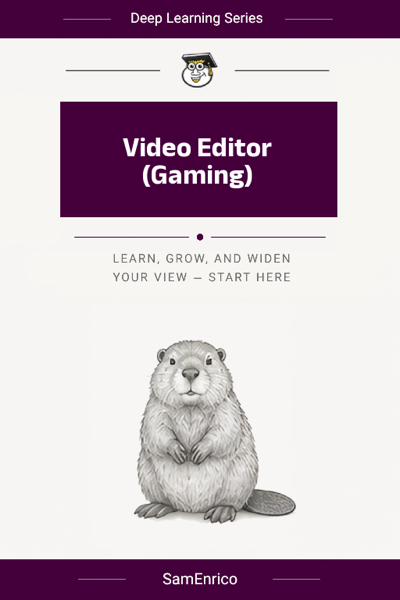
Video Editor (Gaming) eBook
A Coursebook on Video Editor (Gaming)
by Gomes Lavera
A Coursebook on Video Editor (Gaming)
Formats
Free sample
Chapter 1: The Patch Notes Origin...--Every great gaming editor begins the same way: staring at a timeline full of chaotic footage, a deadline breathing down their neck, and absolutely no idea which frames matter.You have a 40-minute recording of a raid boss fight. Your friend—or client, or maybe just your own ego—expects a 90-second highlight reel that captures the tension, the near-wipes, the screaming victory. You've watched the footage twice. You're still lost. Every cut you make feels wrong.
The music doesn't fit. The screams sound flat. And somewhere in the back of your mind, a voice whispers: Maybe I don't know what I'm doing.Here is the secret that separates editors who burn out from editors who build careers: that voice is wrong, but not for the reason you think.You do know what you're doing. You just don't know what to look for yet. And those are two completely different problems.This chapter introduces two frameworks that will become the operating system for every edit you ever make.
The first framework tells you what to keep. The second framework tells you how to improve. Together, they turn editing from a guessing game into a repeatable process. And unlike most editing advice you'll find online, these frameworks don't require expensive software, a faster computer, or natural talent. They require only one thing: the willingness to treat your own work as a video game that needs patching.Welcome to the Patch Notes Mindset.The Problem with Most Editing Advice Before we build anything, we need to clear the rubble.
The internet is full of editing advice, and most of it is useless for gaming content. You'll find tutorials on color grading, LUTs, transitions, and "cinematic" effects. You'll watch You Tubers show off their motion graphics templates and green screen setups. And none of it will help you answer the only question that actually matters:Why should someone keep watching?Here's the harsh truth. A beautiful color grade won't save a boring clip.
A fancy transition won't make a dead moment come alive. And no amount of motion graphics will convince a viewer to stay past the first five seconds if you haven't given them a reason to care. Traditional editing advice comes from film and television, where the audience has already committed. They bought a ticket. They cleared an hour.
They're sitting in a dark room with no phone notifications. Gaming content lives in the opposite universe. Your viewer has their thumb on the screen, sixteen other tabs open, and a friend texting them about dinner. You are competing for fractions of attention against the entire internet.That's why this book starts here, with psychology, not software. A faster computer won't make you a better editor.
A stronger understanding of why people watch will.Framework One: The Lens of Essential Experience Every piece of gaming footage contains hundreds of moments. Most of them are useless. Your job is not to preserve everything. Your job is to kill your darlings—to delete the frames that don't serve the single emotion you're trying to deliver.The Lens of Essential Experience is a mental tool that asks one question: What single emotion must survive the cut?Not two emotions. Not three.
One. If you try to make a clip funny, suspenseful, and heartwarming all at once, you'll likely achieve none of them. The Lens forces you to choose. Is this a funny clip? Then every frame that isn't funny gets cut.
Is this a suspenseful clip? Then every frame that releases tension too early gets cut. Is this a triumphant clip? Then every frame that doesn't build toward the victory gets cut.This sounds brutal. It is.
And that's exactly why it works.Intrinsic vs. Extrinsic Fun To use the Lens effectively, you need to understand the two kinds of "fun" that appear in gaming footage. Game designers have studied this distinction for decades, and it maps perfectly onto editing decisions.Intrinsic fun comes from mastery, discovery, and skill expression. It's the satisfaction of landing a perfect combo in Street Fighter, solving a puzzle in Portal, or executing a risky strategy that pays off. Intrinsic fun is earned.
The viewer feels it because they understand what the player did and why it was difficult. When you watch a speedrunner clip through a wall, you're experiencing intrinsic fun—the joy of witnessing human skill overcoming system design.Extrinsic fun comes from rewards, randomness, and spectacle. It's the dopamine hit of a rare loot drop, the surprise of an unexpected jump scare, the thrill of an explosion. Extrinsic fun is delivered to the player. They didn't earn it through skill; they were lucky, or the game gave it to them.
When you watch a streamer open 100 loot boxes and finally get the legendary item, you're experiencing extrinsic fun—the shared relief of randomness finally paying off.Here's what most editors get wrong. They assume all fun is the same. It's not. A clip driven by intrinsic fun needs different editing than a clip driven by extrinsic fun.An intrinsic fun clip requires context. The viewer needs to understand the difficulty of what just happened.
That means you might need to show the setup, the failure, the practice. Speedrun edits that show only the successful run lose their power because viewers don't know how hard the success was. The best intrinsic fun edits include a "failure montage"—three quick cuts of previous attempts—before the victory. Those failures make the success meaningful.An extrinsic fun clip requires reaction. The viewer doesn't need to understand mechanics; they need to see the player's emotional response to randomness.
That means you cut to the facecam immediately. The loot box opening isn't the moment—the scream is. Extrinsic fun edits live and die on the reaction shot. If the player doesn't react, the clip is dead.The Lens of Essential Experience helps you choose. Before you cut a single frame, ask yourself: Is the core emotion here about skill or about luck?
Your answer determines everything else.Case Study: The 40-Minute Raid Boss Let's walk through a real example. You have 40 minutes of footage from a World of Warcraft raid boss attempt. The team wiped six times, learned the mechanics, adjusted their strategy, and finally killed the boss on the seventh attempt. You need a 90-second highlight reel.Most editors would start by finding the kill moment and building backward. That's a mistake.
Start with the Lens instead. What's the single emotion? In this case, it's triumph through persistence. Not just victory. Victory after failure.
That means the edit needs to show the struggle, not just the success.Now you know what to look for. You need three things:The learning pattern (one example of the team figuring out a mechanic)The despair (one wipe that felt especially crushing)The euphoria (the kill, plus immediate reactions)Notice what's not on that list. You don't need the full forty minutes. You don't need every wipe. You don't need the loot rolling, the inventory management, or the ten seconds of dead air after each death.
Those frames don't serve the emotion. They get cut.The finished edit might look like this:0:00-0:15: Establishing shot of the boss…
This is the end of the free sample. Get the eBook to keep going. Buy now
About this book
Details
- Author
- Gomes Lavera
- Publisher
- SamEnrico
- Language
- English
- Genre
- Non-Fiction, Informative, Educational
- Released
- 2026-06-03
- Pages (approx.)
- 147
- Available as
- eBook, Audiobook

Read better in the ZLOADR app
Your eBooks on your phone or tablet. Sign in with your SamEnrico account and start reading.
More by Gomes Lavera
 Plant Based Hypothyroidism Diet GuideGomes Lavera$11.99
 Remote Work Collaboration TimeGomes Lavera$11.99
 Meeting Reduction HandbookGomes Lavera$11.99
 The Thoracic Rotation FixGomes Lavera$11.99
 Abraham Lincoln Emancipation LifeGomes Lavera$11.99
 The Great Influenza Mystery: How a 1918 Survivor’s Blood Saved MillionsGomes Lavera$11.99
 The Footprints of Time: Uncovering Africa's First AncestorsGomes Lavera$11.99
 IP Insurance Cost GuideGomes Lavera$12.99
 Local Business Sales ScriptGomes Lavera$12.99
 Understanding Curly Hair Ankyloblepharon Nail Dysplasia SyndromeGomes Lavera$17.99
 How to Become a Tray DrierGomes Lavera$11.99
You may also like
 Hong Kong Handover 1997Dunn Johnnie$11.99
 Zumba For Postnatal Recovery CourseNeal Christian$11.99
 Zumba for BeginnersLadner Nikia$11.99
 YouTube Comment Mining GuideHumes Pandora$12.99
 Worry Box MeditationCarlin Rudy$11.99
 Workplace Stress MeditationNguyen Lynn$11.99
 Workplace Stress and Sleep RepairHawley Ivory$11.99
 Workplace Perfectionism CureDelaney Jeffry$11.99
 Workplace Injustice Anger GuideWallen Isabelle$11.99
 Work Addiction and Burnout LinkGreenwood Ester$11.99
 Women in Yoga and WellnessBeattie Galina$11.99
 Women in Stand Up ComedyChun Evangeline$11.99