
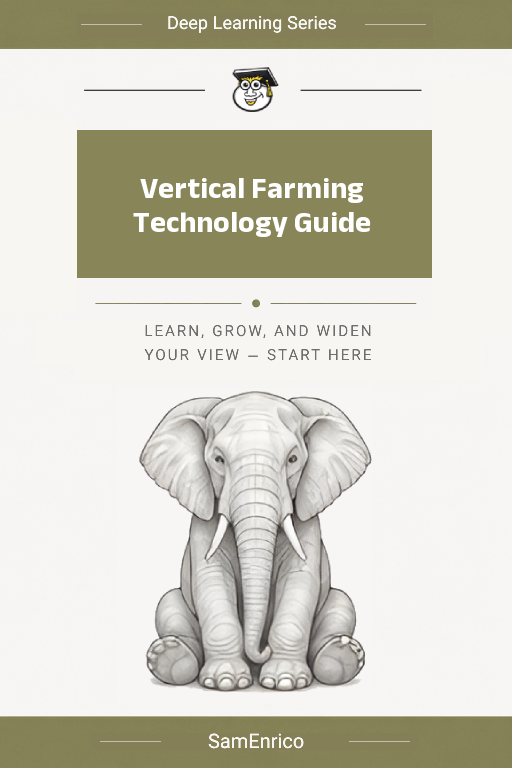
Non-FictionForecast & OutlookVertical Farming
Vertical Farming Technology Guide eBook
Explore indoor stacked growing systems with LED li
by Stepp Gavin
Explore indoor stacked growing systems with LED lighting, hydroponics, and climate control for year-round production.
Formats
Free sample
Chapter 1: The Eight Billion Dollar Mistake--– In 2021, a vertical farming startup called Aero Farms was valued at 1.8billion.Itsinvestorsincluded Goldman Sachs,Prudential Financial,andthesovereignwealthfundof Abu Dhabi.Thecompanyhadraisedover1.8 billion. Its investors included Goldman Sachs, Prudential Financial, and the sovereign wealth fund of Abu Dhabi. The company had raised over 1.8billion.Itsinvestorsincluded Goldman Sachs,Prudential Financial,andthesovereignwealthfundof Abu Dhabi.Thecompanyhadraisedover300 million, built a gleaming 70,000-square-foot facility inside a former steel mill in Newark, New Jersey, and convinced the world that it had solved the oldest problem in agriculture: how to grow food reliably, anywhere, without soil or sunlight.Twenty months later, on June 6, 2023, Aero Farms filed for Chapter 11 bankruptcy protection. The stock had gone to zero. Hundreds of employees were laid off.
The steel mill farm went silent.What happened? Did the technology fail? No. The technology worked. Aero Farms could grow beautiful lettuce, kale, and arugula.
Their yields per square foot were among the highest in the industry. Their patented aeroponic system—a misting technology that delivered nutrients directly to suspended roots—was genuinely innovative.The failure was not technological. It was mathematical. And that failure has been repeated, with staggering consistency, by dozens of vertical farming companies that together burned through more than $8 billion of investor capital between 2017 and 2024.Infarm, based in Berlin, raised over 600millionbeforecollapsingintoinsolvency,itsmodulargrowingunitsoncefeaturedinhigh−endgrocerystoresacross Europe,the United States,and Japan.Bowery,a New York Citydarlingbackedbycelebritiesandventurecapitalfirms,narrowlyavoidedclosureonlybylayingoff35percentofitsworkforceandpivotingawayfromthegrocerystoremodelentirely.Plenty Unlimited,backedby Jeff Bezosand Soft Bank,burnedthroughover600 million before collapsing into insolvency, its modular growing units once featured in high-end grocery stores across Europe, the United States, and Japan. Bowery, a New York City darling backed by celebrities and venture capital firms, narrowly avoided closure only by laying off 35 percent of its workforce and pivoting away from the grocery store model entirely.
Plenty Unlimited, backed by Jeff Bezos and Soft Bank, burned through over 600millionbeforecollapsingintoinsolvency,itsmodulargrowingunitsoncefeaturedinhigh−endgrocerystoresacross Europe,the United States,and Japan.Bowery,a New York Citydarlingbackedbycelebritiesandventurecapitalfirms,narrowlyavoidedclosureonlybylayingoff35percentofitsworkforceandpivotingawayfromthegrocerystoremodelentirely.Plenty Unlimited,backedby Jeff Bezosand Soft Bank,burnedthroughover800 million before finally achieving positive unit economics—on a single crop, at a single facility, in Wyoming, where electricity costs a fraction of what they pay in California. Fifth Season, based in Pittsburgh, raised 150millionandbuiltafullyautomatedfarmwithrobotsthatneverneededtosleep.Itclosedin2021.Pod Ponics,anearlypioneerincontainerfarming,raised150 million and built a fully automated farm with robots that never needed to sleep. It closed in 2021. Pod Ponics, an early pioneer in container farming, raised 150millionandbuiltafullyautomatedfarmwithrobotsthatneverneededtosleep.Itclosedin2021.Pod Ponics,anearlypioneerincontainerfarming,raised15 million, built a network of shipping container farms around Atlanta, and went bankrupt in 2016 after discovering that the economics of lettuce in a box simply do not work.This book is not another celebration of vertical farming's potential. That story has been told, repeatedly, by futurists and techno-optimists who have never had to make payroll.
This book is an autopsy of an industry that nearly killed itself with hype, followed by a reconstruction manual for anyone smart enough to learn from the dead.If you are reading this, you are probably one of three people: an entrepreneur who wants to build a vertical farm without losing your life savings, an investor who lost money on one of the bankruptcies and wants to understand what you missed, or a farmer who knows that traditional agriculture is becoming impossible but isn't sure what comes next. This book is for all of you.Here is the truth that the billion-dollar failures learned too late: vertical farming is brutally, unforgivingly, mathematically difficult to make profitable. The technology works. The biology works. The physics are unforgiving.
And the only path to survival is to understand, before you break ground, exactly how the numbers work.This chapter tells the story of the crash—the hype cycle, the over-promising, the fatal flaw that everyone ignored—and then extracts the one lesson that separates the bankrupt from the profitable.The Dream That Sold a Thousand Pitch Decks The modern vertical farming movement can be traced to one man and one book. Dickson Despommier, a professor of public health at Columbia University, published "The Vertical Farm" in 2010. The book was not a technical manual. It was a work of speculative imagination. Despommier proposed skyscrapers filled with hydroponic growing systems, each floor dedicated to a different crop, the entire building producing enough food to feed fifty thousand people, year-round, without pesticides, without weather risk, and with ninety-five percent less water than conventional farming.The idea was intoxicating.
It arrived at exactly the right cultural moment. The local food movement was gaining steam. Concern about climate change was becoming mainstream. The global financial crisis had exposed the fragility of long, just-in-time supply chains. And here was a vision that promised to solve all of it: food grown in cities, for cities, clean and efficient and modern.Investors fell in love.
And they fell hard.Between 2017 and 2023, venture capital firms poured more than 5billionintoverticalfarmingstartups.Thatfiguredoesnotincludethehundredsofmillionsingovernmentgrants,corporateinvestments,anddebtfinancingthatflowedalongsideit.Thetotalcapitalcommittedtothesector,includingfollow−oninvestmentsandrealestatecosts,easilyexceeded5 billion into vertical farming startups. That figure does not include the hundreds of millions in government grants, corporate investments, and debt financing that flowed alongside it. The total capital committed to the sector, including follow-on investments and real estate costs, easily exceeded 5billionintoverticalfarmingstartups.Thatfiguredoesnotincludethehundredsofmillionsingovernmentgrants,corporateinvestments,anddebtfinancingthatflowedalongsideit.Thetotalcapitalcommittedtothesector,includingfollow−oninvestmentsandrealestatecosts,easilyexceeded8 billion.The pitch deck that raised this money was remarkably consistent across companies. It contained five slides that every investor saw, and every investor believed.Slide One: The World Is Running Out of Farmland. A chart showing global population rising to 9.7 billion by 2050.
Another chart showing arable land per person declining from 0.4 hectares in 1960 to 0.2 hectares in 2020. A third chart showing topsoil depletion rates—the planet losing thirty-three billion tons of soil each year, faster than it can regenerate. The conclusion: we cannot feed nine billion people with the farming methods of the twentieth century.Slide Two: The Supply Chain Is Broken. A map of the United States with arrows showing the average vegetable traveling 1,500 miles from field to plate. A timeline showing that a head of lettuce harvested in California takes five to seven days to reach a grocery store in New York, during which time it loses nutritional value, accumulates carbon debt, and risks spoilage.
The conclusion: growing food closer to where it is eaten is not just an environmental virtue but an economic necessity.Slide Three: Water Is the New Oil. A bar chart comparing water consumption: conventional farming uses seventy percent of global freshwater withdrawals. A single head of lettuce grown in California's Salinas Valley requires fifteen gallons of water over its lifetime. A photograph of the drying Colorado River reservoir, Lake Mead, with a bathtub ring showing where the water used to be. The conclusion: hydroponic systems use ninety-five percent less water.
Vertical farming is a solution to water scarcity.Slide Four: Our Technology Is Superior. A photograph of the company's growing facility—gleaming white racks, purple LED lights, lush green plants. A bullet-point list of proprietary innovations: patented aeroponic misting heads, custom-developed LED spectra, machine learning algorithms that predict harvest dates, closed-loop climate control systems. The conclusion: this is not farming. This is manufacturing.Slide Five: The Market Is Enormous.
A stacked bar chart showing the total addressable market for leafy greens in the United States: 8billionannually.Forherbs:8 billion annually. For herbs: 8billionannually.Forherbs:2 billion.…
This is the end of the free sample. Get the eBook to keep going. Buy now
About this book
Details
- Author
- Stepp Gavin
- Publisher
- SamEnrico
- Language
- English
- Genre
- Non-Fiction, Forecast & Outlook, Vertical Farming
- Released
- 2026-06-01
- Pages (approx.)
- 157
- Available as
- eBook, Audiobook

Read better in the ZLOADR app
Your eBooks on your phone or tablet. Sign in with your SamEnrico account and start reading.
More by Stepp Gavin
 Oceanside Sleep MeditationStepp Gavin$11.99
 Runway ML Video Workflow GuideStepp Gavin$11.99
 Same Sex Relationship Self EsteemStepp Gavin$11.99
 OKRs for Writing a BookStepp Gavin$11.99
 Emotional Healing After AlcoholismStepp Gavin$11.99
 The Oracle of Delphi: Wisdom at the Heart of GreeceStepp Gavin$11.99
 Ultimate Handbook Guide to Tianchang : (China) Travel GuideStepp Gavin$11.99
 China-US Tariff Reset ManualStepp Gavin$12.99
 Understanding Idiopathic Dilatation of The Pulmonary ArteryStepp Gavin$17.99
 ProtestingStepp Gavin$11.99
You may also like
 Hong Kong Handover 1997Dunn Johnnie$11.99
 Zumba For Postnatal Recovery CourseNeal Christian$11.99
 Zumba for BeginnersLadner Nikia$11.99
 YouTube Comment Mining GuideHumes Pandora$12.99
 Worry Box MeditationCarlin Rudy$11.99
 Workplace Stress MeditationNguyen Lynn$11.99
 Workplace Stress and Sleep RepairHawley Ivory$11.99
 Workplace Perfectionism CureDelaney Jeffry$11.99
 Workplace Injustice Anger GuideWallen Isabelle$11.99
 Work Addiction and Burnout LinkGreenwood Ester$11.99
 Women in Yoga and WellnessBeattie Galina$11.99
 Women in Stand Up ComedyChun Evangeline$11.99