
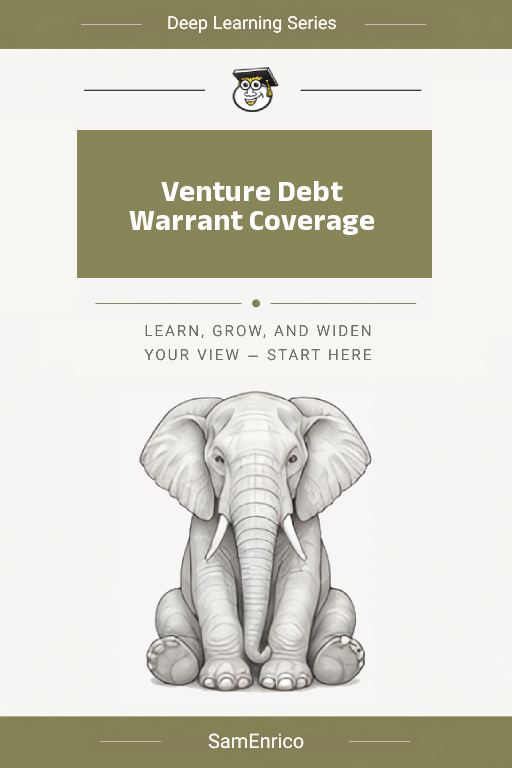
Non-FictionStartup GuideCapital Comparison
Venture Debt Warrant Coverage eBook
Understand warrant coverage in venture debt. Equit
Understand warrant coverage in venture debt. Equity kickers and total cost of capital.
Formats
Free sample
Chapter 1: The Missing Middle--A founder raises $20 million in equity. Two years later, she owns 8 percent of her own company. Her co-founder, who built the same business but used a different capital structure, owns 22 percent. Same outcome. Same valuation.
Same effort. Different wealth.This is not a story about failure. It is a story about structure.Most founders are taught that equity is the default fuel for growth. You need cash. You sell a piece of your company.
You repeat. The math seems simple: raise a Series A at 20 percent dilution, raise a Series B at another 15 percent, and you have lost 35 percent of your company before you have shipped your first product at scale. That 35 percent is gone forever. It does not matter if you used that capital brilliantly or poorly. The ownership does not come back.This chapter will introduce you to a different path.
Not a replacement for equity, but a complement. A tool that allows you to fund growth without selling permanent ownership. It is called venture debt, and at its heart lies a strange, misunderstood instrument called a warrant. Before we can understand warrants, we need to understand why equity alone is an expensive breakfast.The Real Cost of Equity That No One Talks About Equity is patient capital. That is what the VCs tell you, and they are not wrong.
Equity does not demand monthly payments. Equity does not come with covenants that trigger defaults. Equity waits for the exit, sometimes for a decade or more. But patience has a price, and that price is permanence.When you sell equity, you are selling a piece of the future upside of your company. Every dollar of equity you raise costs you a percentage of every future dollar your company will ever make.
If you raise 10millionata10 million at a 10millionata40 million post-money valuation, you have sold 25 percent of your company. That 25 percent follows you through every subsequent round, every pivot, every breakthrough. It does not get cheaper over time. It does not expire. It does not care whether you used the capital efficiently.Consider the math of the 2x Dilution Trap.
A typical startup raises a Series A at 20 percent dilution. Eighteen months later, it raises a Series B at another 15 percent. A year after that, a Series C at another 10 percent. The founder who started with 60 percent ownership now holds roughly 60 percent times 0.8 times 0.85 times 0.9, which equals approximately 36.7 percent. That is before the employee option pool, which typically adds another 10 to 15 percent dilution.
The founder is now below 30 percent. The early employees are diluted even more. The angels who wrote the first check are now below 5 percent.None of this dilution is evil. It is the price of growth. But it is a price that founders pay without ever asking the question: is there a cheaper way to fund this particular growth milestone?The Capital Stack and Where Warrants Live To understand why venture debt can be cheaper than equity, you must first understand the capital stack.
The capital stack is simply the order of who gets paid first when a company liquidates or exits. It is the hierarchy of claims on the company's assets and future cash flows.At the top of the stack sits senior debt. This is bank debt, lines of credit, term loans. Senior debt is secured by collateral. If the company fails, the senior lender gets paid first, often by seizing assets.
This is why senior debt has the lowest interest rate. The risk is low.Below senior debt sits subordinated debt. This is debt that has agreed to stand behind senior debt. If the company fails, subordinated debt gets paid only after senior debt is fully satisfied. This is riskier, so the interest rate is higher.Below subordinated debt sits warrant holders, but only if the warrants have been exercised.
This is a critical distinction that most finance primers get wrong. An unexercised warrant is not in the capital stack at all. It is a contingent claim. It only becomes a claim on the company when the lender chooses to exercise it. Once exercised, warrants typically sit below all debt but above preferred equity.
They are senior to common equity but junior to most other claims.Below warrants sits preferred equity. This is the equity sold to VCs. Preferred equity has liquidation preferences, which means that in an exit, preferred shareholders get their money back (often 1x to 3x their investment) before common shareholders see a dollar.At the bottom sits common equity. This is what founders and employees hold. Common equity gets paid last, after everyone else has taken their share.Why does this matter for warrants?
Because the position of warrants in the capital stack determines both their risk and their upside. Warrants are not as safe as debt. If the company fails, warrants expire worthless. But they are not as diluted as common equity. In a successful exit, warrant holders get paid before common shareholders.
This middle position is precisely why warrants are such a powerful tool for lenders. They offer equity-like upside with debt-like seniority.The Runway Gap and the Missing Middle Between equity rounds, startups face a structural problem. A typical Series A provides 18 to 24 months of runway. The company uses that cash to build product, hire a team, and acquire initial customers. Eighteen months in, the company is growing but is not yet ready for a Series B.
It needs another 6 to 12 months of cash to hit the metrics that will attract the next round of investors.This period is called the Runway Gap. It is the missing middle in startup finance. The company cannot raise a Series B yet because it does not have the revenue or traction to command a fair valuation. It cannot raise a Series A-2 because that would signal weakness to future investors. It cannot slow down growth because that would miss the window.
So what does it do?Most founders turn to equity again. They raise a bridge round at flat or down terms. They give up another 5 to 10 percent of their company for six months of cash. This is almost always a mistake.The alternative is venture debt. A venture debt facility provides 6 to 18 months of cash at a cost of 3 to 5 percent effective dilution, not 5 to 10 percent.
The difference is the difference between a founder exiting with 25 percent ownership versus 15 percent ownership. On a 100millionexit,thatis100 million exit, that is 100millionexit,thatis10 million in the founder's pocket versus the lender's pocket.Let us make this concrete with a real-world framing. A Saa S company has 3millioninannualrecurringrevenuegrowing100percentyearoveryear.Itneeds3 million in annual recurring revenue growing 100 percent year over year. It needs 3millioninannualrecurringrevenuegrowing100percentyearoveryear.Itneeds2 million to hire a sales team that will expand into a new vertical. The founders have two options.Option one is to raise a small equity round at a 20millionpre−moneyvaluation.A20 million pre-money valuation.
A 20millionpre−moneyvaluation.A2 million investment at that valuation costs the founders 9 percent of the company. That 9 percent dilution is permanent. Even if the sales team generates $10 million in new revenue, the founders still own 9 percent less of that revenue forever.Option two is to raise…
This is the end of the free sample. Get the eBook to keep going. Buy now
About this book
Details
- Author
- Scherer Christoper
- Publisher
- SamEnrico
- Language
- English
- Genre
- Non-Fiction, Startup Guide, Capital Comparison
- Released
- 2026-05-30
- Pages (approx.)
- 133
- Available as
- eBook, Audiobook

Read better in the ZLOADR app
Your eBooks on your phone or tablet. Sign in with your SamEnrico account and start reading.
More by Scherer Christoper
 PTSD Couples Healing GuideScherer Christoper$11.99
 Prometheus Monitoring OutageScherer Christoper$11.99
 Anger Restructuring ResearchScherer Christoper$11.99
 The Trello Memory Board GuideScherer Christoper$11.99
 Home Modification for Aging AccessibilityScherer Christoper$11.99
 The Maestro of the Mississippi: William Grant Still and the Symphony of SoulScherer Christoper$11.99
 Relief Early Childhood Assistant TeacherScherer Christoper$11.99
 Terms for Contests & PromotionsScherer Christoper$12.99
 Understanding Waardenburg Syndrome, Type 4Scherer Christoper$17.99
 How to Start a Blinds Made of Wood (excluding Shop Blinds) Business (Beginners Guide)Scherer Christoper$11.99
You may also like
 Hong Kong Handover 1997Dunn Johnnie$11.99
 Zumba For Postnatal Recovery CourseNeal Christian$11.99
 Zumba for BeginnersLadner Nikia$11.99
 YouTube Comment Mining GuideHumes Pandora$12.99
 Worry Box MeditationCarlin Rudy$11.99
 Workplace Stress MeditationNguyen Lynn$11.99
 Workplace Stress and Sleep RepairHawley Ivory$11.99
 Workplace Perfectionism CureDelaney Jeffry$11.99
 Workplace Injustice Anger GuideWallen Isabelle$11.99
 Work Addiction and Burnout LinkGreenwood Ester$11.99
 Women in Yoga and WellnessBeattie Galina$11.99
 Women in Stand Up ComedyChun Evangeline$11.99