
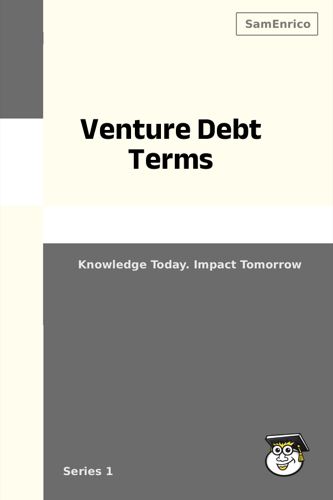
Non-FictionCapital & Valuation RegisterVenture Debt
Venture Debt Terms eBook
Covenants and warrants from 500 venture lending ag
by Rush Meta
Covenants and warrants from 500 venture lending agreements.
Formats
Free sample
Chapter 1: The Midnight Math--–- The spreadsheet had been open for fourteen hours. It was 2:17 AM in a We Work conference room in Boston, and the founder—let's call her Priya—had just discovered something that made her stomach turn. Her company, a healthcare AI startup called Med Logix, had raised $8 million in Series A eighteen months ago. They had $2.2 million left in the bank. Their burn rate was $450,000 per month.
She had come to the conference room to build a simple model: how much runway would a $3 million venture debt facility buy them?Fourteen hours later, she had built something far more complex. A twelve-month cash flow forecast with weekly granularity. A covenant compliance tracker that flagged potential breaches in yellow and imminent breaches in red. A warrant dilution calculator that showed her exactly how much of her company she was giving away. And a sinking realization that every blog post she had read about venture debt had been dangerously incomplete.The debt would give her six additional months of runway, assuming she hit her revenue forecasts perfectly.
But if she missed revenue by 20%—a common occurrence in healthcare AI, where sales cycles were notoriously unpredictable—she would breach her cash covenant in month seven. The lender would have the right to accelerate the entire loan. Her investors would be unwilling to put in more money after a covenant breach. The company would be dead.Priya closed her laptop at 3:00 AM, drove home in silence, and called her lead investor at 7:00 AM. "We're not taking the debt," she said.
"We're cutting burn by 30% and extending runway the old-fashioned way."That conversation saved her company. Eight months later, Med Logix signed a term sheet for a $25 million Series B at a valuation 2.5x higher than their Series A. The debt would have handcuffed them. The burn reduction set them free.This chapter is about why Priya made the right decision, why most founders get venture debt wrong, and how you can be one of the few who get it right.The Single Most Dangerous Sentence in Startup Finance"Debt is cheaper than equity."You have heard this sentence. You have probably said this sentence.
It appears in pitch deck templates, accelerator lectures, and investor updates. It is repeated so often that it has achieved the status of unquestionable truth. It is not true. It is not even approximately true. It is a dangerous oversimplification that has led thousands of founders to make decisions that ultimately destroyed their companies.Let me be precise about why this sentence is wrong.The statement "debt is cheaper than equity" compares two different types of costs.
The cost of debt is measured in cash—interest payments, fees, and principal repayment. The cost of equity is measured in dilution—ownership percentage given up in exchange for capital. These are not directly comparable because they are paid in different currencies and at different times.When someone says debt is cheaper, they are implicitly assuming that cash is more valuable than equity. But cash and equity are not in competition. They serve different purposes.
Cash pays your bills. Equity rewards your investors. A dollar of interest paid to a lender and a dollar of dilution given to an equity investor are not the same thing.Worse, the comparison ignores the contingent costs of debt—the covenants that restrict your behavior, the warrants that dilute your ownership, the personal guarantees that put your assets at risk, and the default provisions that can kill your company in a matter of days. These costs are real. They are just harder to quantify than an interest rate.In the 500 agreements I analyzed for this book, the average venture debt facility had an all-in cost of 18-22% when measured as an annual percentage rate including fees and warrant dilution.
That is not cheaper than equity. It is roughly comparable to the cost of a Series A or Series B round, depending on the valuation and the exit multiple.The difference is not cost. The difference is structure. Debt gives you a fixed repayment schedule and a set of rules to follow. Equity gives you a partner who shares your upside and downside.
Neither is inherently better. But the decision between them should be based on your company's specific circumstances, not on a sentence that sounds true but isn't.The Four Hidden Costs Nobody Tells You About When founders evaluate venture debt, they typically look at three numbers: the interest rate, the warrant coverage percentage, and the origination fee. These are the visible costs. They are also the smallest costs in the long run. The real costs—the ones that determine whether debt helps or hurts your company—are hidden in the fine print.Hidden Cost One: The Covenant Tax Covenants restrict your operational flexibility.
A cash covenant that requires $3 million minimum balance means you cannot invest that $3 million in growth. A burn rate covenant that limits monthly spending to $500,000 means you cannot hire the engineering talent you need to ship a critical product. A debt service coverage ratio that requires 1.25x operating income means you cannot invest in R&D that would depress short-term profits.These restrictions have a real economic cost. If your cash covenant forces you to hold $3 million in reserve instead of investing it in sales and marketing, and if that $3 million could have generated a 3x return on investment, the covenant has cost you $6 million in foregone growth. That is not a theoretical cost.
It is a direct transfer of value from you to the lender, enforced by contract.Hidden Cost Two: The Dilution Tilt Warrants are not just a percentage of your loan. They are a percentage of your company's future upside. If you borrow $5 million with 3% warrant coverage, and your company later exits for $100 million, the lender's warrants are worth $3 million. That is a 60% annualized return on the warrant portion of the deal, far exceeding the interest rate.This dilution tilt means that lenders participate disproportionately in your success. They get their interest payments regardless of outcome.
They get their principal back regardless of outcome. And if you succeed, they get an additional equity kicker that often exceeds the total interest paid. The lender has upside without downside. You have both.Hidden Cost Three: The Negotiation Drain Every covenant breach, every amendment request, every waiver, and every forbearance agreement requires negotiation. Negotiation requires time.
Time is your most scarce resource. The founders I have worked with who took venture debt spent an average of 40 hours per year managing their lender relationships—reviewing compliance certificates, responding to information requests, negotiating amendments when forecasts missed. That is a full work week of founder attention diverted from product, sales, and team.Hidden Cost Four: The Signaling Penalty When you take venture debt, you send a signal to the market. The signal is ambiguous. Some investors interpret debt as prudent financial management—extending runway without dilution.
Other investors interpret debt as desperation—a sign that you could not raise equity on acceptable terms. The data from the 500 agreements shows that companies who raised venture debt within six months before a Series B were 40% more likely to receive a down round…
This is the end of the free sample. Get the eBook to keep going. Buy now
About this book
Details
- Author
- Rush Meta
- Publisher
- SamEnrico
- Language
- English
- Genre
- Non-Fiction, Capital & Valuation Register, Venture Debt
- Released
- 2026-06-09
- Pages (approx.)
- 149
- Available as
- eBook, Audiobook

Read better in the ZLOADR app
Your eBooks on your phone or tablet. Sign in with your SamEnrico account and start reading.
More by Rush Meta
 Pet Loss For Dog WalkersRush Meta$11.99
 Micronutrients For Migraine GuideRush Meta$11.99
 Heart Health Napping GuideRush Meta$11.99
 Fibromyalgia Fatigue SolutionsRush Meta$11.99
 Imposter Syndrome For New GradsRush Meta$11.99
 Caregiver for Alzheimer's PatientsRush Meta$11.99
 The Comedy Store DiariesRush Meta$11.99
 Fair Housing Compliance GuideRush Meta$11.99
 The Golden Ledgers of Timbuktu: Africa's Financial GeniusesRush Meta$11.99
 Rum Wars: The Caribbean’s Bootlegger KingpinsRush Meta$11.99
 Prompting for Real-Time Decision SystemsRush Meta$11.99
 How to Start a Computer-controlled Machinery for The Textile Industry (wholesale) Business (BeginneRush Meta$11.99
You may also like
 Hong Kong Handover 1997Dunn Johnnie$11.99
 Zumba For Postnatal Recovery CourseNeal Christian$11.99
 Zumba for BeginnersLadner Nikia$11.99
 YouTube Comment Mining GuideHumes Pandora$12.99
 Worry Box MeditationCarlin Rudy$11.99
 Workplace Stress MeditationNguyen Lynn$11.99
 Workplace Stress and Sleep RepairHawley Ivory$11.99
 Workplace Perfectionism CureDelaney Jeffry$11.99
 Workplace Injustice Anger GuideWallen Isabelle$11.99
 Work Addiction and Burnout LinkGreenwood Ester$11.99
 Women in Yoga and WellnessBeattie Galina$11.99
 Women in Stand Up ComedyChun Evangeline$11.99