
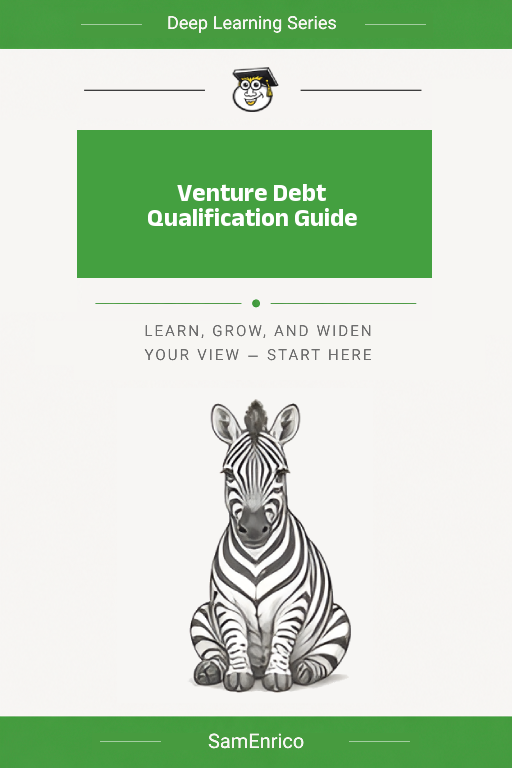
Venture Debt Qualification Guide Audiobook
Meet revenue and runway requirements for venture d
by Elkins Paige
Meet revenue and runway requirements for venture debt from lenders.
Formats
Free sample
Chapter 1: The Equity Trap--–- The pitch deck was perfect. Fifteen slides, hockey-stick growth, a total addressable market of 47billion,andaleadinvestorwhohadjustwrittena47 billion, and a lead investor who had just written a 47billion,andaleadinvestorwhohadjustwrittena5 million term sheet. Sarah, the founder of a promising B2B Saa S startup, had done everything right. She had raised her Seed round from a respected micro-fund, built a team of 12 engineers, and grown annual recurring revenue to 800,000injust14months.Nowshewasraisingher Series A,andthetermsheetpromiseda800,000 in just 14 months. Now she was raising her Series A, and the term sheet promised a 800,000injust14months.Nowshewasraisingher Series A,andthetermsheetpromiseda10 million post-money valuation.
Her lawyer, her board, and her mentors all gave the same advice: "Take the equity. It's free money. Debt is dangerous."So Sarah raised $5 million in equity. She gave up 33% of her company. At the time, it felt like a victory.Eighteen months later, that decision cost her $47 million.This is not a story about failure.
Sarah's company succeeded. It grew to 12millionin ARR,attractedacquisitioninterestfromapubliccompany,andsoldfor12 million in ARR, attracted acquisition interest from a public company, and sold for 12millionin ARR,attractedacquisitioninterestfromapubliccompany,andsoldfor65 million. But here is what her advisors never told her: If she had raised 2millioninequityand2 million in equity and 2millioninequityand3 million in venture debt instead, she would have given up only 13% of her company at the Series A. The difference in her exit proceeds would have been $47 million. Forty-seven million dollars that she left on the table because she believed the lie that "equity is free."This chapter exists to destroy that lie.The Most Expensive Word in Venture Capital The word is "free." As in, "We can raise more equity – it's basically free money compared to debt." Every founder has heard this.
Most believe it. Almost all of them are wrong.Equity is not free. It is, in fact, the most expensive form of capital you will ever raise – not in cash flow, but in ownership. When you sell equity, you are selling a perpetual claim on every future dollar your company will ever earn. When you sell debt, you are paying rent on money that you will eventually return, keeping all future upside for yourself and your existing shareholders.Here is the simple math that every founder should memorize but almost none are taught:Equity Cost = (Ownership % Sold) × (Future Exit Value)Debt Cost = (Interest Rate × Loan Amount) + (Warrant Dilution)Let…
This is the end of the free sample. Get the Audiobook to keep going. Buy now
About this book
Details
- Author
- Elkins Paige
- Publisher
- SamEnrico
- Language
- English
- Genre
- Non-Fiction, Startup Guide
- Released
- 2026-05-30
- Pages (approx.)
- 133
- Available as
- eBook, Audiobook

Listen in the VoxFlicks app
Audiobooks and audio dramas wherever you go. Sign in with your SamEnrico account and press play.
More by Elkins Paige
 1031 Exchange Primary Residence RulesElkins Paige$11.99
 Road Rage for Emergency RespondersElkins Paige$11.99
 Siesta Circadian RhythmElkins Paige$11.99
 Seed Dream Jungian ViewElkins Paige$11.99
 Morning Sunlight Exposure GuideElkins Paige$11.99
 Working Memory ResearchElkins Paige$11.99
 Immigrant Mom Boss Success StoryElkins Paige$11.99
 NVC Role Play ScenariosElkins Paige$11.99
 Email Blocking StrategyElkins Paige$11.99
 The Lost Codex: How a 16th-Century Manuscript Vanished from the VaticanElkins Paige$11.99
 Echoes of the Quantum Dawn: How a 1989 Experiment Changed RealityElkins Paige$11.99
 The Desert Codebreakers: How Bedouin Mathematicians Pioneered Early AI in the Sands of ArabiaElkins Paige$11.99
You may also like
 Hong Kong Handover 1997Dunn Johnnie$11.99
 Zumba For Postnatal Recovery CourseNeal Christian$11.99
 Zumba for BeginnersLadner Nikia$11.99
 YouTube Comment Mining GuideHumes Pandora$12.99
 Worry Box MeditationCarlin Rudy$11.99
 Workplace Stress MeditationNguyen Lynn$11.99
 Workplace Stress and Sleep RepairHawley Ivory$11.99
 Workplace Perfectionism CureDelaney Jeffry$11.99
 Workplace Injustice Anger GuideWallen Isabelle$11.99
 Work Addiction and Burnout LinkGreenwood Ester$11.99
 Women in Yoga and WellnessBeattie Galina$11.99
 Women in Stand Up ComedyChun Evangeline$11.99