
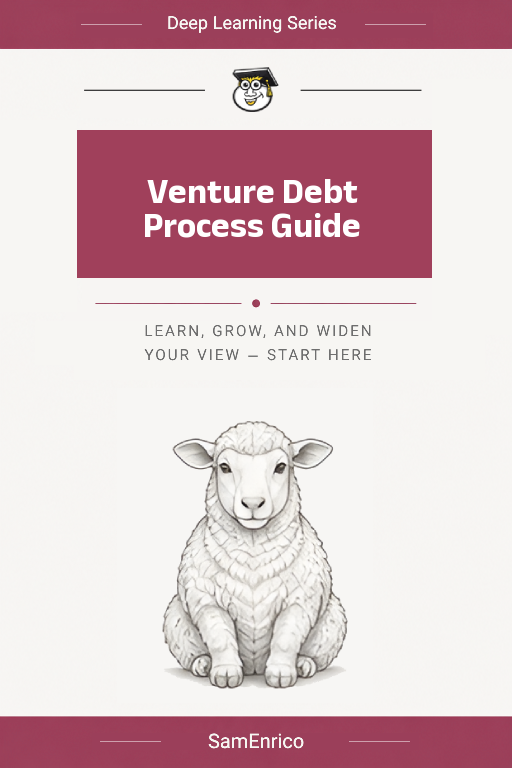
Non-FictionStartup GuideCapital Comparison
Venture Debt Process Guide eBook
Step-by-step venture debt process. Application, du
Step-by-step venture debt process. Application, due diligence, and closing procedures.
Formats
Free sample
Chapter 1: The Readiness Trap--–- By the time you finish this chapter, you will know exactly why most founders who seek venture debt should not take it—and why you might be the exception. This is not a trick or a reverse psychology ploy. It is a hard truth that the venture debt industry does not want you to know. Lenders make money when you borrow. Their marketing materials will tell you that debt is cheap, non-dilutive, and accessible.
They will not tell you that the average venture debt application is rejected. They will not tell you that of the loans that close, a meaningful percentage end in default, restructuring, or the loss of intellectual property. And they will certainly not tell you that the single biggest predictor of success or failure has nothing to do with interest rates, warrant coverage, or lender relationships. It has everything to do with whether you were truly ready to borrow in the first place.This chapter is your readiness trapdoor. It exists to catch you before you fall.
By the end, you will have a framework to assess your company against the four non-negotiable pillars of borrowing. You will know the quantitative metrics that lenders use to separate the growth stories from the survival stories. You will understand why your venture capital backer matters more than your revenue. And you will have a clear-eyed view of whether you should proceed to Chapter 2 or stop now, fix what is broken, and return when you are ready.Let me tell you about a founder named Marcus. He was brilliant, driven, and utterly convinced that his startup was the exception to every rule.
His company, a B2B software platform called Chain Flow, had raised a 4millionseedroundfromarespectablebutnottop−tierventurefirm.Hehad4 million seed round from a respectable but not top-tier venture firm. He had 4millionseedroundfromarespectablebutnottop−tierventurefirm.Hehad8 million in annual recurring revenue, seventy-two percent gross margins, and a customer list that included several Fortune 500 companies. On paper, he looked like the ideal venture debt candidate. But Marcus made a mistake that you will see again and again in this book: he confused a strong business with a ready business.Marcus had 1.2millioninthebankandwasburning1.2 million in the bank and was burning 1.2millioninthebankandwasburning400,000 per month. He had three months of runway.
Three months. That meant he needed to raise more money immediately or shut down. He had heard that venture debt was faster than equity, so he applied to five lenders. Three rejected him within a week. One offered a term sheet with a 14 percent interest rate and a personal guarantee.
The fifth, a private credit fund, offered a reasonable term sheet but required that his existing VC put in a "reserve" of $500,000 to backstop the loan. His VC refused.Marcus was out of options. He shut down Chain Flow six weeks later. He lost everything. And the painful truth is that he was never ready for venture debt.
He was in survival mode, not growth mode. He needed equity, not debt. But he didn't know the difference, and that lack of knowledge cost him his company.This chapter exists so that you never become Marcus.The Four Pillars of Borrowing Venture debt is not a loan. That sounds contradictory, but it is true. A traditional bank loan is a transaction.
You fill out an application. The bank checks your credit. They say yes or no. You get money. You pay it back.
Done.Venture debt is a partnership. The lender is not just giving you money; they are placing a bet on your future. They are saying, "We believe you will be worth more in three years than you are today, and we want a small piece of that upside through our warrant, but we also want our principal back with interest."Because it is a partnership, lenders are picky. They do not lend to everyone. They lend to companies that meet four specific criteria.
I call these the Four Pillars of Borrowing. Miss even one pillar, and you will either be rejected outright or given terms so punitive that you will wish you had been rejected.Let me walk you through each pillar in detail.Pillar One: Board Approval The first pillar is non-negotiable. Every venture lender will require a formal board resolution authorizing the debt transaction. This is not a casual conversation. This is a legal document, signed by every member of your board of directors, stating that the company has the authority to borrow money, grant a security interest in its assets, and issue warrants.Why does this matter?
Because in a default scenario, the lender wants to know that they can enforce the loan against the company without the board claiming that the chief executive officer acted without authority. It is a simple piece of paper, but without it, the deal cannot close.For Founders: Board approval is not automatic. If you have outside investors, they will want to review the term sheet before approving. Some venture capitalists are hostile to debt. They see it as a signal that the company cannot raise equity.
Others are supportive, especially if the debt extends runway into an up-round. You need to know where your board stands before you approach lenders. Have the conversation early. Say, "I am considering venture debt as a non-dilutive financing option. Would you support a term sheet with reasonable terms?" If the answer is no, you save yourself weeks of wasted effort.For Finance Leads: The board resolution must be a unanimous written consent.
Do not try to pass it with a simple majority. Lenders will ask for the signature page showing all directors. If one director refuses to sign, the deal is dead. Get alignment before you start the process.Real-world example: A Series B fintech company called Pay Flow had a board with four members: two founders and two venture capitalists. One venture capitalist was philosophically opposed to debt.
He believed that debt distracted management from fundraising. The chief executive officer spent three months negotiating a venture debt term sheet, only to have that board member veto it at the final hour. The chief executive officer had to raise an equity round at a down round, losing 25 percent of the company. The lesson: get board approval in principle before you spend a single hour on lender outreach.Pillar Two: Cash Flow Visibility The second pillar is about predictability. Venture lenders want to see that you have a clear line of sight to your cash flows for the next twelve to eighteen months.
They do not expect you to be profitable. Most venture-backed startups are not. But they do expect you to know, within a reasonable margin of error, how much cash you will burn each month and when you will need to raise your next equity round.What lenders look for: A twelve to eighteen month forecast, updated monthly, with three scenarios: base, upside, and downside. The forecast must include detailed assumptions about revenue growth, headcount, marketing spend, and capital expenditures. It cannot be a one-page spreadsheet with five lines.
Lenders want to see that you have thought through the drivers of your business.For Founders: If you cannot predict your cash flow…
This is the end of the free sample. Get the eBook to keep going. Buy now
About this book
Details
- Author
- Adamson Louis
- Publisher
- SamEnrico
- Language
- English
- Genre
- Non-Fiction, Startup Guide, Capital Comparison
- Released
- 2026-05-29
- Pages (approx.)
- 134
- Available as
- eBook, Audiobook

Read better in the ZLOADR app
Your eBooks on your phone or tablet. Sign in with your SamEnrico account and start reading.
More by Adamson Louis
 Charity CEO Embezzlement Case CourseAdamson Louis$11.99
 Stonewalling Recovery GuideAdamson Louis$11.99
 Fast Food Addiction RecoveryAdamson Louis$11.99
 SonarQube Code Quality OutageAdamson Louis$11.99
 The Cornell Note Taking GuideAdamson Louis$11.99
 The Healing Hands of the Nile: Ancient Egypt's Royal PhysiciansAdamson Louis$11.99
 US via Madrid SystemAdamson Louis$12.99
 Shunt DriverAdamson Louis$11.99
 Understanding WartsAdamson Louis$17.99
 How to Start a Blazers for Men and Boys Business (Beginners Guide)Adamson Louis$11.99
You may also like
 Hong Kong Handover 1997Dunn Johnnie$11.99
 Zumba For Postnatal Recovery CourseNeal Christian$11.99
 Zumba for BeginnersLadner Nikia$11.99
 YouTube Comment Mining GuideHumes Pandora$12.99
 Worry Box MeditationCarlin Rudy$11.99
 Workplace Stress MeditationNguyen Lynn$11.99
 Workplace Stress and Sleep RepairHawley Ivory$11.99
 Workplace Perfectionism CureDelaney Jeffry$11.99
 Workplace Injustice Anger GuideWallen Isabelle$11.99
 Work Addiction and Burnout LinkGreenwood Ester$11.99
 Women in Yoga and WellnessBeattie Galina$11.99
 Women in Stand Up ComedyChun Evangeline$11.99