
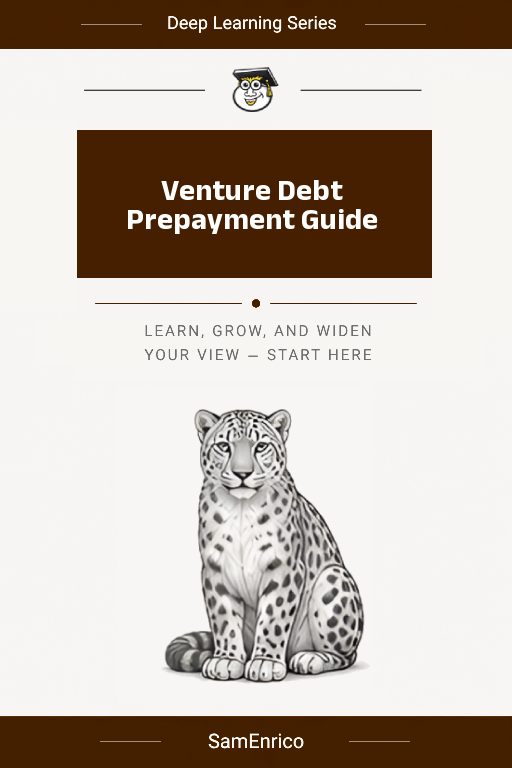
Non-FictionStartup GuidePrepayment
Venture Debt Prepayment Guide Audiobook
Understand prepayment penalties and negotiate prep
Understand prepayment penalties and negotiate prepayment flexibility in venture debt agreements.
Formats
Free sample
Chapter 1: The Silent Tax--–- Venture debt is marketed with an almost hypnotic simplicity: “non-dilutive capital.” The phrase appears on pitch decks, term sheet summaries, and lender websites like a mantra. Take our money, the logic goes, and you give up no equity. No board seats. No control. Just a reasonable interest rate and a small warrant coverage.
What could be cleaner? What could be cheaper?The answer, as thousands of founders have discovered too late, is that the cheapest-looking debt often becomes the most expensive. And the weapon of choice—the silent tax that transforms a 10% loan into a 20% effective cost—is the prepayment penalty.This chapter dismantles the “non-dilutive” myth. It reveals why venture debt is rarely as cheap as it appears, how prepayment penalties undermine the entire value proposition, and why understanding the lender’s economics is the first step to protecting your company’s optionality. By the end, you will never look at a term sheet the same way again.The Allure of “Non-Dilutive”Let us begin with the pitch.
A venture debt lender approaches your Series B company. You have just raised 10millioninequityata10 million in equity at a 10millioninequityata50 million valuation. The lender offers $5 million in debt. The terms: 10% interest, 2% origination fee, 15% warrant coverage, and a three-year maturity. Your venture capital partner nods approvingly.
“It’s non-dilutive,” they say. “You keep your equity.”The math seems straightforward. If you borrow 5millionat105 million at 10% for three years, you will pay 5millionat101.5 million in interest. Add the 100,000originationfee(2100,000 origination fee (2% of 100,000originationfee(25 million), and the total cost is 1.6million.Comparedtoraisinganother1.6 million. Compared to raising another 1.6million.Comparedtoraisinganother5 million in equity at a $50 million valuation—which would cost you 9.1% of your company—the debt looks cheap.
You save 9% dilution. What is not to love?The problem is that this back-of-the-envelope calculation assumes you will hold the debt to maturity. It assumes no early exit. No acquisition. No refinancing.
No change in your business model that might make debt unnecessary. In the venture-backed world, where the average time to exit is four to six years and the average time between funding rounds is twelve to eighteen months, holding a three-year loan to maturity is the exception, not the rule.The Hidden Tax Revealed Let us revisit our example with a more realistic scenario. You borrow $5 million. Eighteen months later, you receive an acquisition offer. The acquirer wants a clean…
This is the end of the free sample. Get the Audiobook to keep going. Buy now
About this book
Details
- Author
- Huntington Cassondra
- Publisher
- SamEnrico
- Language
- English
- Genre
- Non-Fiction, Startup Guide, Prepayment
- Released
- 2026-05-29
- Pages (approx.)
- 135
- Available as
- eBook, Audiobook

Listen in the VoxFlicks app
Audiobooks and audio dramas wherever you go. Sign in with your SamEnrico account and press play.
More by Huntington Cassondra
 Caregiver Stress Relationship GuideHuntington Cassondra$11.99
 Uber Acceptance Rate StrategyHuntington Cassondra$11.99
 Operating Cash Flow GuideHuntington Cassondra$11.99
 Breaking The Spending CycleHuntington Cassondra$11.99
 Mobile Game Addiction FixHuntington Cassondra$11.99
 Value Based Inflation PricingHuntington Cassondra$11.99
 The Community Fridge FounderHuntington Cassondra$11.99
 Growth Mindset for ConstructionHuntington Cassondra$11.99
 The Wrongful Conviction of Simon Mokoena: A Fight for Justice in South AfricaHuntington Cassondra$11.99
 The Hollow Crown: A Queen’s Forgotten WarHuntington Cassondra$11.99
 How to Start a Anti-sprouting Products Business (Beginners Guide)Huntington Cassondra$11.99
 Webhook and Notification API GuideHuntington Cassondra$12.99
You may also like
 Hong Kong Handover 1997Dunn Johnnie$11.99
 Zumba For Postnatal Recovery CourseNeal Christian$11.99
 Zumba for BeginnersLadner Nikia$11.99
 YouTube Comment Mining GuideHumes Pandora$12.99
 Worry Box MeditationCarlin Rudy$11.99
 Workplace Stress MeditationNguyen Lynn$11.99
 Workplace Stress and Sleep RepairHawley Ivory$11.99
 Workplace Perfectionism CureDelaney Jeffry$11.99
 Workplace Injustice Anger GuideWallen Isabelle$11.99
 Work Addiction and Burnout LinkGreenwood Ester$11.99
 Women in Yoga and WellnessBeattie Galina$11.99
 Women in Stand Up ComedyChun Evangeline$11.99