
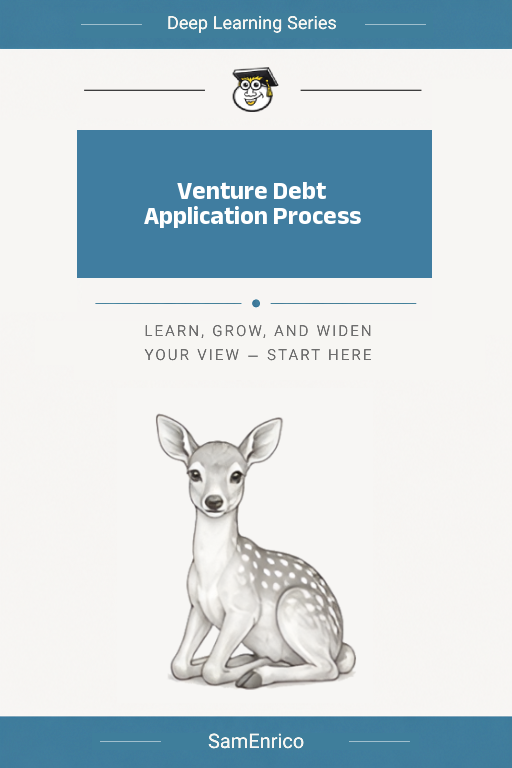
Venture Debt Application Process eBook
Submit due diligence documents and covenant monito
by Jean Kylie
Submit financials, cash flow projections, and due diligence materials for venture debt approval.
Formats
Free sample
Chapter 1: The Lender’s Mind...--Chapter 1: The Lender’s Mind– The Seven Words That Almost Killed a Unicorn Elena’s thumb hovered over the send button. On her screen was a short email to a lender she had met at a conference two weeks prior. She had raised $45 million in equity over five years. She had survived a pandemic, a near-death bridge round, and the loss of her co-founder. But venture debt?
That was new territory. Her lead VC had suggested it casually during a board update: “Debt is cheap right now. You should look into it. Non-dilutive. No brainer.”So Elena drafted the email.
Seven words: “We have about three months of cash left.”She thought she was being honest. Transparent. The kind of founder lenders want to back.She was about to make the most expensive mistake of her career.The lender who received that email—let’s call him Mark—read it, sighed, and deleted it. Not because the company was bad. The metrics were solid: 120% net dollar retention, a growing mid-market customer base, and a CTO who had built proprietary technology that was genuinely defensible.
But those seven words triggered every alarm in Mark’s underwriting manual. Three months of cash did not signal a financing need. It signaled desperation. And in venture debt, desperation is the one thing lenders fear more than bad credit.Elena never found out why Mark stopped responding. She assumed the lender wasn’t interested.
She moved on, eventually raised a different debt facility from a different lender at worse terms, and paid an extra $400,000 in fees that she could have avoided. She never learned that the problem wasn’t her company—it was her narrative.This book exists to ensure you are never Elena.Venture debt is fundamentally different from venture capital, yet 87% of founders approach it with an equity-raising mindset. That mismatch is not a minor inconvenience. It is a structural error that leads to rejected term sheets, predatory terms, and, in the worst cases, acceleration events that destroy companies. This chapter rewires your understanding of the lender’s psychology, reframes the initial conversation from “selling upside” to “proving downside protection,” and gives you the exact language, questions, and outputs you need to pass the first gate.The Asymmetric Relationship Nobody Talks About Before we discuss tactics, you must internalize a single sentence that will appear throughout this book: Lenders underwrite downside protection.
VCs underwrite upside moonshots.This is not a semantic distinction. It is the foundational asymmetry that governs every interaction, every document, and every covenant you will encounter.A venture capitalist looks at your company and asks: What is the probability that this becomes a $1 billion business? They need one winner to cover ten losers. They are paid to take risk. They celebrate volatility because volatility on the upside creates outliers.A venture debt lender looks at your company and asks: What is the probability that this company cannot pay us back?
They need ninety-nine winners to survive one loser. They are paid to avoid risk. They fear volatility because volatility on the downside creates defaults.This means everything you say and do in the application process is filtered through a single lens: Does this increase or decrease the perceived risk of default?Your passion about your product road map? The lender hears “unproven R&D spending.”Your excitement about a new market expansion? The lender hears “cash burn without revenue visibility.”Your honesty about a challenging quarter?
The lender hears “potential covenant breach.”This chapter does not ask you to become a different person or to misrepresent your company. It asks you to become a bilingual founder—fluent in the language of equity and the language of debt. When you speak to lenders, you translate your story into their vocabulary. Not because you are hiding something, but because you are respecting the fact that they have a different job, different incentives, and a different definition of a good outcome.The Lender’s Underwriting Framework: A Peek Behind the Curtain To understand what lenders want to hear, you must understand how they think. Every venture debt lender—whether a large bank like Silicon Valley Bank or a non-bank like Runway Growth Capital—uses a variant of the same underwriting framework.
It has four pillars, and you need to address each one explicitly in your initial conversations.Pillar One: Runway and Burn Rate The first thing a lender calculates is how long your current cash will last at your current burn rate. This is not because they plan to wait until you run out of money. It is because they want to know how much time they have to work with you if things go wrong.A company with 18 months of runway can survive a bad quarter, a slow sales cycle, or a delayed equity round. A company with 6 months of runway cannot. The lender is not in the business of being your last source of capital before bankruptcy.The threshold: Most lenders want to see a minimum of 12 months of cash runway at the time of closing.
Eighteen months is better. Six months is a non-starter.The trap: Founders often think they are being honest by saying, “We have six months of cash, but we are raising equity to extend that.” Lenders hear, “We are currently in distress and hoping you will rescue us.” Even if the equity round is highly probable, the lender will discount that probability by 50% or more. They have seen too many “sure thing” equity rounds collapse.Pillar Two: Capital Efficiency Venture debt is most attractive to companies that can turn borrowed dollars into growth dollars efficiently. A software company that spends $1 to generate $5 of annual recurring revenue is a good debt candidate. A hardware company that spends $1 to generate $0.80 of gross margin is not.Lenders measure capital efficiency in several ways, but the most common is gross margin retention—often called Net Dollar Retention (NDR).
An NDR above 100% means your existing customers are spending more over time, which is the single best predictor of stable future revenue.The threshold: Lenders prefer NDR above 100%. Below 90% is a red flag. Below 80% is usually a decline.The trap: Founders often lead with total addressable market or growth rates. Lenders want to hear about unit economics, payback periods, and customer lifetime value. Lead with efficiency metrics, not size metrics.Pillar Three: Investor Quality Lenders rarely lend to a company solely on its own merits.
They lend based on the quality of your equity investors. This is not unfair—it is rational. When a company begins to struggle, the first source of rescue capital is existing investors. A lender wants to know that those investors have the willingness and ability to write follow-on checks.What lenders look for: Top-tier venture firms (Andreessen Horowitz, Sequoia, Accel, etc.) signal that sophisticated investors have already performed their own diligence. Large funds signal that those investors have reserves for future rounds.
A cap table with many small angel investors or crowdfunding participants signals the opposite.The trap: Do not hide a weak cap table. Instead, address it directly: “Our lead investor is a $2 billion fund with a history of supporting portfolio…
This is the end of the free sample. Get the eBook to keep going. Buy now
About this book
Details
- Author
- Jean Kylie
- Publisher
- SamEnrico
- Language
- English
- Genre
- Operational Plan, Startup Guide, Application
- Released
- 2026-06-14
- Pages (approx.)
- 154
- Available as
- eBook, Audiobook

Read better in the ZLOADR app
Your eBooks on your phone or tablet. Sign in with your SamEnrico account and start reading.
More by Jean Kylie
 Letting Go of School ShameJean Kylie$11.99
 Self Esteem for Micromanaged RolesJean Kylie$11.99
 Meaningful Connection GuideJean Kylie$11.99
 The Bus Driver MentorJean Kylie$11.99
 LinkedIn Professional BalanceJean Kylie$11.99
 Free Cash Flow Analysis GuideJean Kylie$11.99
 Growth Mindset for ScientistsJean Kylie$11.99
 Forensic Autopsy Reports ReviewedJean Kylie$11.99
 The Digital Phoenix: How the Internet Archive Saved the World's LibrariesJean Kylie$11.99
 The Blood of the Fujiwara: The Battle of Uji That Shattered the HeikeJean Kylie$11.99
 Service Providers Guide to Clock RepairJean Kylie$11.99
 How to Produce TubasJean Kylie$11.99