
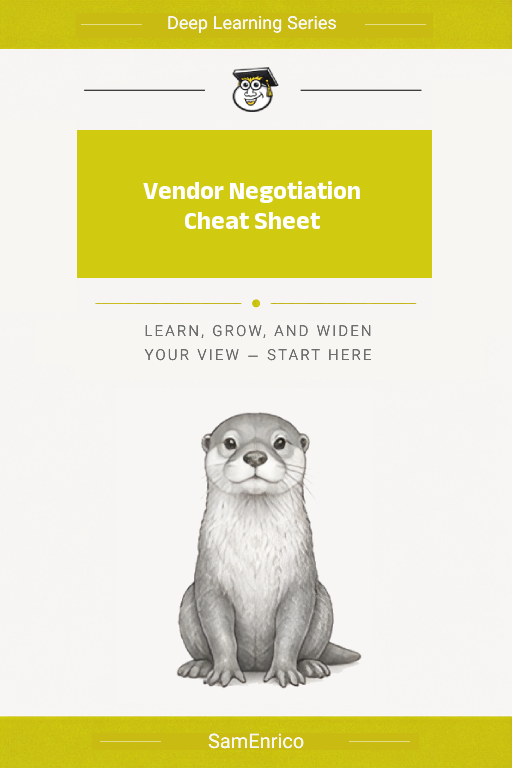
Non-FictionProfessional's Cheat SheetVendor
Vendor Negotiation Cheat Sheet eBook
Ask for discounts, waive fees, and get added value
by Brink Tran
Ask for discounts, waive fees, and get added value from every event supplier.
Formats
Free sample
Chapter 1: The Iceberg Lie--–- You have been lied to about negotiation.Not maliciously, not conspiratorially, but lied to nonetheless. The lie whispers that negotiation is about price. That the goal is to get the vendor to lower the number at the bottom of the proposal. That a successful negotiation ends with a smaller check. This lie is seductive because it is simple.
It reduces a complex, high-stakes human interaction to a single variable: dollars.And it is costing you far more money than you will ever save by haggling over room rates.Welcome to the first and most critical chapter of Vendor Negotiation Cheat Sheet. Before we talk about scripts, timing, contracts, or tactics—before we do anything else—we must rebuild your understanding of what negotiation actually is. Because everything you think you know about getting a good deal from event suppliers is probably wrong.The $10,000 Mistake You Make Every Time You Negotiate Let me tell you about Sarah.Sarah is a real event planner. Her name has been changed, but her story is drawn from hundreds of conversations with professionals exactly like you. She was planning a three-day corporate conference for 250 people at a mid-tier hotel in a secondary market.
The room rental was 8,000. The F&B minimum was 25,000. AV was quoted at 12,000.Totalvisiblecost:12,000. Total visible cost: 12,000.Totalvisiblecost:45,000.Sarah was proud of her negotiation. She pushed hard on the room rental and got it down to $5,000—a 37.5% discount.
Her boss was thrilled. Sarah was promoted six months later.Here is what Sarah did not know.The hotel added a 22% "service charge" on the AV that she never asked about. They charged a 1,200"earlysetupfee"becauseherteamneededaccessat6AM.Theyapplieda1,200 "early setup fee" because her team needed access at 6 AM. They applied a 1,200"earlysetupfee"becauseherteamneededaccessat6AM.Theyapplieda900 "energy surcharge" to the ballroom lighting. The F&B minimum included a "cake cutting fee" of 4perperson—4 per person—4perperson—1,000 for something she could have done with a knife from her own kitchen.
Her speakers needed Wi Fi, so she paid the 2,500"premiumconnectivityfee"insteadofaskingforthe2,500 "premium connectivity fee" instead of asking for the 2,500"premiumconnectivityfee"insteadofaskingforthe500 basic package. When her attendance dropped by forty people at the last minute, the attrition clause cost her $6,000 for rooms that sat empty.Sarah saved 3,000ontheroomrental.Shepaid3,000 on the room rental. She paid 3,000ontheroomrental.Shepaid11,600 in hidden fees, penalties, and service charges that she never knew existed.Her net loss from negotiation: $8,600.This is the Iceberg Principle. And until you understand it, every discount you win will be erased by the 90% of costs that lurk beneath the waterline.The Iceberg Principle: Why You Are Looking at the Wrong Number The Iceberg Principle is simple but devastating. When a vendor presents a proposal, you see the visible costs: room rental, per-person meal price, AV equipment line items.
These are the tip of the iceberg. They are what the vendor wants you to see because they are what you will negotiate over.Beneath the waterline—often hidden in footnotes, "terms and conditions," or never mentioned at all—are the real costs. Overtime fees. Setup and teardown charges. Service charges on top of service charges.
Attrition penalties. Cancellation fees. Energy surcharges. Delivery fees for items you could carry in your hand. "Administrative fees" that no one can define.
Mandatory gratuities on mandatory service charges. Union labor minimums that apply even if you do not use the labor.The typical event vendor proposal conceals between 30% and 50% of the true cost in these hidden fees. Let me repeat that: thirty to fifty percent of what you will actually pay is not visible in the line items you are negotiating over.I have reviewed over five hundred event contracts in the past decade. I have seen a 15,000proposalbecomea15,000 proposal become a 15,000proposalbecomea28,000 final bill. I have seen a "free" venue (yes, free room rental) cost 19,000inmandatory AVandlaborcharges.Ihaveseenaplannerwhocelebrateda2019,000 in mandatory AV and labor charges.
I have seen a planner who celebrated a 20% discount on F&B pay an additional 19,000inmandatory AVandlaborcharges.Ihaveseenaplannerwhocelebrateda207,000 in "plate delivery fees" and "warming station surcharges."The planners who lose the most money are not the ones who fail to get discounts. They are the ones who celebrate small victories on visible costs while being slaughtered on invisible ones.The Resource Sum: A Better Way to Think About Negotiation Let me introduce you to a concept that will change how you approach every vendor conversation.The Resource Sum is the total value created by an event transaction, shared between you and the vendor. It includes price, but also includes service quality, flexibility, risk allocation, convenience, relationship capital, and future opportunity.Here is the insight that separates expert negotiators from amateurs: negotiation is not about dividing a fixed pie. It is about expanding the pie so that both parties get more of what they value.An amateur negotiator says: "I want a lower price. You want a higher price.
We fight over the difference, and whoever has more power wins."An expert negotiator says: "What do you value that costs you little but matters to me? What do I have that costs me little but matters to you? How can we trade these things so we both walk away better off?"The vendor might not be able to lower the room rate by 20%—their margins might be too thin. But they might be able to throw in free Wi Fi (which costs them nothing), waive the cake cutting fee (a policy, not a cost), upgrade you to a nicer suite (which would otherwise sit empty), or give you late checkout (zero marginal cost). These concessions have high value to you and low cost to them.
That is the Resource Sum in action.Conversely, you might be able to offer something valuable to the vendor: a longer commitment (sign for three years instead of one), a flexible date (move to their low season), a testimonial (they need marketing content), or early payment (they need cash flow). These things cost you little but matter to them.The most profitable negotiators do not win battles. They expand the battlefield.Why "How Much Did You Save?" Is the Wrong Question Here is a test. After your next event, when your boss or board asks "How much did you save?", what will you say?Most planners answer with a single number: "I saved $3,000 on the room rental." Or "I got the AV down by 15%."This answer is not just incomplete. It is actively misleading.
Because it ignores everything else you secured—and everything you lost.A better question is: What total value did I secure relative to the vendor's best initial offer?Total value includes:Dollars saved on visible line items Dollars waived on hidden fees Upgrades and comps received Favorable contract terms (flexible attrition, reasonable cancellation)Relationship capital preserved for future events Let me give you a concrete framework. When I train event professionals, I have them complete a "Value Capture Statement" after every major negotiation. It looks like this:Initial vendor proposal total (all fees, all charges): _______ **Final contract total:** _______Dollar savings: $_______Hidden fees identified: _______Hidden fees waived: _______Value of waived fees: $_______Comps and upgrades received: _______Estimated value of comps: $_______Favorable contract terms secured: _______Estimated risk reduction value: $_______Total value captured…
This is the end of the free sample. Get the eBook to keep going. Buy now
About this book
Details
- Author
- Brink Tran
- Publisher
- SamEnrico
- Language
- English
- Genre
- Non-Fiction, Professional's Cheat Sheet, Vendor
- Released
- 2026-06-01
- Pages (approx.)
- 119
- Available as
- eBook, Audiobook

Read better in the ZLOADR app
Your eBooks on your phone or tablet. Sign in with your SamEnrico account and start reading.
More by Brink Tran
 Anki For BotanyBrink Tran$11.99
 The College Drinking GuideBrink Tran$11.99
 Spin Bike Maintenance GuideBrink Tran$11.99
 Racism at Work Self EsteemBrink Tran$11.99
 Patagonian Desert Border CrossingBrink Tran$11.99
 Managing Distractions for Real EstateBrink Tran$11.99
 Creative Confidence for DoctorsBrink Tran$11.99
 Quercetin DasatinibBrink Tran$11.99
 The Great Space Potato Mystery: How a Tiny Tuber Changed NASA's MissionBrink Tran$11.99
 The Edison Effect: How One Man Lit Up the Modern WorldBrink Tran$11.99
 The Essential Guide to CoolBrink Tran$11.99
 How to Produce Equestrian EquipmentBrink Tran$11.99
You may also like
 Hong Kong Handover 1997Dunn Johnnie$11.99
 Zumba For Postnatal Recovery CourseNeal Christian$11.99
 Zumba for BeginnersLadner Nikia$11.99
 YouTube Comment Mining GuideHumes Pandora$12.99
 Worry Box MeditationCarlin Rudy$11.99
 Workplace Stress MeditationNguyen Lynn$11.99
 Workplace Stress and Sleep RepairHawley Ivory$11.99
 Workplace Perfectionism CureDelaney Jeffry$11.99
 Workplace Injustice Anger GuideWallen Isabelle$11.99
 Work Addiction and Burnout LinkGreenwood Ester$11.99
 Women in Yoga and WellnessBeattie Galina$11.99
 Women in Stand Up ComedyChun Evangeline$11.99