
Non-FictionHealth & WellnessFood Phobias
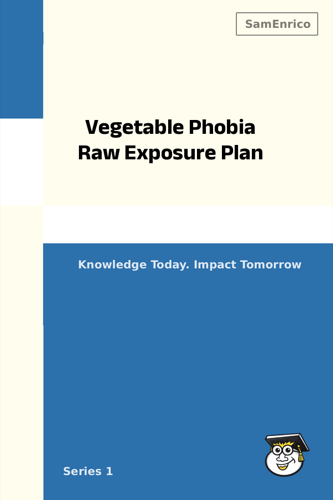
Vegetable Phobia Raw Exposure Plan eBook
Touch raw carrot, then lick, then bite, then chew,
by Lash Harley
Touch raw carrot, then lick, then bite, then chew, working up to full swallow.
Formats
Free sample
Chapter 1: The Orange Enemy--–- The first time Rachel cried over a carrot, she was twenty-nine years old, sitting in a crowded restaurant across from her new boyfriend’s parents. The salad arrived. She saw the orange slivers nestled between the lettuce leaves like tiny glowing warnings. Her heart rate tripled. Her palms soaked through the cloth napkin.
When her boyfriend’s mother said, “The carrots are from our garden—so sweet!” Rachel excused herself to the bathroom and hyperventilated for twelve minutes. She did not eat the salad. She did not eat anything. She broke up with him three weeks later, partly because she couldn’t face another dinner. The carrot had won.This is not a book about picky eating.
This is not a book about people who simply dislike raw vegetables. This is a book about the approximately four percent of adults who experience a full-blown specific phobia of a food—and specifically, one of the most common and seemingly absurd targets: the raw carrot.You are holding this book for one of three reasons. First, you have a raw carrot phobia yourself and you are exhausted by the shame, the social gymnastics, and the secret terror of a vegetable that costs twenty cents. Second, you love someone who has this phobia and you want to understand why a grown adult cannot take a single bite of something so benign. Third, you are a therapist or coach looking for a protocol that works for the surprisingly large number of clients who gag at the sight of orange crudités.Whatever brought you here, let me say clearly what no one else has said to you: You are not weak.
You are not childish. You are not being dramatic. You have a brain that learned something—a very powerful, very protective, very wrong thing—and this book exists because that learning can be unlearned.Understanding Your Personal Enemy Before we take a single step toward exposure, we must understand what a phobia actually is. The word gets thrown around casually. “I have a phobia of spiders.” “Oh, I’m so phobic about public speaking.” But clinically, a specific phobia is not a dislike, an aversion, or even a strong fear.
It is a diagnosable condition with four specific features, all of which you will recognize if you have a raw carrot phobia.First, the fear is disproportionate to the actual danger. A raw carrot cannot kill you. It cannot choke you if properly chewed. It carries no toxin. It is, by any objective measure, one of the safest substances you will ever put near your mouth.
Yet your body responds as if you are holding a live cobra. That disproportion is not a character flaw—it is the definition of a phobia, and it tells you that something in your brain’s threat-detection system has been miscalibrated.Second, the fear is persistent. This is not a passing worry that comes and goes with your stress levels. You have probably had this phobia for years, perhaps since childhood. It has survived every logical argument you have thrown at it.
You have told yourself, “It’s just a carrot,” a thousand times. Your amygdala does not care.Third, the fear leads to active avoidance. You do not simply dislike carrots and prefer not to eat them. You scan menus. You interrogate hosts about salad ingredients.
You pick through mixed vegetables with the focus of a bomb disposal expert. You have developed elaborate safety behaviors that we will catalog in Chapter 2. Your life has been rearranged around the absence of one orange root vegetable.Fourth, and most importantly for our work together, the fear causes clinically significant distress or impairment in your daily functioning. Maybe you have skipped dinners with friends. Maybe you have lied about allergies.
Maybe you have felt a wave of nausea walking past the produce section. Maybe you have cried in a restaurant bathroom. That is not trivial. That is not something to be embarrassed about. That is something to fix.The Three Faces of Carrot Phobia Over years of researching exposure therapy and working with individuals who have food phobias, I have identified three distinct profiles of raw carrot phobia.
You will likely recognize yourself in one of them. This matters because each profile requires slightly different emphasis in the exposure protocol, though the underlying ladder (touch, lick, bite, chew, swallow) works for all three.The Gagger is driven primarily by fear of choking or vomiting. For these individuals, the carrot represents not a taste or texture problem but an airway threat. They imagine—often vividly—the carrot piece lodging in their throat, the inability to breathe, the panic of suffocation. Interestingly, many gaggers have never actually choked on anything.
Their fear is entirely anticipatory, built from stories they heard, videos they watched, or a single frightening incident where they gagged on something else entirely. The gagger’s body responds to the carrot with throat tightening, increased salivation, and a reflexive retch that occurs before the carrot even touches the tongue. For the gagger, the exposure protocol will emphasize the swallow steps (Chapter 8) and the anatomical reassurance that a properly chewed carrot piece cannot block an adult airway.The Texture Sensitive is driven by sensory processing issues. This profile is overrepresented among individuals with autism spectrum disorder, sensory processing disorder, or high levels of tactile defensiveness. For these readers, the carrot is not threatening because of what it might do—it is threatening because of what it feels like.
The crunch. The fibrous strands. The way it squeaks against teeth. The heterogeneity of its texture (smooth skin, gritty interior, wet surface). Texture sensitives often have difficulty with multiple raw vegetables, not just carrots, and may also struggle with foods like celery, bell peppers, and raw mushrooms.
For this profile, the exposure protocol will emphasize the touch and lick steps (Chapters 4 and 5) and the texture blending techniques described in Chapter 9, which start with grated carrot (feels like wet sand) and gradually work up to whole pieces.The Traumatic Eater has a specific, memorable incident that created the phobia. Perhaps you choked on a carrot as a child. Perhaps you were forced to eat raw vegetables at a punitive dinner and vomited. Perhaps you witnessed someone else gag or choke on a carrot. Traumatic eaters can usually point to a single moment when the phobia began.
The good news is that this profile often responds well to exposure therapy because the fear is attached to a discrete memory, and memory reconsolidation techniques (which we will touch on in Chapter 3) can be particularly effective. The bad news is that traumatic eaters often have the highest initial SUDS scores (see Chapter 3 for an explanation of this scale) and may require more time at each ladder step.You may recognize elements of multiple profiles. That is normal. The important thing is to identify your primary driver: Is it choking fear? Texture disgust?
A traumatic memory? Write your answer down now. You will return to it in Chapter 3 when you build your personalized fear ladder.The Evolutionary Mismatch: Why Your Brain Hates Carrots To understand why a raw carrot triggers such an…
This is the end of the free sample. Get the eBook to keep going. Buy now
About this book
Details
- Author
- Lash Harley
- Publisher
- SamEnrico
- Language
- English
- Genre
- Non-Fiction, Health & Wellness, Food Phobias
- Released
- 2026-06-09
- Pages (approx.)
- 132
- Available as
- eBook, Audiobook

Read better in the ZLOADR app
Your eBooks on your phone or tablet. Sign in with your SamEnrico account and start reading.
More by Lash Harley
 Bipolar Mania Suicide Attempt StoryLash Harley$11.99
 AI Lesson Plan RepositoryLash Harley$11.99
 Polish Fake Train DeparturesLash Harley$11.99
 Stress Related Night Sweats ExplainedLash Harley$11.99
 Jaguar’s Whisper: The Lost Olmec OracleLash Harley$11.99
 How to Become a Knitter MechanicLash Harley$11.99
 Remote Review Recording PolicyLash Harley$12.99
 Industrial Automation Robotics GuideLash Harley$12.99
 Understanding Maroteaux–verloes–stanescu SyndromeLash Harley$17.99
 Oats TradingLash Harley$11.99
You may also like
 Hong Kong Handover 1997Dunn Johnnie$11.99
 Zumba For Postnatal Recovery CourseNeal Christian$11.99
 Zumba for BeginnersLadner Nikia$11.99
 YouTube Comment Mining GuideHumes Pandora$12.99
 Worry Box MeditationCarlin Rudy$11.99
 Workplace Stress MeditationNguyen Lynn$11.99
 Workplace Stress and Sleep RepairHawley Ivory$11.99
 Workplace Perfectionism CureDelaney Jeffry$11.99
 Workplace Injustice Anger GuideWallen Isabelle$11.99
 Work Addiction and Burnout LinkGreenwood Ester$11.99
 Women in Yoga and WellnessBeattie Galina$11.99
 Women in Stand Up ComedyChun Evangeline$11.99