
Non-FictionHealth & WellnessSupplementation
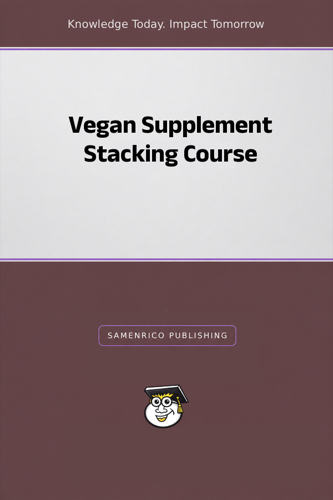
Vegan Supplement Stacking Course eBook
Reviews evidence-based supplement protocols for ve
by Beyer Jeffie
Reviews evidence-based supplement protocols for vegans including B12, D, iodine, and zinc.
Formats
Free sample
Chapter 1: The Silent Depletion...--Imagine waking up one day – three years into a perfectly planned vegan diet – and realizing you cannot remember where you parked your car. Your hair is thinning. Your hands and feet occasionally tingle for no reason. You feel tired by 2 PM no matter how much sleep you get. Your doctor runs standard blood work and tells you everything is "normal."And yet, you know something is wrong.This is the vegan paradox.
You adopted a plant-based diet for ethical, environmental, or health reasons – perhaps all three. You gave up animal products. You eat more vegetables, beans, legumes, nuts, seeds, and whole grains than almost anyone you know. By every conventional measure, you are eating "healthy." Your cholesterol is excellent. Your blood pressure is enviable.
Your body weight is likely optimal.But something is missing. And the missing pieces are not your fault.The dirty secret of modern vegan nutrition – the one that influencer culture, documentary filmmakers, and even many well-meaning dietitians gloss over – is that a plant-only diet, as currently practiced in industrialized societies, creates predictable, measurable, and potentially dangerous nutrient gaps. These gaps do not appear overnight. They creep in silently over months and years, like a leak in a basement you never visit. By the time you notice the damage, some of it may be irreversible.This chapter is not an attack on veganism.
The author of this book has been vegan for over a decade. This chapter is a wake-up call. It is the first lesson in a course designed to ensure you thrive – not just survive – on a plant-based diet. To do that, you must first understand why the "plants are perfect" narrative is incomplete, which nutrients are most at risk, and why random supplementing (the "shotgun approach") fails so miserably.Let us begin by dismantling three comfortable myths.The Three Myths That Keep Vegans Deficient Myth #1: "Our Ancestors Ate Plants Exclusively and Thrived"This is the most seductive myth because it contains a kernel of truth. Humans have consumed plant-heavy diets for most of our evolutionary history.
Certain populations – the Kitavans of Papua New Guinea, the indigenous peoples of the Okinawan islands, and various traditional agricultural societies – consumed diets that were 80-90% plant-based by calories. They were healthy. They did not suffer from the chronic diseases that plague modern Western populations.But here is what the myth leaves out.Those ancestral and traditional populations did not eat modern plants grown in depleted industrial soils. They ate from biologically diverse, mineral-rich earth that had never been subjected to decades of monocropping, synthetic fertilizers, and chemical pesticides. More critically, they consumed small amounts of animal products – insects, grubs, small fish, eggs, or organ meats – depending on the population.
Even the most plant-heavy traditional diets were not 100% vegan. And those that came close (certain Jain communities in India) have historically struggled with the same deficiencies this book addresses.Most importantly, traditional populations did not have access to modern sanitation. This sounds counterintuitive, but it is crucial. Vitamin B12 is produced by bacteria in soil and contaminated water. Before chlorination and modern hygiene, humans ingested B12 constantly – from unwashed root vegetables, from drinking water, from soil residue on hands and tools.
That invisible bacterial coating on pre-industrial food provided a steady, low-dose stream of B12 that kept deficiency at bay.Modern vegans wash their vegetables. They drink filtered or chlorinated water. They use hand sanitizer. They live in environments that are, by historical standards, sterile. This is overwhelmingly good for preventing infectious disease.
But it has eliminated the natural, environmental source of B12 that kept our ancestors functional.You cannot eat your way out of this problem with plant foods alone. No plant – not spirulina, not nori, not chlorella, not fermented foods – contains reliable, bioavailable B12. Some contain B12 analogs that actually block true B12 receptors, making deficiency worse. This is not a failure of veganism. It is a feature of modern life.
And it requires a modern solution.Myth #2: "If You Eat a Varied Whole-Food Diet, You Get Everything You Need"This myth persists because it is true for most nutrients – and dangerously false for a specific few.A varied whole-food vegan diet absolutely provides sufficient carbohydrates, fiber, most B vitamins (except B12), vitamin C, vitamin E, vitamin K, magnesium, potassium, manganese, and a host of phytochemicals and antioxidants. In many cases, vegans have higher intakes of these nutrients than omnivores. That is genuine good news.But variety cannot compensate for three fundamental problems: bioavailability, anti-nutrients, and the complete absence of certain compounds from the plant kingdom.Bioavailability refers to the proportion of a nutrient that your body can actually absorb and use. Just because a food contains 10mg of iron on a nutrition label does not mean your body absorbs 10mg of iron. For plant-based (non-heme) iron, absorption ranges from 5% to 12% depending on what you eat with it.
For animal-based (heme) iron, absorption is 25% regardless of co-consumed foods. This means a vegan needs to consume two to five times more iron than an omnivore to absorb the same amount. The same principle applies to zinc, calcium, and omega-3 fatty acids.Anti-nutrients – specifically phytates (phytic acid) found in all beans, grains, nuts, and seeds – bind directly to minerals like zinc, iron, and calcium, preventing their absorption. Phytates are not inherently bad; they have antioxidant properties and may reduce cancer risk. But they are a double-edged sword.
A vegan diet rich in whole grains, legumes, nuts, and seeds is necessarily high in phytates. Those phytates actively steal minerals from your system before you can absorb them. This is why zinc deficiency is common among vegans who eat impeccably healthy diets. You can be eating enough zinc on paper and still be deficient in practice.Complete absence applies to a short list of nutrients that simply do not exist in the plant kingdom. Vitamin B12 is the most famous example – no plant produces it, period.
Vitamin D3 (the form humans synthesize from sunlight) is not present in plants; only D2 (ergocalciferol) is, and it is less effective. Creatine is found only in animal muscle tissue. Carnosine and its precursor beta-alanine are found only in animal proteins. Heme iron is found only in blood and muscle. Long-chain omega-3s (DHA and EPA) are not produced by land plants; only marine algae produce them, and most vegans do not eat algae.A varied diet cannot conjure nutrients that do not exist in the plant kingdom.
You can eat fifty different plant foods every day and still be deficient in B12, D3, creatine, and DHA. Variety is a virtue, but it is not a magic wand.Myth #3: "Supplements Are Unnatural – I Should Get Everything From Food"This myth is both understandable and dangerous. It arises from a commendable desire to eat real, whole, unprocessed foods. It is reinforced by the naturalistic fallacy – the belief that "natural" equals better. But it ignores a simple reality: modern vegans cannot access the natural sources of certain nutrients because those sources have been eliminated by civilization.Consider vitamin D.
Humans evolved in equatorial Africa, where year-round intense sunlight allowed bare skin to synthesize massive amounts of vitamin D3. When humans migrated to northern…
This is the end of the free sample. Get the eBook to keep going. Buy now
About this book
Details
- Author
- Beyer Jeffie
- Publisher
- SamEnrico
- Language
- English
- Genre
- Non-Fiction, Health & Wellness, Supplementation
- Released
- 2026-06-08
- Pages (approx.)
- 137
- Available as
- eBook, Audiobook

Read better in the ZLOADR app
Your eBooks on your phone or tablet. Sign in with your SamEnrico account and start reading.
More by Beyer Jeffie
 Remote Work Priority MatrixBeyer Jeffie$11.99
 Email Priority SystemBeyer Jeffie$11.99
 The Stretch Habit TrackerBeyer Jeffie$11.99
 Franchising Your Local Brand Across Borders Digital MarketingBeyer Jeffie$11.99
 The Last Broadcast of the Titanic’s AIBeyer Jeffie$11.99
 Ice & Iron: The Rise and Fall of the 'Crystal Cartel'Beyer Jeffie$11.99
 Understanding Cutis Laxa OsteoporosisBeyer Jeffie$17.99
 A Beginners Guide to Balance Beam (Volume 1)Beyer Jeffie$11.99
 India Green Incentive GuideBeyer Jeffie$12.99
 Marketing Plan Template GuideBeyer Jeffie$12.99
 Area Marketing RepresentativeBeyer Jeffie$11.99
You may also like
 Hong Kong Handover 1997Dunn Johnnie$11.99
 Zumba For Postnatal Recovery CourseNeal Christian$11.99
 Zumba for BeginnersLadner Nikia$11.99
 YouTube Comment Mining GuideHumes Pandora$12.99
 Worry Box MeditationCarlin Rudy$11.99
 Workplace Stress MeditationNguyen Lynn$11.99
 Workplace Stress and Sleep RepairHawley Ivory$11.99
 Workplace Perfectionism CureDelaney Jeffry$11.99
 Workplace Injustice Anger GuideWallen Isabelle$11.99
 Work Addiction and Burnout LinkGreenwood Ester$11.99
 Women in Yoga and WellnessBeattie Galina$11.99
 Women in Stand Up ComedyChun Evangeline$11.99