
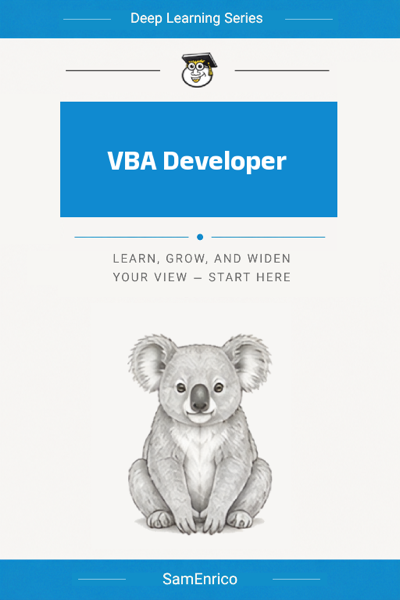
VBA Developer eBook
A Coursebook on VBA Developer
by Beale Gidget
A Coursebook on VBA Developer
Formats
Free sample
Chapter 1: The Automation Mindset--–- Every Excel user knows the feeling. It begins as a faint irritation—a column of numbers that needs reformatting, a report that must be generated daily, a set of files that require the same fifteen clicks every morning. At first, you tolerate it. You tell yourself it is faster just to do it manually than to figure out a better way. But then the data grows.
The reports multiply. The fifteen clicks become fifty. And one day, you find yourself spending four hours on a task that a machine could complete in four seconds. That is the moment you become ready to think like a developer.This book is not about memorizing syntax or collecting snippets of code. It is about a fundamental transformation in how you approach problems in Excel.
You are about to learn the language and logic of automation, but more importantly, you are going to develop a mindset—a way of seeing spreadsheets not as static documents but as dynamic systems waiting to be programmed. Welcome to the journey of becoming a VBA Developer.The Cost of Manual Work Before you write a single line of code, you must understand what is at stake. Every manual action you perform in Excel has a cost. That cost is not just your time in the moment; it is the cumulative drain of repetitive tasks on your focus, your accuracy, and your ability to do meaningful work.Consider a simple scenario. Each week, you receive a raw data export from your company’s accounting system.
You open the file, delete columns B through D because they contain irrelevant codes, insert a new column for calculated totals, apply a filter, copy the visible rows to a new sheet, format the headers in bold and blue, and save the file with the current week’s date. This process takes you about ten minutes. Every week. Fifty weeks a year. That is over eight hours annually—a full working day—spent on a task that never changes, never requires judgment, and never makes you better at your job.Now multiply that across the dozens of small automations that could exist in your workflow.
The time lost is staggering. But the hidden cost is worse: context switching. Every time you interrupt your analytical thinking to perform a mechanical task, you lose momentum. The quality of your thinking degrades. Mistakes creep in.
You forget where you were. By the time you return to the problems that actually require human intelligence, your cognitive resources are depleted.VBA exists to eliminate this waste. It is the bridge between the tedious and the transformative. And the first step across that bridge is learning to identify automation opportunities before you even open the Visual Basic Editor.Recognizing Automation Opportunities Not every task should be automated. Some tasks are truly one-off—a single report requested by a manager who will never ask again, a temporary data cleanup for a specific project, an analysis that changes structure every time you run it.
Automating these would be like building a factory to bake a single cookie. The setup cost exceeds the benefit.The tasks worth automating share a common profile. They are repetitive (you perform them more than three times), rule-based (the steps do not require human judgment), and time-consuming (the manual method takes more than a minute). When you encounter a task that meets all three criteria, you have found a candidate for VBA.Let us refine this framework. Ask yourself four questions about any recurring task:First, does the task follow a consistent sequence of steps?
If you can write down the instructions as a numbered list that someone else could follow without interpretation, VBA can execute it. If the task requires decisions like “remove the outliers that look suspicious” or “format the data attractively,” those ambiguous instructions are harder to automate. VBA needs precision.Second, does the task involve more than five manual actions? A simple copy-paste operation may not be worth writing code to automate. But when you find yourself selecting, copying, switching sheets, pasting, formatting, filtering, renaming, saving, and closing—that is a clear signal.Third, will you perform this task again next month?
Automation has a return on investment. The first time you write code for a task, it may take longer than doing it manually. The second time, you break even. The third time and beyond, you are saving time with every repetition.Fourth, is the task error-prone when done manually? This is the most compelling argument for automation.
If humans frequently make mistakes on a task—misplacing a formula, forgetting to update a reference, skipping a step—VBA can perform it with perfect consistency every time.Throughout this book, you will develop the instinct to spot these opportunities. By Chapter 5, when you learn to process arrays in memory, you will see data cleaning tasks differently. By Chapter 6, when you master events, you will design spreadsheets that respond intelligently to user actions. But for now, simply practice noticing. Keep a log for one week of every manual Excel task you perform.
At the end of the week, review the list and circle the tasks that are repetitive, rule-based, and time-consuming. Those are your first automation projects.Introducing the Course Project: The Sales Invoice System Theory is essential, but skill is forged in practice. Throughout this book, you will build a complete, professional-grade application: the Sales Invoice and Reporting System. This project will appear in every chapter, growing in sophistication as your capabilities expand. By Chapter 12, you will have a signed, deployable add-in with a custom ribbon, error handling, and full documentation—something you can add to your portfolio or use in your workplace immediately.Let me describe what you will build.
The Sales Invoice System is a tool for a small business that sells products to customers and needs to generate invoices, track sales, and produce monthly reports. The business currently manages everything in Excel manually, but the owner has grown frustrated with calculation errors, misplaced invoices, and the time spent recreating the same reports.Your system will solve these problems by providing:A data entry User Form that guides the user through invoice creation, validating inputs and calculating totals automatically. This form will populate a hidden worksheet that serves as the system’s database.An intelligent worksheet that uses event programming to look up product descriptions and prices as soon as a product code is entered, eliminating manual lookups.A batch import routine that can process hundreds of invoices from external files in under a second, using advanced array techniques.An error handling system that logs any problems to a dedicated worksheet and alerts the user without crashing.A custom ribbon that adds new buttons to Excel’s interface, making the system feel like a native part of the application.And finally, a deployable add-in that installs once and works with any workbook, protecting your intellectual property while providing value to users.In this chapter, you will create the foundation: a new workbook, properly organized, with a standard module named mod Invoice System. You will write your first macro—a simple welcome message—and learn to run it. You will also establish the naming conventions and project structure that professional…
This is the end of the free sample. Get the eBook to keep going. Buy now
About this book
Details
- Author
- Beale Gidget
- Publisher
- SamEnrico
- Language
- English
- Genre
- Non-Fiction, Informative, Educational
- Released
- 2026-05-04
- Pages (approx.)
- 154
- Available as
- eBook, Audiobook

Read better in the ZLOADR app
Your eBooks on your phone or tablet. Sign in with your SamEnrico account and start reading.
More by Beale Gidget
 Smile Authenticity TestBeale Gidget$11.99
 Parent Remote Worker GuideBeale Gidget$11.99
 Immigrant Child Poetry DiscoveriesBeale Gidget$11.99
 Small Talk for Gym and FitnessBeale Gidget$11.99
 Group Flow State GuideBeale Gidget$11.99
 McKenzie Method GuideBeale Gidget$11.99
 Parental Anger at Childs WeightBeale Gidget$11.99
 Dream Time Distortion LogBeale Gidget$11.99
 The Sultan’s Forgotten Vizier: A Djinn’s BargainBeale Gidget$11.99
 The Ghosts of Kursk: The Armored Titans of WWIIBeale Gidget$11.99
 A Collector's Handbook to the Standard Flying FourteenBeale Gidget$11.99
 How to Start a Correspondence College Specialising In Higher Education Courses (degree Level) BusineBeale Gidget$11.99