
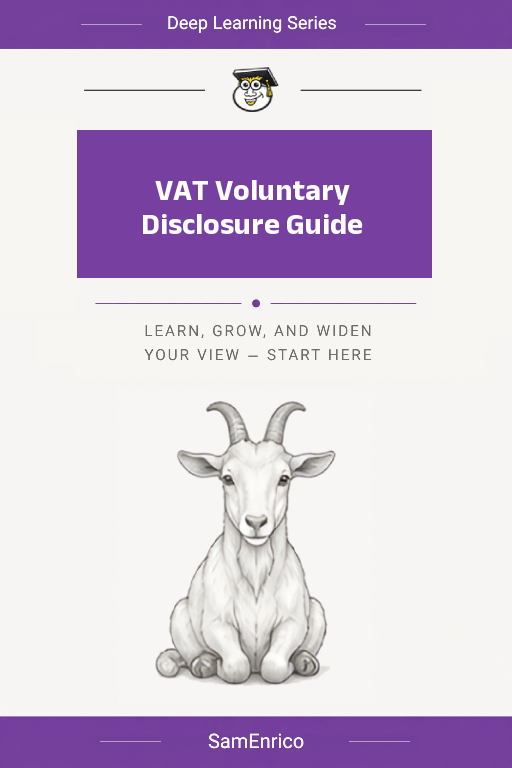
Non-FictionBusiness BriefDisclosure
VAT Voluntary Disclosure Guide
Make voluntary disclosures for past VAT errors to
by Silvia Heike
Make voluntary disclosures for past VAT errors to reduce penalties across all three jurisdictions.
Formats
About this book
Free sample
Chapter 1: The Penalty Volcano...--You have just discovered a VAT error. Your stomach drops. Your mind races through worst-case scenarios. You imagine penalty notices, audits, perhaps even a knock on the door from tax authorities. The instinct to freeze, to wait, to hope no one notices, is overwhelming.That instinct will cost you a fortune.This chapter reframes the discovery of a past VAT error not as a failure, but as a critical decision point—one where the right action can save hundreds of thousands in penalties, and the wrong action can destroy a business.
You will learn why silence is no longer a viable option in any jurisdiction, how digital reporting and international data sharing have made hidden errors nearly impossible to conceal, and why the three major VAT jurisdictions (United Kingdom, European Union member states, and the United Arab Emirates) have fundamentally different approaches to voluntary disclosure. By the end of this chapter, you will understand the core thesis of this entire book: penalties follow predictable formulas based on behavior, timing, and jurisdiction. And predictable means you can minimize them.The Anatomy of a VAT Error Before we discuss penalties and disclosures, we must understand what we are actually dealing with. A VAT error occurs when a business submits a VAT return that does not accurately reflect its tax liability for a given period. Errors take many forms: under-declared output tax (you collected VAT but did not remit it), over-declared input tax (you claimed deductions you were not entitled to), incorrect application of zero-rating or exemption, misclassification of goods or services, errors in cross-border transactions (missing EC Sales Lists, incorrect place of supply determinations), and simple arithmetic mistakes that compound across multiple periods.The critical distinction—and one that will determine your penalty exposure more than any other factor—is between innocent errors and deliberate wrongdoing.
Innocent errors arise from miscalculations, misinterpretation of complex rules, system failures, or genuine oversight. The tax authority may still penalize you, but the penalty range starts much lower. Deliberate wrongdoing involves evasion, fraud, intentional non-compliance, or concealment. In this category, penalties skyrocket…
This is the end of the free sample. Get the eBook to keep going. Buy now
Contents
- Chapter 1
- Chapter 2
- Chapter 3
- Chapter 4
- Chapter 5
- Chapter 6
- Chapter 7
- Chapter 8
- Chapter 9
- Chapter 10
- Chapter 11
- Chapter 12
Details
- Author
- Silvia Heike
- Publisher
- SamEnrico
- Language
- English
- Genre
- Non-Fiction, Business Brief, Disclosure
- Released
- 2026-05-29
- Pages (approx.)
- 160
- Available as
- eBook, Audiobook

Read better in the ZLOADR app
Your eBooks on your phone or tablet. Sign in with your SamEnrico account and start reading.
More by Silvia Heike
 Morning Rituals Of BillionairesSilvia Heike$11.99
 Sober Celebration MilestonesSilvia Heike$11.99
 Sunscreen SPF GuideSilvia Heike$11.99
 The Red Cloud BiographySilvia Heike$11.99
 Task Breakdown for ProcrastinatorsSilvia Heike$11.99
 Self Talk For Making MistakesSilvia Heike$11.99
 Weekly Review for EngineersSilvia Heike$11.99
 Caregiver and Work BalanceSilvia Heike$11.99
 The Lioness of Dahomey: The Warrior Queen Who Shaped an EmpireSilvia Heike$11.99
 Whispers of the Vanishing: The Last Speakers of the AinuSilvia Heike$11.99
 The Essential Guide to Blues-rockSilvia Heike$11.99
 A Collector's Handbook to the AC E-bristolSilvia Heike$11.99
You may also like
 Hong Kong Handover 1997Dunn Johnnie$11.99
 Zumba For Postnatal Recovery CourseNeal Christian$11.99
 Zumba for BeginnersLadner Nikia$11.99
 YouTube Comment Mining GuideHumes Pandora$12.99
 Worry Box MeditationCarlin Rudy$11.99
 Workplace Stress MeditationNguyen Lynn$11.99
 Workplace Stress and Sleep RepairHawley Ivory$11.99
 Workplace Perfectionism CureDelaney Jeffry$11.99
 Workplace Injustice Anger GuideWallen Isabelle$11.99
 Work Addiction and Burnout LinkGreenwood Ester$11.99
 Women in Yoga and WellnessBeattie Galina$11.99
 Women in Stand Up ComedyChun Evangeline$11.99