
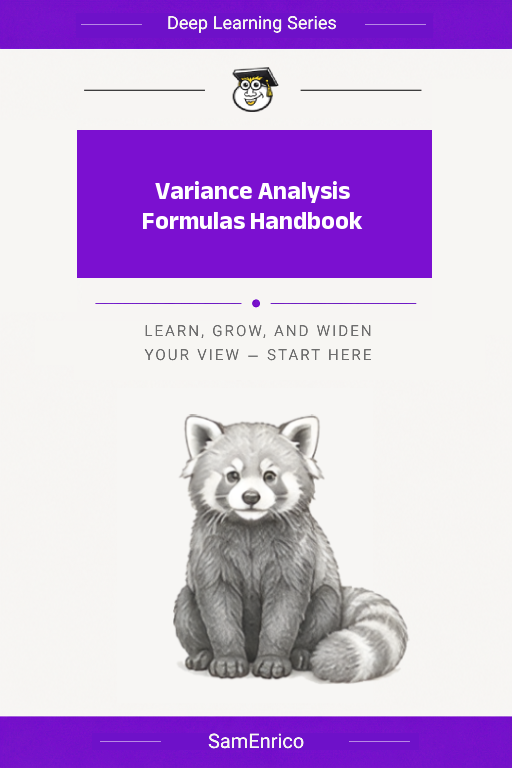
Non-FictionStudent's ShortcutCost Accounting
Variance Analysis Formulas Handbook Audiobook
Calculate material, labor, and overhead variances
Calculate material, labor, and overhead variances for standard costing systems without calculation errors.
Formats
Free sample
Chapter 1: The Standard Lie--–- In twenty years of manufacturing finance, I never met a variance that was actually a variance. Every single one was a symptom of something else: a standard that hadn't been updated since the Clinton administration, a Bill of Materials that listed components nobody had used in three years, or a labor routing that assumed workers could teleport between workstations. The math was always perfect. The inputs were always wrong.This chapter argues a provocative thesis that will sound like heresy to anyone who suffered through intermediate accounting: ninety percent of variance calculation errors originate not in the arithmetic, but in the standard itself. You can have a Ph D in applied mathematics and a spreadsheet that would make an aerospace engineer weep with envy.
It won't matter. If your standard is garbage, every variance you calculate will be garbage dressed up in decimal places.I learned this lesson the hard way in my first month as a cost accountant at a mid-sized automotive parts manufacturer. The previous accountant had reported "favorable material usage variances" for eighteen consecutive months. The plant manager had received bonuses based on those numbers. The CFO had presented them to the board as evidence of operational excellence.
Then we did a physical inventory count. The discrepancy was $4.2 million. The favorable variance was a lie. The standard was the liar.The Three Types of Standards and Why Only One Works Before we can calculate a single variance correctly, we must understand what a standard actually represents. In standard costing, a "standard" is a carefully predetermined benchmark for the quantity and cost of resources required to produce one unit of output.
But not all standards are created equal. The accounting literature recognizes three distinct types, and choosing the wrong one will doom your variance analysis from the start.Ideal standards assume perfection in every dimension. No machine downtime. No worker fatigue. No material spoilage.
No setup time between batches. The factory runs at theoretical capacity twenty-four hours a day, seven days a week, three hundred sixty-five days a year. Ideal standards are useful for exactly one purpose: demonstrating to production managers how far they are from theoretical perfection. They are useless, and actively harmful, for performance evaluation or variance calculation. Why?
Because an ideal standard guarantees unfavorable variances. Every period. Without exception. The question becomes not "did we perform well?" but "how badly…
This is the end of the free sample. Get the Audiobook to keep going. Buy now
About this book
Details
- Author
- Lindley Myung
- Publisher
- SamEnrico
- Language
- English
- Genre
- Non-Fiction, Student's Shortcut, Cost Accounting
- Released
- 2026-06-01
- Pages (approx.)
- 156
- Available as
- eBook, Audiobook

Listen in the VoxFlicks app
Audiobooks and audio dramas wherever you go. Sign in with your SamEnrico account and press play.
More by Lindley Myung
 Low Carb Sugar Detox CourseLindley Myung$11.99
 Overland Gobi Desert Expedition SurvivalLindley Myung$11.99
 The Walking Meditation JournalLindley Myung$11.99
 Social Media Flow BreakLindley Myung$11.99
 How to Start a Loyalty Programme Administration Business (Beginners Guide)Lindley Myung$11.99
 How to Produce Camera Circuit BoardsLindley Myung$11.99
 Human Resources CoordinatorLindley Myung$11.99
You may also like
 Hong Kong Handover 1997Dunn Johnnie$11.99
 Zumba For Postnatal Recovery CourseNeal Christian$11.99
 Zumba for BeginnersLadner Nikia$11.99
 YouTube Comment Mining GuideHumes Pandora$12.99
 Worry Box MeditationCarlin Rudy$11.99
 Workplace Stress MeditationNguyen Lynn$11.99
 Workplace Stress and Sleep RepairHawley Ivory$11.99
 Workplace Perfectionism CureDelaney Jeffry$11.99
 Workplace Injustice Anger GuideWallen Isabelle$11.99
 Work Addiction and Burnout LinkGreenwood Ester$11.99
 Women in Yoga and WellnessBeattie Galina$11.99
 Women in Stand Up ComedyChun Evangeline$11.99