
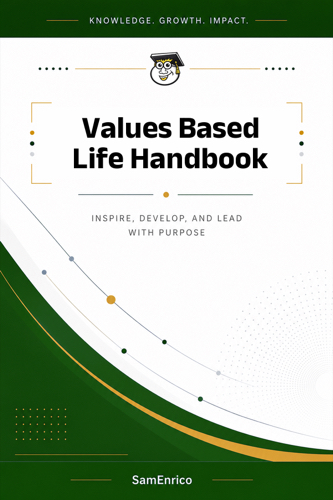
Non-FictionSelf-HelpValues Clarification
Values Based Life Handbook eBook
Align daily actions with your deepest principles u
Align daily actions with your deepest principles using this practical purpose guide.
Formats
Free sample
Chapter 1: The Value Delusion--–- Most people believe they know their values. They will tell you, with complete sincerity, that they value family, integrity, health, and growth. They have perhaps even written these words on a vision board, typed them into a journal, or recited them during a job interview. And yet, if you were to secretly audit their lives—to pull up their calendar for the past six months, review their bank statements, and analyze their screen-time reports—you would discover a shocking truth. Their actual values bear almost no resemblance to the pretty words they have spoken.This is not because they are liars or hypocrites.
It is because they have fallen into what this chapter calls the Value Delusion: the sincere but false belief that declaring a value is the same as living it. The Value Delusion is the single greatest obstacle to building a values-based life, and until you see it clearly in your own behavior, no amount of philosophy, habit tracking, or goal setting will save you.Consider a typical example. A man named David once sat in my workshop and announced that his highest value was “family.” He spoke passionately about his two young children and his wife of twelve years. He almost teared up describing his father’s funeral and his vow to be more present than his own workaholic dad had been. The room nodded in recognition.
Then I asked a simple question: “David, how many hours did you spend last week on undistracted, intentional time with your children—not counting watching TV in the same room or scrolling your phone while they played nearby?”He went silent. Then he admitted: maybe two hours. A total of two hours out of one hundred and sixty-eight.I asked a second question: “How many hours did you spend on work, including emails, commuting, and thinking about work while at home?”He estimated sixty hours. Possibly more.Then I asked a third question: “If a stranger looked at your calendar and your bank account—your time and your money—what would they conclude you value most?” David did not need to answer. The silence was his answer.
His calendar declared that he valued work. His bank account showed he valued a certain lifestyle. His screen-time log showed he valued distraction. His stated value of “family” was nowhere to be found in his actual resource allocation.David was not a bad person. He was a deluded one.
And so, most likely, are you.The Two Types of Values: Aspirational vs. Actual The Value Delusion persists because we confuse two fundamentally different categories of values: aspirational values and actual values.Aspirational values are the pretty words you want to believe about yourself. They are the ideals you were raised with, the virtues your culture admires, and the identity you hope to project to others. Aspirational values live in your conscious mind, your vision statements, and your New Year’s resolutions. They feel good to declare.
They cost nothing to say.Actual values, by contrast, are not declared at all. They are demonstrated—silently, inevitably, and without your permission—by where you spend your time, your money, your attention, and your energy. Actual values are the operating system running beneath your conscious intentions. They are revealed in your calendar, your bank statement, your web browser history, and your post-work exhaustion patterns.Here is the hard truth that most self-help books will not tell you: Your actual values are your real values. The aspirational ones are just wishes.
A wish is not a value any more than a recipe is a meal.The Stoic philosopher Epictetus understood this two thousand years ago. He wrote, “It is not death or pain that is to be feared, but the fear of death or pain.” He meant that our actions reveal our true commitments, not our words. If you say you value courage but run from every difficult conversation, your actual value is comfort. If you say you value generosity but your charitable giving is zero, your actual value is accumulation. If you say you value health but you have not exercised in six months, your actual value is entropy.This sounds harsh.
It is meant to. Because the first step out of the Value Delusion is not gentle self-affirmation. It is radical, uncomfortable honesty. You cannot fix what you refuse to see.The Eulogy vs. Resume Exercise How do you distinguish your aspirational values from your actual ones?
The most powerful tool I have found comes from the New York Times columnist David Brooks, who adapted it from a exercise used in Yale University’s most popular course, “Life Worth Living.”Here is what you will do. Take two sheets of paper. On the first sheet, you will write your resume self. This is not your literal employment history, but rather the list of achievements, titles, skills, and credentials you are proud of. What have you accomplished?
What awards have you won? What promotions, degrees, sales numbers, or competitive victories can you point to? Be specific. Fill the page.On the second sheet, you will write your eulogy self. This is not what you have achieved, but what you hope people would say about your character at your funeral.
What virtues would they mention? “She was kind.” “He showed up when it mattered.” “They forgave easily.” “She made everyone feel seen.” “He never compromised his integrity.” This list is not about outcomes; it is about who you were as a person.Now compare the two lists. Look at the gap between them.For most people, the resume list is full of measurable, external, competitive achievements. The eulogy list is full of relational, internal, moral qualities. The resume self is what you have done.
The eulogy self is who you have become.The tragic discovery of this exercise is that most of us have been building our resume self for years—decades, even—while quietly hoping that our eulogy self will somehow take care of itself. We work sixty-hour weeks to get the promotion, telling ourselves that “someday” we will be more present for our children. We climb the ladder, accumulate the toys, check the boxes—and wake up at fifty to realize we have built a life that looks impressive from the outside but feels hollow from within.A client named Sarah completed this exercise and burst into tears. Her resume list was long: two advanced degrees, a director title, published papers, a six-figure salary. Her eulogy list had three items: “She was present,” “She listened,” and “She made people feel loved.” She looked at the gap and whispered, “I don’t know if anyone would say any of those things about me right now.”The gap is not a verdict.
It is not a life sentence. It is simply data—the most important data you will ever collect about yourself. The gap tells you exactly where your aspirational values and your actual values diverge. And that divergence is precisely where your work begins.The Resource Allocation Principle To understand why the gap exists, you must understand a fundamental law of human behavior: Values are revealed by resource allocation, not by verbal declaration.Every…
This is the end of the free sample. Get the eBook to keep going. Buy now
About this book
Details
- Author
- Dorman Erminia
- Publisher
- SamEnrico
- Language
- English
- Genre
- Non-Fiction, Self-Help, Values Clarification
- Released
- 2026-06-06
- Pages (approx.)
- 138
- Available as
- eBook, Audiobook

Read better in the ZLOADR app
Your eBooks on your phone or tablet. Sign in with your SamEnrico account and start reading.
More by Dorman Erminia
 Operation Drumbeat ExplainedDorman Erminia$11.99
 The Behavioral Addiction CBT GuideDorman Erminia$11.99
 Spirituality And Senior Self EsteemDorman Erminia$11.99
 The Breast Cancer Caregiver GuideDorman Erminia$11.99
 The Sleep Experiment: How the CIA Tried to Erase a Man's MemoryDorman Erminia$11.99
 Unix EngineerDorman Erminia$11.99
 Installment Sale to Intentionally Defective Grantor TrustDorman Erminia$12.99
 Crop Insurance Climate RiskDorman Erminia$12.99
 How to Become a Police-academy InstructorDorman Erminia$11.99
 Understanding Spasticity Multiple ExostosesDorman Erminia$17.99
You may also like
 Hong Kong Handover 1997Dunn Johnnie$11.99
 Zumba For Postnatal Recovery CourseNeal Christian$11.99
 Zumba for BeginnersLadner Nikia$11.99
 YouTube Comment Mining GuideHumes Pandora$12.99
 Worry Box MeditationCarlin Rudy$11.99
 Workplace Stress MeditationNguyen Lynn$11.99
 Workplace Stress and Sleep RepairHawley Ivory$11.99
 Workplace Perfectionism CureDelaney Jeffry$11.99
 Workplace Injustice Anger GuideWallen Isabelle$11.99
 Work Addiction and Burnout LinkGreenwood Ester$11.99
 Women in Yoga and WellnessBeattie Galina$11.99
 Women in Stand Up ComedyChun Evangeline$11.99