
Non-FictionBusiness BriefPricing Strategy
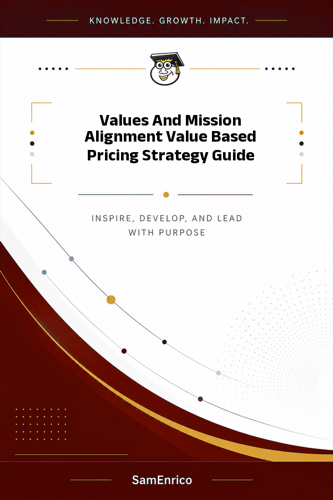
Values And Mission Alignment Value Based Pricing Strategy Guide eBook
Sets prices reflecting mission-driven value rather
by Vela Roseann
Sets prices reflecting mission-driven value rather than just costs.
Formats
Free sample
Chapter 1: The Time Sheet Trap...--–- The email arrived at 11:47 PM on a Tuesday. I remember because I was staring at my own time sheet, wondering how fourteen billable hours had become the measure of my professional worth. The client, a non-profit director with exhaustion etched into her voice, had written: “Your team logged 47 hours last month. Our grant only covers 40. Can you write off the extra 7?”She wasn’t asking for a discount.
She was asking me to validate my own value—and I couldn’t. Because I had built my entire pricing model on the assumption that my hours were my product. And when a customer questions the number of hours, they aren’t questioning your efficiency. They are questioning your right to exist at that price point.That was the moment I realized the time sheet was a trap. Not just for me, but for every mission-driven organization that confuses effort with impact, activity with outcome, and cost with value.This chapter is about why that trap exists, why it feels so reasonable, and why abandoning it is the single most important step you will take toward pricing your mission instead of your minutes.The Most Expensive Lie in Business Let me state this as clearly as I can: Your customers do not care how long something took you.They never have.
They never will.What they care about is the outcome. The transformation. The problem solved. The headache avoided. The mission advanced.
The cost-plus pricing model—where you tally up your labor hours, add your materials, slap on a standard margin, and present the total as your price—is built on a foundation of administrative convenience, not economic reality.Consider two consultants. Consultant A takes 50 hours to solve a complex regulatory problem for a client, saving them $2 million in potential fines. Consultant B takes 5 hours to solve the exact same problem because she has done it a hundred times before. Under cost-plus pricing, Consultant A bills more (50 hours × rate) and Consultant B bills less (5 hours × rate). The slower, less experienced consultant is rewarded.
The faster, more expert consultant is punished.Does that sound like rational pricing to you?Of course not. But this is exactly what happens every day in law firms, design agencies, consulting practices, software development shops, and even mission-driven non-profits that charge for “staff time” against grants. The time sheet creates a perverse incentive structure where inefficiency is profitable and expertise is a liability.Ron Baker, the preeminent thinker on value-based pricing, calls this the “labor theory of value”—the quaint 18th-century idea that the value of something is determined by the labor required to produce it. Adam Smith recognized this problem in 1776 when he noted the paradox that water (essential, zero labor to collect) is cheap while diamonds (useless, enormous labor to mine) are expensive. If labor determined value, water would be priceless.And yet, here we are in the 21st century, still pricing our missions by the hour.The Psychology of “Fairness” and Why It Destroys You Here is where the trap gets truly dangerous.
Cost-plus pricing feels fair. It feels transparent. It feels like you are being honest with the customer by showing them exactly what went into the work.This is an illusion.When you show a customer your cost breakdown—“$2,000 for labor, $500 for materials, $500 for overhead, plus our 20% margin equals $3,600”—you are not building trust. You are inviting an argument. The customer will immediately look for places to cut.
“Why does labor cost $2,000? Couldn’t a junior person do that part? Why is that material $500? I found it online for $400.” You have now shifted the conversation from value (what they will gain) to cost (what you spent). And you will lose that conversation every time, because there will always be a cheaper way to do something.The behavioral economists call this the “spotlight effect.” When you illuminate your internal costs, you direct the customer’s attention away from the only thing that actually matters: their willingness to pay for the outcome you provide.Worse, cost-plus pricing commoditizes your mission.
If your price is just a markup on hours, then you are fundamentally no different from any other provider of hours. The fact that you exist to advance a mission—to clean oceans, to educate children, to heal patients, to build sustainable communities—becomes irrelevant to the pricing conversation. You have voluntarily stripped the meaning from your own offer.I have watched mission-driven founders do this to themselves more times than I can count. A social enterprise that provides clean water to remote villages. A B Corp that manufactures eco-friendly building materials.
A therapy practice that offers sliding-scale services to underserved communities. Every single one of them started with a beautiful, compelling mission. And every single one of them, when asked about pricing, immediately defaulted to: “Well, it takes our team about X hours, and we pay them Y dollars, so we charge Z.”They buried their mission under a spreadsheet.The Mission Disconnect: Looking Backward Instead of Forward There is a deeper problem here, one that goes beyond economics into organizational psychology.Cost accounting is backward-looking. It asks: “What did we spend?” It tallies past hours, past materials, past overhead. It is a rearview mirror.
Mission alignment, by contrast, is forward-looking. It asks: “What impact can we create?” It imagines a future state for the customer—a problem solved, a life improved, a community strengthened.When you build your pricing on cost accounting, you train your entire organization to look backward. Your team starts tracking hours obsessively. They worry about utilization rates. They agonize over whether a task is “billable” or “non-billable.” They stop asking, “Is this creating value for the customer?” and start asking, “Can I log this time?”I have seen this happen in real time.
A design agency that prided itself on mission-driven work for climate non-profits. The founder genuinely cared about the cause. But she priced by the hour. Soon, her designers were inflating their time sheets (unconsciously, at first) because they knew the client would push back on any reduction. The agency became slower, less responsive, and more adversarial with clients.
The mission—helping climate organizations communicate effectively—was lost beneath a mountain of time-tracking software.The irony is that the customers felt it too. They sensed that the agency was watching the clock rather than solving their problems. Trust eroded. Relationships ended. And the founder couldn’t understand why, because her “costs were reasonable.”She had fallen into the mission disconnect: she thought her mission was the reason for her pricing, but her pricing mechanism (the time sheet) was actively undermining her mission.Why “Fair Pricing” Is Usually Just Low Pricing Many mission-driven leaders believe that “fair pricing” means low pricing.
They worry that charging a premium will exclude the very people they are trying to serve. They fear being seen as greedy or opportunistic.This is a misunderstanding of both fairness and value.Let me tell you about a clinic I consulted with. They provided mental health services to low-income families. Their mission was access and equity. They priced their sessions at $50 per hour—just enough to cover costs.
They felt good about this. They felt fair.But here is what happened: their waiting list grew to six months. Their…
This is the end of the free sample. Get the eBook to keep going. Buy now
About this book
Details
- Author
- Vela Roseann
- Publisher
- SamEnrico
- Language
- English
- Genre
- Non-Fiction, Business Brief, Pricing Strategy
- Released
- 2026-06-08
- Pages (approx.)
- 138
- Available as
- eBook, Audiobook

Read better in the ZLOADR app
Your eBooks on your phone or tablet. Sign in with your SamEnrico account and start reading.
More by Vela Roseann
 Mediterranean Myths DebunkedVela Roseann$11.99
 The Night Shift Stress GuideVela Roseann$11.99
 The Suicide Bereavement GuideVela Roseann$11.99
 Anchoring Influence MethodVela Roseann$11.99
 The Vanishing Masterpiece: The $160 Million Heist That Shocked the Art WorldVela Roseann$11.99
 Understanding Trigonocephaly Ptosis Mental RetardationVela Roseann$17.99
 Franchising into Mexico GuideVela Roseann$12.99
 Cash Flow Projection GuideVela Roseann$12.99
 How to Start a Dolomite (ground) Business (Beginners Guide)Vela Roseann$11.99
 Canoeing and KayakingVela Roseann$11.99
You may also like
 Hong Kong Handover 1997Dunn Johnnie$11.99
 Zumba For Postnatal Recovery CourseNeal Christian$11.99
 Zumba for BeginnersLadner Nikia$11.99
 YouTube Comment Mining GuideHumes Pandora$12.99
 Worry Box MeditationCarlin Rudy$11.99
 Workplace Stress MeditationNguyen Lynn$11.99
 Workplace Stress and Sleep RepairHawley Ivory$11.99
 Workplace Perfectionism CureDelaney Jeffry$11.99
 Workplace Injustice Anger GuideWallen Isabelle$11.99
 Work Addiction and Burnout LinkGreenwood Ester$11.99
 Women in Yoga and WellnessBeattie Galina$11.99
 Women in Stand Up ComedyChun Evangeline$11.99