
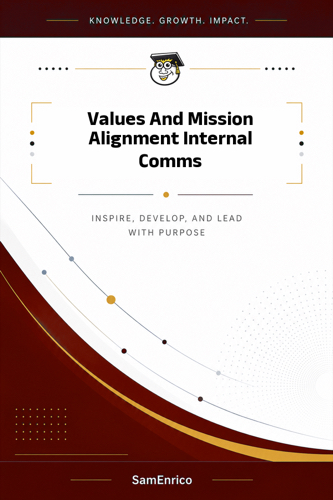
Non-FictionBusiness BriefInternal Communications
Values And Mission Alignment Internal Comms eBook
Reinforce mission through everyday employee commun
Reinforce mission through everyday employee communications using this practical messaging guide.
Formats
Free sample
Chapter 1: The Silent Drift--–- Most employees don’t wake up planning to ignore their company’s mission. They wake up planning to clear their inbox, attend back-to-back meetings, respond to their manager’s urgent request, and maybe—if time allows—think about the customer. The mission statement, beautifully framed in the lobby and laminated in their onboarding packet, simply doesn’t make the cut. Not because they don’t care. Because they don’t see the connection between that lofty language and the gritty reality of their daily grind.This gap between the mission on the wall and the work on the screen is not a failure of employee engagement.
It is a failure of internal communication. And it is the single most expensive, least-discussed problem in modern organizations.Let’s name it: the Alignment Gap.The Alignment Gap is the silent drift that occurs when the volume of transactional, logistical, and reactive messages drowns out the signal of purpose. Every day, in organizations of every size, employees receive dozens—sometimes hundreds—of internal communications. Password reset reminders. Policy updates.
Meeting invitations. Project status reports. Approval requests. None of these are bad. But most of them are empty of mission.
And when the vast majority of internal messages carry no values signal, the mission doesn’t just fade. It dies by a thousand cuts.This chapter diagnoses the Alignment Gap. It explains why mission drift happens not through malice or incompetence, but through fragmentation, siloed thinking, and the tyranny of the urgent. It introduces the core diagnostic tool that will anchor the rest of this book—the Mission-to-Message Ratio—and distinguishes between the two parallel communication systems that every organization must master: asynchronous written messages and synchronous meeting rituals. By the end of this chapter, you will see your organization’s internal communications differently.
You will see the drift. And you will understand why closing the Alignment Gap is the most important work you will ever do.The Framed Statement on the Wall Walk into almost any corporate office, and you will find it. Sometimes it is etched into a glass wall near reception. Sometimes it is printed on a sleek poster in the breakroom. Sometimes it appears as a footer in every email signature: “Our mission is to [insert inspiring verb] [insert customer group] by [insert noble outcome].”These statements are not wrong.
They are often genuinely inspiring. A healthcare company’s mission might be “to heal the sick with compassion and innovation.” A software company’s mission might be “to democratize access to financial tools for small businesses.” A nonprofit’s mission might be “to end childhood hunger in our lifetime.” These are worthy purposes. People join these organizations because they want to be part of something meaningful.And then they start working.The first week, the mission feels present. It is mentioned in orientation. A leader tells a story about a patient whose life was changed.
A customer testimonial plays during a town hall. But by week three, the mission has receded. By month six, it is invisible. By year two, when someone mentions it in a meeting, employees exchange glances that say, “Oh right, that thing.”What happened? The mission did not change.
The employees did not become cynical overnight. What changed was the communication environment. The volume of mission-free messages grew until it buried the mission entirely.This is the first hard truth of this book: Mission drift is not a culture problem. It is a communications problem. Culture is the result of repeated, reinforced communication over time.
Change the communication, and you will change the culture. But most organizations try to solve mission drift with more posters, more town halls, and more laminated cards. These are events. Alignment requires a system.The Anatomy of Random Acts of Comms To understand the Alignment Gap, we must first understand what fills it. The culprit is what we call Random Acts of Comms.Random Acts of Comms are messages sent without strategic intent, without a clear tie to organizational purpose, and often in reaction to the loudest stakeholder or the most recent fire.
They are not evil. They are not stupid. They are simply unmanaged. And they multiply like weeds in a garden that no one tends.Consider a typical Tuesday in a mid-sized organization. By 10:00 AM, employees have already received:An automated Slack notification from the CRM about a new lead (transactional)An email from IT about a scheduled server maintenance window (logistical)A calendar invitation for a cross-functional meeting with no agenda (reactive)A message from a colleague asking for an expedited approval (urgent, but not important)A company-wide announcement about a new hire in the accounting department (informational, but mission-neutral)None of these messages are bad.
The server does need maintenance. The new hire does deserve an announcement. But collectively, they create an environment in which the mission is completely absent. By the time a leader sends a message that actually ties to purpose—a customer win, a strategic shift, a values spotlight—employees are already suffering from notification fatigue. They skim.
They delete. They miss it.Random Acts of Comms have three defining characteristics:First, they are reactive. They respond to the latest request, the newest fire, the most recent complaint. There is no calendar, no rhythm, no intentionality. Communication happens when someone yells loud enough.Second, they are siloed.
Marketing sends marketing messages. Finance sends finance messages. HR sends HR messages. Each function optimizes for its own goals, not for the employee’s experience of a coherent, mission-driven organization. The result is not a chorus singing the same song.
It is a cacophony.Third, they are mission-neutral at best, mission-contradictory at worst. Most Random Acts of Comms simply have no values signal. They are empty calories. But some actively contradict the mission. A company that claims to value “transparency” sends an email about layoffs that is reviewed by legal six times and stripped of all useful information.
A company that claims to value “speed” implements a six-step approval process for every customer refund. The message—what employees actually hear—is not the mission statement. It is the lived experience of the process.The High Cost of Mission Drift Organizations pay for the Alignment Gap in four currencies. Each is measurable. Each is expensive.Currency One: Employee Disengagement.
Gallup has measured this for decades. Only about one-third of U.S. employees are engaged at work. The other two-thirds are either “not engaged” (showing up but checked out) or “actively disengaged” (working against the organization’s interests). Mission drift is a primary driver of disengagement.
When employees cannot see how their daily work connects to a larger purpose, they stop caring. They do their job, collect their paycheck, and go home. They do not innovate. They do not go the extra mile. They do not stay when a recruiter calls.Currency Two: Talent Turnover.
The cost of replacing a salaried employee is conservatively estimated at six to nine months of their salary. For a manager, that can exceed $50,000. For an executive, it can exceed $200,000. Mission-driven organizations have significantly lower turnover because employees feel a sense of belonging and significance. When the…
This is the end of the free sample. Get the eBook to keep going. Buy now
About this book
Details
- Author
- Thatcher Charline
- Publisher
- SamEnrico
- Language
- English
- Genre
- Non-Fiction, Business Brief, Internal Communications
- Released
- 2026-06-08
- Pages (approx.)
- 151
- Available as
- eBook, Audiobook

Read better in the ZLOADR app
Your eBooks on your phone or tablet. Sign in with your SamEnrico account and start reading.
More by Thatcher Charline
 Weekly Lessons LearnedThatcher Charline$11.99
 Breath Awareness For Mindfulness Based Stress ReductionThatcher Charline$11.99
 Franchise Builder's Food Truck LaunchThatcher Charline$11.99
 The Cosmic Symphony: How Voyager 1’s Golden Record Became Humanity’s Interstellar Love LetterThatcher Charline$11.99
 The Forgotten Bomb: How a Single Test in the Pacific Almost Changed HistoryThatcher Charline$11.99
 Understanding Hypertrophic MyocardiopathyThatcher Charline$17.99
 Prosthetic Bionic Limb GuideThatcher Charline$12.99
 Specialty Coding Career ManualThatcher Charline$12.99
 Leasing RepresentativeThatcher Charline$11.99Leasing RepresentativeThatcher Charline$11.99
 How to Start a Multigraphing Business (Beginners Guide)Thatcher Charline$11.99
You may also like
 Hong Kong Handover 1997Dunn Johnnie$11.99
 Zumba For Postnatal Recovery CourseNeal Christian$11.99
 Zumba for BeginnersLadner Nikia$11.99
 YouTube Comment Mining GuideHumes Pandora$12.99
 Worry Box MeditationCarlin Rudy$11.99
 Workplace Stress MeditationNguyen Lynn$11.99
 Workplace Stress and Sleep RepairHawley Ivory$11.99
 Workplace Perfectionism CureDelaney Jeffry$11.99
 Workplace Injustice Anger GuideWallen Isabelle$11.99
 Work Addiction and Burnout LinkGreenwood Ester$11.99
 Women in Yoga and WellnessBeattie Galina$11.99
 Women in Stand Up ComedyChun Evangeline$11.99