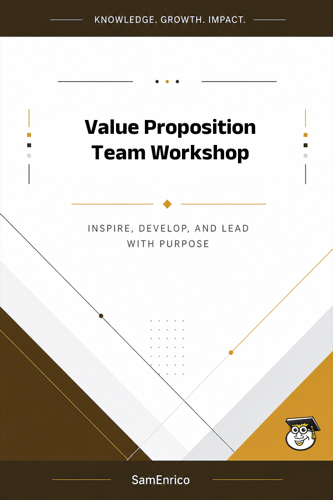
Value Proposition Team Workshop eBook
Articulate customer value collaboratively using th
Articulate customer value collaboratively using this group creativity guide.
Formats
Free sample
Chapter 1: The Vocabulary Trap...--–- Maria had been leading product at a fast-growing B2B Saa S company for three years when she found herself staring at a whiteboard that told her everything she needed to know about why her last quarter had failed.The whiteboard was divided into three columns. The left column, written in red marker by her Sales VP, read: "We save customers time." The middle column, written in blue marker by her Marketing Director, read: "We're the most innovative platform on the market." The right column, written in green marker by her Head of Engineering, read: "We offer 99.99% uptime with sub-50ms latency across all regions."Three columns. Three teams. Three completely different answers to the same question: What value do we actually deliver?Maria's CEO had called the meeting to finalize the company's new value proposition ahead of a major product launch. Instead, she got a turf war.
Sales argued that technical claims don't close deals. Marketing insisted that "innovation" was the only message that broke through the noise. Engineering refused to sign off on any statement that wasn't literally true down to the millisecond.The meeting ended with no agreement, a frustrated CEO, and a product launch now delayed by six weeks while Marketing rewrote the website for the fourth time.Maria's problem was not a bad product. Her problem was not a weak market. Her problem was a vocabulary trap—a seemingly invisible cage built from words that her team used every day, never realizing that those same words meant radically different things to different people.This chapter dismantles that trap.
It gives you the precise language you need to escape it, and it arms you with a shared vocabulary that transforms a room full of arguing executives into a team that can articulate value together. By the end of this chapter, you will never again confuse a feature with a benefit, a benefit with a value proposition, or a slogan with a testable hypothesis. More importantly, your entire team will stop talking past each other—and start building something they can all believe in.The Tower of Babel Problem in B2B Companies Every organization suffers from what linguists call semantic discord—the same words meaning different things to different people. In most companies, this is a minor nuisance. But when it comes to value propositions, semantic discord is catastrophic.Consider the word "value" itself.
Ask five different people in your organization what "value" means, and you will get five different answers.Sales thinks value means "what I can promise to close the deal."Marketing thinks value means "what differentiates us in a crowded market."Product thinks value means "what the software actually does."Customer Support thinks value means "what we can realistically deliver without causing a fire."Finance thinks value means "margins, lifetime value, and unit economics."None of these definitions is wrong. None is complete. And when a team tries to build a value proposition without first aligning on vocabulary, they are not collaborating—they are translating in real time, badly, under pressure, with millions of dollars at stake.The result is what I call The Value Vacuum—the empty space created when teams cannot agree on what value means. Nature abhors a vacuum, and so does business. Into that empty space rushes price pressure (if we can't agree on value, the customer decides based on cost), internal politics (whoever yells loudest fills the void with their definition), and feature bloat (we'll just add more stuff until something sticks).Every failed value proposition I have studied—and I have studied hundreds across B2B software, manufacturing, professional services, and healthcare—traces its root cause not to a bad product or a stupid customer, but to a vocabulary trap that the team never knew they were in.The Three Words That Destroy Alignment Most teams think they need better data, better research, or better customers.
They are wrong. They need better definitions for three common words that they use every day without ever realizing how those words are sabotaging them.Those three words are: feature, benefit, and value proposition.Teams that cannot distinguish among these three will never align on a message. Teams that can distinguish among them—clearly, consistently, as a reflex—can build consensus in hours instead of weeks.Let me define each one with surgical precision.Feature: What It Is A feature is a factual, verifiable attribute of your product or service. It contains no interpretation, no judgment, no claim about what the feature does for the customer. It simply describes what exists.Examples of features:"Our dashboard updates every 15 minutes.""We offer 256-bit encryption.""The software integrates with Salesforce via REST API.""We provide phone support 24 hours per day, 7 days per week.""Our mobile app is available for i OS and Android."Notice what these statements do not contain.
They do not say why any of this matters. They do not promise an outcome. They simply state a fact.The test for a feature is simple: Can you verify it with a screenshot, a log file, or a demonstration? If yes, it is a feature. If no, keep reading.Features are not bad.
Features are necessary. But features alone are insufficient because customers do not buy features—they buy what features do for them. A customer does not buy a drill bit because they want a drill bit. They buy a drill bit because they want a hole. The drill bit is the feature.
The hole is something else entirely.Benefit: What the Feature Does A benefit describes the direct, immediate result of a feature. It answers the question: "What happens when I use this feature?" Benefits are still one step removed from the customer's deeper motivations, but they are closer than features.Examples of benefits (mapped to the features above):Feature: "Dashboard updates every 15 minutes" → Benefit: "You always see current data."Feature: "256-bit encryption" → Benefit: "Your data is secure from unauthorized access."Feature: "Salesforce integration" → Benefit: "You don't have to manually copy data between systems."Feature: "24/7 phone support" → Benefit: "You can get help whenever you need it."Feature: "i OS and Android app" → Benefit: "You can use our product on your phone."Benefits are better than features. They translate product attributes into customer outcomes. But they still fall short of a true value proposition because they do not answer the most important question of all: So what?Let me show you why "so what" matters.A customer hears "You always see current data" and thinks, "So what? What does current data actually do for my business?" A customer hears "Your data is secure" and thinks, "So what?
Security is table stakes—every vendor says that." A customer hears "You don't have to manually copy data" and thinks, "So what? Manual copying takes ten minutes a week—I don't care."Benefits describe what a feature does. A value proposition describes what that outcome means to the customer's world.Value Proposition: The Economic or Functional Impact A value proposition describes the measurable, meaningful change that occurs in the customer's business or life because of the feature and its benefit. It answers the question: "So what does that actually get you in…
This is the end of the free sample. Get the eBook to keep going. Buy now
About this book
Details
- Author
- Keener Tristan
- Publisher
- SamEnrico
- Language
- English
- Genre
- Non-Fiction, Self-Help, Value Proposition
- Released
- 2026-06-07
- Pages (approx.)
- 149
- Available as
- eBook, Audiobook

Read better in the ZLOADR app
Your eBooks on your phone or tablet. Sign in with your SamEnrico account and start reading.
More by Keener Tristan
 Work Self Esteem HandbookKeener Tristan$11.99
 Novak Djokovic Mental MasteryKeener Tristan$11.99
 Menopause Hair Texture GuideKeener Tristan$11.99
 SEAL VBSS Team LeaderKeener Tristan$11.99
 The Djinn King’s Last Lesson: Wisdom from the Smokeless FlameKeener Tristan$11.99
 The Deep Blue Hunt: Neutrinos Beneath the AtlanticKeener Tristan$11.99
 Collection ManagerKeener Tristan$11.99
 ESL Certification ComparisonKeener Tristan$12.99
 Creative Economy HandbookKeener Tristan$12.99
 Understanding Gamma-sarcoglycanopathyKeener Tristan$17.99
 How to Become a Jewelry CoaterKeener Tristan$11.99