
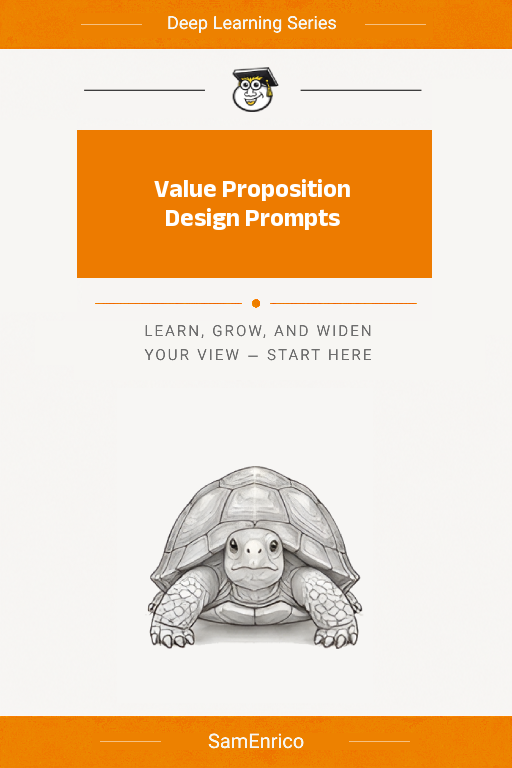
Non-FictionAI OperatorValue Prop
Value Proposition Design Prompts eBook
Craft prompts that articulate value propositions f
Craft prompts that articulate value propositions from customer pains and gains data for business analysts.
Formats
Free sample
Chapter 1: The Translation Gap--–- The email arrived at 2:47 PM on a Tuesday. Sandrine, a senior business analyst at a mid-sized logistics software company, had just finished her third customer interview of the day. The subject line read: "Urgent: Dashboard feature request from top client." The body contained a single sentence from a logistics manager named Carlos: "Your dashboard is too slow. I need something that just works. Can you build a faster dashboard?"Sandrine had seen this pattern before.
She forwarded the email to her product team with a note: "Customer pain: dashboard performance. Proposed solution: optimize query times and reduce initial load to under 2 seconds." The team spent six weeks refactoring the database, rewriting the API layer, and deploying a demonstrably faster dashboard. The day of release, Sandrine called Carlos. His response? "Oh, that's nice.
But the real problem is I have to log into three different systems to track a single shipment. Can you fix that instead?"Six weeks. Zero revenue impact. A feature nobody asked for, solving a problem that wasn't the real problem.This is the Translation Gap. And it is the single most expensive failure mode in business analysis.The Pain Every BA Knows but Rarely Names Let me be direct with you.
If you have ever:– Spent weeks building a feature based on a customer's explicit request, only to watch it go unused– Presented a value proposition you were certain would resonate, only to be met with blank stares– Looked at a spreadsheet full of customer interview transcripts and felt completely unable to summarize what actually matters– Delivered a "data-driven" recommendation that your stakeholders immediately challenged as biased...then you have personally experienced the Translation Gap.Here is the brutal truth that no one tells you in business school: raw customer data does not translate directly into value propositions. It never has. It never will. The gap between what customers say and what they mean, between what they request and what they need, between the data you collect and the insight you require is where value propositions go to die.I have watched teams at startups, scale-ups, and Fortune 500 companies make the same mistake over and over. They collect data rigorously.
They conduct interviews faithfully. They transcribe calls, tag support tickets, and analyze survey responses. And then they attempt to move directly from this raw material to a value proposition. They skip the translation layer. And they fail.The cost of this failure is not theoretical.
It is measured in engineering hours, opportunity cost, delayed revenue, and ultimately, careers. The BA who champions a feature that flops loses credibility. The product manager who launches a value proposition that doesn't resonate gets overruled. The startup that builds what customers ask for instead of what they need runs out of runway.This book exists because I have seen the alternative. I have watched BAs who master the Translation Gap consistently deliver value propositions that resonate, features that get used, and insights that stakeholders trust.
They do not have better data than you. They do not have more expensive tools. They have a structured approach to translation. They use prompts.But before I show you the solution, we must understand the enemy.The Curse of Knowledge: Why Experts Make Terrible Customers The primary culprit of the Translation Gap is a cognitive bias so powerful and so invisible that even knowing about it does not fully protect you from it. It is called the Curse of Knowledge.The Curse of Knowledge was first documented by economists Colin Camerer, George Loewenstein, and Martin Weber in 1989, but it was popularized by Chip and Dan Heath in their book Made to Stick.
The core insight is devastatingly simple: once you know something, it becomes nearly impossible to imagine not knowing it. Your brain literally cannot return to a state of ignorance.For the business analyst, this curse is professional poison.You know how your product works. You know the architecture, the database schema, the API endpoints, the business logic, the edge cases, the workarounds. You have internalized the product's internal logic to the point where it feels like common sense. And because it feels like common sense, you assume your customers share your understanding.
They do not.When Carlos said "your dashboard is too slow," what did he actually mean? The Curse of Knowledge whispered to Sandrine: "He means the query execution time. Optimize the database." But Carlos, who knows nothing about the database, meant something entirely different. He meant: "I feel anxious every time I open this dashboard because I never know if the information I need will appear before my boss asks for it. I feel incompetent because I have to keep three other tabs open as backups.
I feel frustrated because the thing that was supposed to make my life easier is making it harder."Carlos did not request a database optimization. He expressed a bundle of functional, social, and emotional pains. Sandrine heard a technical request because the Curse of Knowledge translated his human frustration into her technical vocabulary.This happens thousands of times every day in every product organization. A customer says: "The onboarding is confusing." The BA hears: "We need a tutorial video." A customer says: "I can never find the export button." The BA hears: "Move the export button to the top navigation." A customer says: "The reporting is limited." The BA hears: "Add three more chart types."In every case, the BA has taken a raw expression of human experience and immediately jumped to a solution. They have skipped the translation step.
They have assumed that the customer's surface-level complaint maps directly to a surface-level fix. And they have been wrong often enough that every experienced BA has a graveyard of unused features to prove it.The Curse of Knowledge does not make you stupid. It makes you efficient in exactly the wrong way. It allows you to move quickly from problem to solution without passing through understanding. And speed without understanding is just speed toward the wrong destination.Why Raw Data Is Not Insight (And Why Most Analytics Are Wasted)Let me make a distinction that will shape everything that follows in this book.
Data and insight are not the same thing. They are not even close.Data is raw. Data is abundant. Data is cheap. Data is the exhaust of customer activity: transcripts, tickets, clicks, calls, surveys, logs, reviews.
You have more data than you could ever process. Your company is drowning in data and starving for insight.Insight is refined. Insight is rare. Insight is expensive. Insight is the pattern that emerges after data has been structured, filtered, interpreted, and translated.
Insight is what allows you to predict behavior, design solutions that work, and communicate value that resonates.The Translation Gap is the space between these two states. Most BAs try to jump directly from data to insight. They read a transcript and think "aha, they want X." They see a support ticket and think "aha, we need Y." This is not analysis. This is pattern-matching bias disguised as expertise.Let me give you a concrete example. Consider the following three pieces of raw customer data:"It takes too many clicks to…
This is the end of the free sample. Get the eBook to keep going. Buy now
About this book
Details
- Author
- Canales Criselda
- Publisher
- SamEnrico
- Language
- English
- Genre
- Non-Fiction, AI Operator, Value Prop
- Released
- 2026-06-01
- Pages (approx.)
- 148
- Available as
- eBook, Audiobook

Read better in the ZLOADR app
Your eBooks on your phone or tablet. Sign in with your SamEnrico account and start reading.
More by Canales Criselda
 Work Life Integration Burnout CourseCanales Criselda$11.99
 Stoma Self Esteem WorkbookCanales Criselda$11.99
 Premature Baby Sleep GuideCanales Criselda$11.99
 Dwan Western PulpCanales Criselda$11.99
 Navigating Layoff and Firing ConversationsCanales Criselda$11.99
 The Vanishing Vermeer: The 1932 Heist That Shook the Art WorldCanales Criselda$11.99
 Understanding MesomeliaCanales Criselda$17.99
 How to Become a Needle-loom TenderCanales Criselda$11.99
 Systems SupportCanales Criselda$11.99
 UAE Data Protection Law GuideCanales Criselda$12.99
You may also like
 Hong Kong Handover 1997Dunn Johnnie$11.99
 Zumba For Postnatal Recovery CourseNeal Christian$11.99
 Zumba for BeginnersLadner Nikia$11.99
 YouTube Comment Mining GuideHumes Pandora$12.99
 Worry Box MeditationCarlin Rudy$11.99
 Workplace Stress MeditationNguyen Lynn$11.99
 Workplace Stress and Sleep RepairHawley Ivory$11.99
 Workplace Perfectionism CureDelaney Jeffry$11.99
 Workplace Injustice Anger GuideWallen Isabelle$11.99
 Work Addiction and Burnout LinkGreenwood Ester$11.99
 Women in Yoga and WellnessBeattie Galina$11.99
 Women in Stand Up ComedyChun Evangeline$11.99