
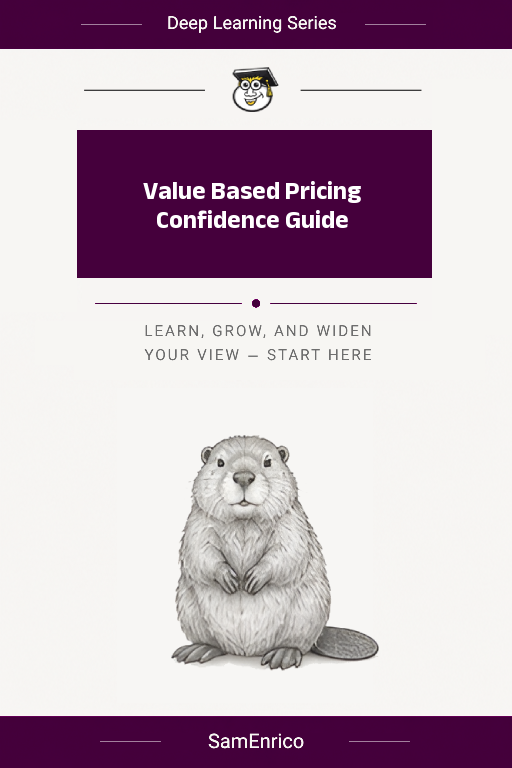
Non-FictionFirst 30 DaysValue Pricing
Value Based Pricing Confidence Guide eBook
Prices based on customer value rather than costs,
Prices based on customer value rather than costs, building confidence in premium pricing without fear of losing sales.
Formats
Free sample
Chapter 1: The Discounting Disease--–- It happens in conference rooms every hour of every business day. A salesperson, armed with data, a genuine solution, and the authority to close a deal, looks across the table at a buyer and says, “I can probably find another 5% for you.” The buyer smiles. The salesperson feels a flicker of relief. The deal closes. And the company just left 50,000,50,000, 50,000,500,000, or $5 million on the table—not because the product was overpriced, but because the seller was infected with a chronic, undiagnosed condition.That condition is the Discounting Disease.
Its symptoms are subtle but deadly. Preemptive discounting—lowering the price before the customer even asks. Self-doubt disguised as pragmatism (“We’re lucky to get any deal”). A strange pride in being the “affordable option.” The clinical term among pricing economists is the White Horse Syndrome: the tendency to believe that your price is a problem to be solved rather than a reflection of value to be defended. This chapter is the diagnosis.
And the first step toward a cure.The $8 Trillion Leak Let us begin with a number so large it borders on abstraction: $8 trillion. That is the approximate annual revenue lost globally to unnecessary discounting, according to aggregated data from the Professional Pricing Society and Bain & Company. To put it in perspective, if you eliminated every instance of fear-based discounting tomorrow, you would generate more economic value than the entire GDP of Japan. No new customers. No new products.
No layoffs. Just the simple act of not cutting your own price before you have to.But the real damage is not macroeconomic. It is personal. Consider the math that every business leader should have tattooed on their forearm. A 1% improvement in price—not volume, not cost reduction, just price—increases operating profit by an average of 8%.
This is not a hypothetical. It is the consistent finding of dozens of studies across industries, most famously by Hermann Simon and later confirmed by Hinterhuber’s meta-analysis of 1,200 companies. Compare that to a 1% reduction in variable costs, which yields only a 3% profit increase, or a 1% increase in volume, which yields a measly 2.5% increase (assuming you can even achieve volume growth without additional marketing spend). Price is the most powerful lever you have, and most sellers are leaning on it backward.Here is a simple test. Imagine your company does 20millioninannualrevenuewitha1020 million in annual revenue with a 10% net margin—20millioninannualrevenuewitha102 million in profit.
If you raise your average selling price by just 1% (not every deal, just the average), and everything else stays the same, your profit jumps to 2.16million.Thatisanextra2.16 million. That is an extra 2.16million.Thatisanextra160,000 for doing nothing except not discounting. Now multiply that by the number of deals you close each year. Still think a 5% discount is “no big deal”?What Is the White Horse Syndrome?The term “White Horse Syndrome” comes from an old sales parable. A traveling merchant is asked the price of his magnificent white horse.
He looks at the horse, then at the buyer, and says, “He is not for sale.” The buyer insists. The merchant names a price three times what the horse is worth. The buyer pays it without negotiation—because the merchant communicated, from the first moment, that this horse was valuable and that he had no fear of walking away. The syndrome, ironically, is the opposite: the seller who assumes the buyer will refuse the listed price and therefore rushes to offer a discount before any resistance appears. You have seen it a thousand times.
“Our list price is 10,000,but Icando10,000, but I can do 10,000,but Icando8,500 for you.” The buyer, who had not yet objected, now knows two things: first, that $8,500 is the real price, and second, that the seller is desperate enough to offer a discount without being asked.This is not negotiation. This is unilateral disarmament.Procurement departments are exquisitely trained to exploit this fear. In a study of 500 B2B procurement professionals, 78% reported that their first negotiation tactic is simply to say, “Your price is too high,” with no justification. They do this because it works 60% of the time. The second tactic is silence—the long, uncomfortable pause after a price is quoted.
Sellers, desperate to fill the void, rush to fill it with a discount. The third tactic is the “good cop, bad cop” routine: one buyer walks out of the room, another expresses sympathy, and the seller gratefully offers a concession to “salvage the relationship.”You are not being out-negotiated. You are being out-psychologied. And the only defense is to recognize that the fear of losing a deal is almost always greater than the actual risk of losing it.The Cost-Plus Delusion Most sellers who suffer from the Discounting Disease are not bad people. They are rational actors responding to the incentives and training they have received.
And the training usually sounds something like this: “Determine your costs, add your desired margin, and that is your price.” This is cost-plus pricing. It is simple. It is intuitive. And it is completely, catastrophically wrong for one simple reason: your customer does not care about your costs.Think about it. When you buy a cup of coffee, do you ask the barista about the rent, the labor costs, or the wholesale price of beans?
Of course not. You care about the taste, the convenience, the warmth of the cup in your hand, and the 15 minutes of peace it buys you. The same is true in B2B. A manufacturing executive does not care that your raw material costs went up. He cares whether your machine reduces his downtime from 10% to 2%.
A hospital administrator does not care about your R&D budget. She cares whether your device reduces readmission rates and saves her from regulatory fines. Cost-plus pricing is inward-looking. Value-based pricing is outward-looking. One asks, “What do we need?” The other asks, “What are you worth?”Here is the cruel irony.
Cost-plus pricing actually reduces your confidence. Because when you lead with costs, the customer’s natural response is, “I don’t care about your costs. What can I get it for?” You have no answer to that question except to start defending your internal operations—a conversation you will always lose. Value-based pricing, by contrast, shifts the conversation to the customer’s world. “Based on our analysis, your current process costs you 500,000peryearinwaste.Oursolutioneliminates80500,000 per year in waste.
Our solution eliminates 80% of that waste. That is 500,000peryearinwaste.Oursolutioneliminates80400,000 in savings. Our price is 100,000.Younet100,000. You net 100,000.Younet300,000 in year one.” Now the customer is not negotiating against your costs. They are negotiating against their own inefficiency.
That is a battle you can win.The 20-30-50 Rule of Discounting Damage Let me share a piece of data that should terrify you. In a longitudinal study of 10,000 B2B transactions, researchers found that the average discount from list price across all industries was 23%. That means for every 100ofpotentialrevenue,companiesvoluntarilyleft100 of potential revenue, companies voluntarily left 100ofpotentialrevenue,companiesvoluntarilyleft23 on the table. But the distribution was not uniform. The worst offenders—the bottom quartile—discounted by an average of 42%.
The best performers—the top quartile—discounted by only 11%. The difference in profit between those two groups was staggering: 340% higher…
This is the end of the free sample. Get the eBook to keep going. Buy now
About this book
Details
- Author
- Jacobson Angeline
- Publisher
- SamEnrico
- Language
- English
- Genre
- Non-Fiction, First 30 Days, Value Pricing
- Released
- 2026-05-30
- Pages (approx.)
- 146
- Available as
- eBook, Audiobook

Read better in the ZLOADR app
Your eBooks on your phone or tablet. Sign in with your SamEnrico account and start reading.
More by Jacobson Angeline
 Regional Logistics GrowthJacobson Angeline$11.99
 The Arthritis and Lung Disease GuideJacobson Angeline$11.99
 Assertiveness for PTSDJacobson Angeline$11.99
 Breville Espresso Machine RaceJacobson Angeline$11.99
 The Crypto Gambling AddictionJacobson Angeline$11.99
 The Architects of the Sky: Nubia's Lost Pyramids of MeroëJacobson Angeline$11.99
 Squad Technical LeadJacobson Angeline$11.99
 Arabic Business Etiquette GuideJacobson Angeline$12.99
 Understanding SilicosisJacobson Angeline$17.99
 How to Become a Orthodontic TechnicianJacobson Angeline$11.99
You may also like
 Hong Kong Handover 1997Dunn Johnnie$11.99
 Zumba For Postnatal Recovery CourseNeal Christian$11.99
 Zumba for BeginnersLadner Nikia$11.99
 YouTube Comment Mining GuideHumes Pandora$12.99
 Worry Box MeditationCarlin Rudy$11.99
 Workplace Stress MeditationNguyen Lynn$11.99
 Workplace Stress and Sleep RepairHawley Ivory$11.99
 Workplace Perfectionism CureDelaney Jeffry$11.99
 Workplace Injustice Anger GuideWallen Isabelle$11.99
 Work Addiction and Burnout LinkGreenwood Ester$11.99
 Women in Yoga and WellnessBeattie Galina$11.99
 Women in Stand Up ComedyChun Evangeline$11.99