
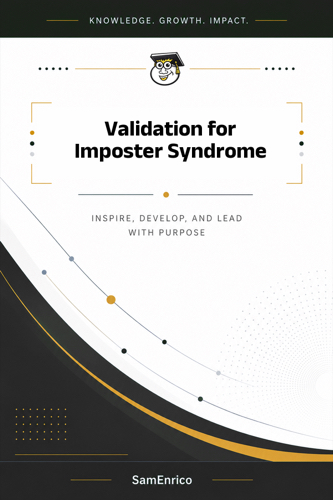
Non-FictionSelf-HelpImposter Syndrome
Validation for Imposter Syndrome eBook
Support high achievers by validating feelings of f
by Duval Elicia
Support high achievers by validating feelings of fraudulence without empty praise.
Formats
Free sample
Chapter 1: The Bridge, Not the Destination...--The first time someone told me “You’ve got this,” I was twenty-four years old, sitting in a windowless conference room, and I had just admitted to my manager that I had no idea how to complete the project I had been assigned. I expected her to reassign the work, or to mentor me through it, or at the very least to acknowledge that the task was objectively difficult for someone with my level of experience. Instead, she smiled warmly and said, “You’re amazing. Stop being so hard on yourself. You’ve got this.”And I felt worse.Not because she was unkind.
She was genuinely trying to help. I felt worse because her words landed in my chest like a door slamming shut. She had just told me that my fear was invalid. She had just implied that my assessment of my own competence was wrong. She had just praised me for something I knew, with absolute certainty, that I did not yet possess.
And now, on top of the original fear of failing at the project, I had a new layer of shame: the shame of not being able to accept a compliment, the shame of feeling like a fraud even when someone believed in me, and the quiet, awful suspicion that if she really knew what was happening inside my head, she would not have said “you’ve got this.” She would have said “you need help.”That moment was not unusual. It was not a failure of management or a uniquely fragile response. That moment is happening right now, in thousands of offices, classrooms, hospitals, and homes, between high achievers and the people who care about them. A high achiever says, “I feel like I don’t know what I’m doing.” A well-meaning friend, partner, or manager says, “You’re amazing. You belong here.
You’ve got this.” And the high achiever walks away feeling more alone, more fraudulent, and more certain that their internal experience cannot be shared with anyone.This book exists because that exchange is broken. And it is broken not because the high achiever is too sensitive, and not because the supporter is too clueless. It is broken because we have been taught a fundamental error about what imposter syndrome actually needs. We have been taught that the antidote to feeling like a fraud is praise, reassurance, and confidence-building. That is wrong.
The antidote to feeling like a fraud is validation—not the soft, soothing kind that tells you everything is fine, but the sharp, accurate kind that says, “Of course you feel this way. Given what you know and what you don’t yet know, that feeling makes perfect sense.”This chapter will introduce the central problem that the rest of the book solves: the paradox of praise. You will learn why “you’ve got this” makes it worse, why high achievers reject reassurance even when they desperately want to believe it, and what to say instead. You will also meet the central argument that will guide every chapter to follow: you do not need to believe in yourself to act competently. External validation is a bridge, not a destination.
You will need it less over time. But telling someone in acute imposter distress to “just validate yourself” is like giving a drowning person swimming lessons. First, you throw them a rope. Then you teach them to swim.The Compliment Trap Let us name the mechanism that no one talks about. When a high achiever shares feelings of fraudulence, they are not asking for praise.
They are asking for their reality to be seen. But the listener, trained by a culture that equates support with positivity, responds with what feels like the kindest available option: reassurance. And reassurance, when delivered to a high achiever, triggers what I call the compliment trap.The compliment trap has three steps.Step one: The high achiever expresses doubt. “I don’t think I’m qualified for this promotion.” “I feel like everyone in the room knows more than I do.” “I got lucky on that last project, and now they’re going to find me out.”Step two: The listener offers praise. “You’re so talented.” “You deserve to be here.” “You’ve got this.”Step three: The high achiever internally rejects the praise.
Not because they are humble or modest in some virtuous way, but because the praise directly contradicts their internal evidence. They know the gaps in their knowledge. They remember the moment last week when they didn’t know the answer. They have a running list of everything they have not yet mastered. The praise feels not only untrue but dangerous—because if they accept it, they will be expected to live up to it.
And they are already certain they cannot.Here is what happens next, and this is the part that most advice overlooks. After rejecting the praise internally, the high achiever then feels shame about the rejection. They think: “Why can’t I just take a compliment? What is wrong with me that I can’t believe someone who is clearly trying to help?” The original fear of incompetence is now joined by a second fear: the fear that they are broken for not being able to receive kindness.This is the paradox of praise. Praise, intended to reduce imposter feelings, actually amplifies them.
It adds shame on top of doubt. It isolates the high achiever further because now they have two secrets: “I don’t belong here” and “I can’t even accept reassurance like a normal person.”I have seen this pattern in software engineers with a decade of experience, in surgeons who have performed thousands of procedures, in tenured professors with decorated careers, and in executives who manage budgets larger than most small countries. The pattern does not fade with success. It intensifies, because success brings higher visibility, greater expectations, and more opportunities to feel like the next failure will be the one that finally exposes you.Why “You’ve Got This” Backfires The phrase “you’ve got this” has become a reflexive comfort blanket in modern workplaces and relationships. It is meant to convey confidence, solidarity, and encouragement.
But for a high achiever with imposter syndrome, it lands as a dismissal. Let me explain why with three psychological mechanisms.First, “you’ve got this” is a prediction about future performance. The high achiever, who has spent years calibrating their internal sense of competence against actual outcomes, knows that they do not yet have the information required to make that prediction. They are not being modest. They are being accurate.
They can list three specific gaps in their knowledge that make success uncertain. The phrase “you’ve got this” ignores those gaps. It says, in effect, “Your assessment of your own readiness is wrong.” And because the high achiever trusts their own gap analysis more than they trust your generic reassurance, they conclude that you do not understand the situation.Second, “you’ve got this” places a demand on the high achiever. Once you have said they have it, they must now prove that you were right. The stakes have been…
This is the end of the free sample. Get the eBook to keep going. Buy now
About this book
Details
- Author
- Duval Elicia
- Publisher
- SamEnrico
- Language
- English
- Genre
- Non-Fiction, Self-Help, Imposter Syndrome
- Released
- 2026-06-08
- Pages (approx.)
- 158
- Available as
- eBook, Audiobook

Read better in the ZLOADR app
Your eBooks on your phone or tablet. Sign in with your SamEnrico account and start reading.
More by Duval Elicia
 Immigrant Cleaning Service To EmpireDuval Elicia$11.99
 Metta For Strangers PracticeDuval Elicia$11.99
 Wholesaling Cash Buyer ListsDuval Elicia$11.99
 Eisenhower For Social MediaDuval Elicia$11.99
 The Whip and the WordDuval Elicia$11.99
 Imposter Syndrome Origin HealingDuval Elicia$11.99
 Commitment Consistency TrapDuval Elicia$11.99
 Bengal Army DissolutionDuval Elicia$11.99
 The Whale Who Saved the River: The True Story of Luna and the Orca RescueDuval Elicia$11.99
 The Last Stand of the Iron GateDuval Elicia$11.99
 The 19th Amendment: A Century of SuffrageDuval Elicia$11.99
 The Mineral Guide to PyrolusiteDuval Elicia$11.99
You may also like
 Hong Kong Handover 1997Dunn Johnnie$11.99
 Zumba For Postnatal Recovery CourseNeal Christian$11.99
 Zumba for BeginnersLadner Nikia$11.99
 YouTube Comment Mining GuideHumes Pandora$12.99
 Worry Box MeditationCarlin Rudy$11.99
 Workplace Stress MeditationNguyen Lynn$11.99
 Workplace Stress and Sleep RepairHawley Ivory$11.99
 Workplace Perfectionism CureDelaney Jeffry$11.99
 Workplace Injustice Anger GuideWallen Isabelle$11.99
 Work Addiction and Burnout LinkGreenwood Ester$11.99
 Women in Yoga and WellnessBeattie Galina$11.99
 Women in Stand Up ComedyChun Evangeline$11.99