
Non-FictionSelf-HelpFirst Responder
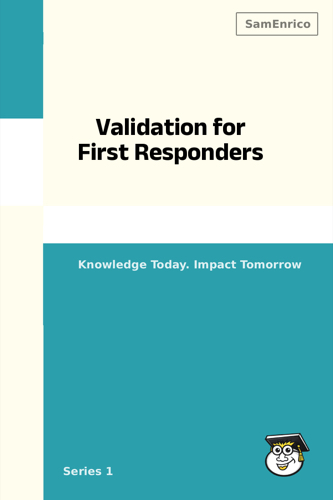
Validation for First Responders eBook
Support victims and colleagues with emotional firs
by Solis Erline
Support victims and colleagues with emotional first aid.
Formats
Free sample
Chapter 1: The Unspoken Weight...--It begins with a sound you never forget.Not the scream—though that comes later. Not the sirens—though those are already fading in your memory. It begins with the sound of your own heartbeat, suddenly too loud in your ears, and the strange realization that your hands are shaking even though the call ended twenty minutes ago.You're sitting in the rig. The lights are off. Your partner is already inside, grabbing coffee, laughing about something that happened yesterday.
Normal. Ordinary. And you cannot move.Because every time you close your eyes, you see her face. The mother. The one who looked at you—not with gratitude, not with relief, but with something worse than anger.
She looked at you with expectation. And you had nothing to give her.You did everything right. You ran the protocols. You checked the airway, the breathing, the circulation. You called for transport.
You handed off to the ER with a perfect verbal report. By every measurable standard, you did your job.But you didn't say the one thing she needed to hear. You didn't know what that thing was. And now, three hours later, her face is still there. Waiting.
Asking.This chapter is about that face. It is about the invisible gap between what we are trained to do and what our victims, our colleagues, and our own hearts actually need. It is about the weight we carry that never makes it onto the incident report.And it is about the first, most important truth of this book: validation is not a soft skill. It is a survival skill.The Crisis No One Talks About Let us begin with numbers, because numbers do not lie, and the numbers are terrifying.In 2022, more firefighters and police officers died by suicide than in the line of duty. Not for the first time.
For the ninth consecutive year. The Ruderman Family Foundation found that the rate of suicide among first responders is anywhere from 18 to 40 percent higher than the general population, depending on the study and the agency.Think about that for a moment.We train for structure fires, active shooters, hazardous materials, high-speed extractions. We spend hours on the range, in the burn building, on the ambulance simulator. We carry tourniquets, Narcan, defibrillators. We prepare for the worst physical threats the world can throw at us.And then we go home and die by our own hands.Not because we are weak.
Not because we are broken. But because the weight of what we carry has no release valve. Because we have been taught, from our very first day at the academy, that toughness means silence. That asking for help is a sign of failure. That the only good responder is the one who feels nothing and moves on to the next call.That teaching is killing us.The stats tell the rest of the story: divorce rates among first responders approach seventy percent in some specialties.
Substance abuse is estimated at double the national average. Early retirement due to psychological attrition—burnout, compassion fatigue, undiagnosed post-traumatic stress—has become a staffing crisis in departments across the country.And here is the cruelest irony: the very traits that make an excellent responder—decisiveness, emotional control, focus under pressure—become obstacles when turned inward. The same mental discipline that allows you to walk into a burning building makes it nearly impossible to admit that you are struggling. The same emotional regulation that lets you deliver a death notification with dignity leaves you unable to cry in your own kitchen.We have built a culture of invulnerability. And invulnerability is a lie.The Paramedic Paradox There is a phenomenon in emergency medicine known informally as the "paramedic paradox." It goes like this: the more competent you become at managing trauma, the less competent you become at recognizing your own.Think about your training.
From day one, you were taught to assess, prioritize, and act. You learned to compartmentalize—to put the horror of one call in a box and open the box for the next call. You learned that hesitation kills, that emotion clouds judgment, that the professional responder is a calm island in a sea of chaos.All of that is true on the scene. All of it is necessary.But the brain does not distinguish between "on the scene" and "off the scene" as cleanly as we pretend. The same neural pathways that allow you to suppress your emotions during a pediatric arrest do not magically reopen when you get home.
They become stronger. They become habits. They become who you are.And then one day, you are sitting in your car in the driveway, and you cannot get out. Or you are lying next to your spouse, and you feel nothing. Or you are staring at a bottle, and you are not sure if you are drinking to relax or drinking to disappear.The paradox is this: the skills that save lives on the truck are destroying lives off it.But here is what no one tells you.
There is a way out of the paradox. It is not about feeling more. It is not about breaking down on every call or becoming a weeping witness to every tragedy. That is not sustainable, and it is not professional.The way out is emotional first aid.What Is Emotional First Aid?You already know physical first aid. You know that when you see a bleeding artery, you do not stand around discussing the patient's childhood.
You apply direct pressure. You elevate. You tourniquet if you have to. You stop the bleed before you worry about the long-term recovery.Emotional first aid is the same thing.When a person is in the middle of an acute stress response—panic, rage, hysteria, dissociation—their brain is not functioning normally. The amygdala, the brain's alarm system, has hijacked the show.
Cortisol and adrenaline are flooding their system. The prefrontal cortex, the part of the brain responsible for logic, impulse control, and decision-making, has gone offline.In that state, you cannot reason with them. You cannot educate them. You cannot ask them to sign a form or answer a series of questions about their medical history.What you can do is stabilize them. You can lower their physiological arousal.
You can bring their nervous system back to baseline. You can stop the emotional bleed so that they can access the rational parts of their brain again.That is emotional first aid. And the primary tool of emotional first aid is validation.Validation vs. Agreement: The Distinction That Changes Everything Here is where most responders get confused. They hear "validation" and they think it means agreeing with everything the person says, endorsing dangerous behavior, or abandoning professional boundaries.That is not validation.
That is a caricature of validation.Validation is the act of communicating to another person that their emotional experience makes sense given the circumstances. It is not about the content of their behavior; it is about the context of their feelings.Agreement is about the content. Agreement says, "What you did was right." Validation says, "Given what you just experienced, it makes sense that…
This is the end of the free sample. Get the eBook to keep going. Buy now
About this book
Details
- Author
- Solis Erline
- Publisher
- SamEnrico
- Language
- English
- Genre
- Non-Fiction, Self-Help, First Responder
- Released
- 2026-06-07
- Pages (approx.)
- 132
- Available as
- eBook, Audiobook

Read better in the ZLOADR app
Your eBooks on your phone or tablet. Sign in with your SamEnrico account and start reading.
More by Solis Erline
 Pharmacology Palace GuideSolis Erline$11.99
 Assertive Negotiation SkillsSolis Erline$11.99
 Failed Exam NightmaresSolis Erline$11.99
 The Vacuum Device GuideSolis Erline$11.99
 Wholesaling LLC FormationSolis Erline$11.99
 ED and Heart Disease ConnectionSolis Erline$11.99
 Sleep Deprivation MitigationSolis Erline$11.99
 The Quantum Echo: How Einstein’s 1905 Thought Experiment Predicted the FutureSolis Erline$11.99
 The Last Stand at Dien Bien Phu: Viet Minh's Triumph Over the French EmpireSolis Erline$11.99
 How to Produce False Eyelash AccessoriesSolis Erline$11.99
 How to Become a Bead StringerSolis Erline$11.99
 Pinterest SEO for VA ClientsSolis Erline$12.99
You may also like
 Hong Kong Handover 1997Dunn Johnnie$11.99
 Zumba For Postnatal Recovery CourseNeal Christian$11.99
 Zumba for BeginnersLadner Nikia$11.99
 YouTube Comment Mining GuideHumes Pandora$12.99
 Worry Box MeditationCarlin Rudy$11.99
 Workplace Stress MeditationNguyen Lynn$11.99
 Workplace Stress and Sleep RepairHawley Ivory$11.99
 Workplace Perfectionism CureDelaney Jeffry$11.99
 Workplace Injustice Anger GuideWallen Isabelle$11.99
 Work Addiction and Burnout LinkGreenwood Ester$11.99
 Women in Yoga and WellnessBeattie Galina$11.99
 Women in Stand Up ComedyChun Evangeline$11.99