
Non-FictionSelf-HelpEmotional Regulation
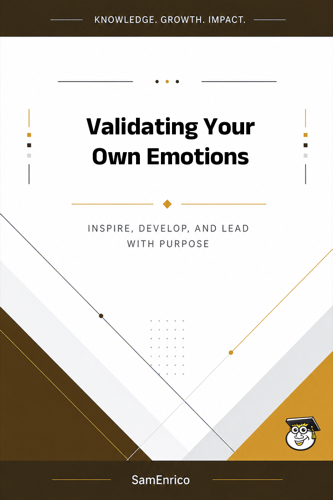
Validating Your Own Emotions eBook
Acknowledge your feelings without judgment.
Acknowledge your feelings without judgment.
Formats
Free sample
Chapter 1: The Empty Bucket--–- Every morning, Maria wakes up and checks her phone before she opens her eyes. The first thing she sees is not the ceiling or the sunlight or her partner’s face. It is a screen full of notifications—likes, comments, messages, emails. Each little red badge feels like a small gift. Each ping sounds like proof that she exists.
And yet, by noon, she feels hollow again. By evening, she is scrolling once more, waiting for the next hit. She once told her therapist, “I don’t know how to feel okay unless someone else tells me I’m okay.” Her therapist nodded and said something Maria has never forgotten: “You have outsourced your emotional worth. It’s time to bring it home.”This book is the journey home.The Diagnosis You Didn’t Know You Had You are not broken. You are not weak.
You are not overly sensitive or needy or dramatic. You are, however, living in a culture that has systematically trained you to look outside yourself for permission to feel. From the moment you were told “stop crying” before you were allowed to finish crying, to the moment you posted a photo and refreshed the screen forty-seven times to see who liked it, you have been taught a single, devastating lesson: Your feelings are not real until someone else says they are.This chapter is called “The Empty Bucket” because that is what happens when you outsource your emotional validation. Imagine a bucket with a small hole in the bottom. Every time someone validates you—every compliment, every like, every reassurance—a little water goes into the bucket.
But because the hole is there, the water drains out. So you need more. And more. And more. You run from person to person, from post to post, from achievement to achievement, trying to fill a bucket that cannot stay full.
The hole is not the problem. The problem is that you have been looking for water outside when the well is inside you.This is the Validation Void: the internal emptiness created when we consistently ignore or override our inner truth. And it is epidemic.The Childhood Origins of External Validation Before you could walk, you learned to read the faces of the adults around you. This is not a flaw; it is a survival mechanism. Infants cannot survive without caregivers, so their brains are wired to seek safety signals from others.
A smile means safe. A frown means danger. A neutral face means check again. This is called “social referencing,” and it is perfectly adaptive—for a baby.The problem is that most of us never unlearn it. We grow into adults with baby brains when it comes to emotional permission.
We still look to the faces of others to tell us whether what we feel is real, acceptable, or even allowed.Think back to a moment from your childhood when you felt something big—anger, sadness, fear—and someone told you not to feel it. Perhaps a parent said, “Don’t be a crybaby.” A teacher said, “You’re overreacting.” A friend said, “Why are you so upset? It’s not a big deal.” In that moment, you received a powerful message: Your internal experience is not trustworthy. Look to me instead.That message did not stay in the past. It lives in you now.
Every time you feel something and immediately ask, “Is this normal?” you are replaying that childhood script. Every time you text a friend, “Am I crazy for feeling this way?” you are handing them the keys to your emotional kingdom. Every time you wait for a boss, a partner, or a social media algorithm to validate your worth, you are feeding the Validation Void.The Addiction We Call “Reassurance Seeking”Let us name this behavior clearly: reassurance seeking is an addiction. It follows the same neurological loop as substance dependence. Something triggers discomfort (a feeling you do not know how to hold), you seek external reassurance (a text, a conversation, a post), you receive temporary relief (the dopamine hit of being seen), and then the discomfort returns—often stronger than before.
So you repeat the cycle. And each repetition deepens the neural pathway, making it harder to sit with your own feelings without reaching for someone else’s approval.Consider the following pattern, which may feel familiar:You feel something uncomfortable—jealousy, inadequacy, anger, sadness.Within seconds, you judge yourself for feeling it. (“I shouldn’t feel this way.”)The judgment creates shame, which feels worse than the original feeling.To escape the shame, you seek external validation. (“Is it okay that I feel this?”)Someone says, “Yes, that’s normal,” and you feel a brief wave of relief.But because you did not learn to validate yourself, the next feeling triggers the same loop.This is the reassurance cycle. It is exhausting.
And it is entirely learned, which means it can be entirely unlearned.The Difference Between Seeking Comfort and Offering Comfort This book will return to this distinction again and again because it is the foundation of everything that follows. Seeking comfort is an outward motion. It says, “I feel bad. Please tell me I am allowed to feel bad. Please tell me I am not crazy.
Please tell me I am good.” Seeking comfort places the locus of control outside yourself. You become a beggar at the door of other people’s opinions, hoping they will let you in.Offering comfort is an inward motion. It says, “I feel bad. That is uncomfortable. And I am going to sit here with myself anyway.” Offering comfort does not mean you never talk to anyone about your feelings.
It means that when you do talk to someone, you are not asking them to give you permission. You are already holding your own permission. You are sharing, not begging.The difference is subtle but seismic. Seeking comfort sounds like: “Can you believe what happened? I’m so upset.
Tell me I’m right to be upset.” Offering comfort sounds like: “I’m upset. I don’t need you to fix it or agree with it. I just want you to know where I am.” The first is a demand disguised as vulnerability. The second is vulnerability without a demand.Most of us have never been taught how to offer ourselves comfort because we were never offered it as children. We were told to stop feeling, not to sit with feeling.
We were given solutions, not presence. This book will teach you the lost art of self-witnessing—the ability to watch your own emotional landscape without needing to change it, escape it, or outsource it.The Cost of the Validation Void Living in the Validation Void is expensive. Not in dollars, but in something far more precious: your aliveness.Here is what chronic external validation seeking does to a human being over time:Anxiety. When your emotional stability depends on other people’s responses, you live in a state of constant hypervigilance. You scan faces for disapproval.
You reread texts for hidden meanings. You replay conversations to check if you said the “right” thing. This is not…
This is the end of the free sample. Get the eBook to keep going. Buy now
About this book
Details
- Author
- Slattery Jadwiga
- Publisher
- SamEnrico
- Language
- English
- Genre
- Non-Fiction, Self-Help, Emotional Regulation
- Released
- 2026-06-06
- Pages (approx.)
- 143
- Available as
- eBook, Audiobook

Read better in the ZLOADR app
Your eBooks on your phone or tablet. Sign in with your SamEnrico account and start reading.
More by Slattery Jadwiga
 The Workaholic Emotional Sobriety GuideSlattery Jadwiga$11.99
 French Revolution LiteratureSlattery Jadwiga$11.99
 Stress and VasculitisSlattery Jadwiga$11.99
 The Great Gold Bullion Robbery: The Heist That Shook Victorian BritainSlattery Jadwiga$11.99
 US Title Raise CalculatorSlattery Jadwiga$12.99
 How to Become a Lozenge-dough MixerSlattery Jadwiga$11.99
 How to Produce Antibacterial Bar SOAPSlattery Jadwiga$11.99
 Cause-Driven Business LaunchSlattery Jadwiga$11.99
You may also like
 Hong Kong Handover 1997Dunn Johnnie$11.99
 Zumba For Postnatal Recovery CourseNeal Christian$11.99
 Zumba for BeginnersLadner Nikia$11.99
 YouTube Comment Mining GuideHumes Pandora$12.99
 Worry Box MeditationCarlin Rudy$11.99
 Workplace Stress MeditationNguyen Lynn$11.99
 Workplace Stress and Sleep RepairHawley Ivory$11.99
 Workplace Perfectionism CureDelaney Jeffry$11.99
 Workplace Injustice Anger GuideWallen Isabelle$11.99
 Work Addiction and Burnout LinkGreenwood Ester$11.99
 Women in Yoga and WellnessBeattie Galina$11.99
 Women in Stand Up ComedyChun Evangeline$11.99