
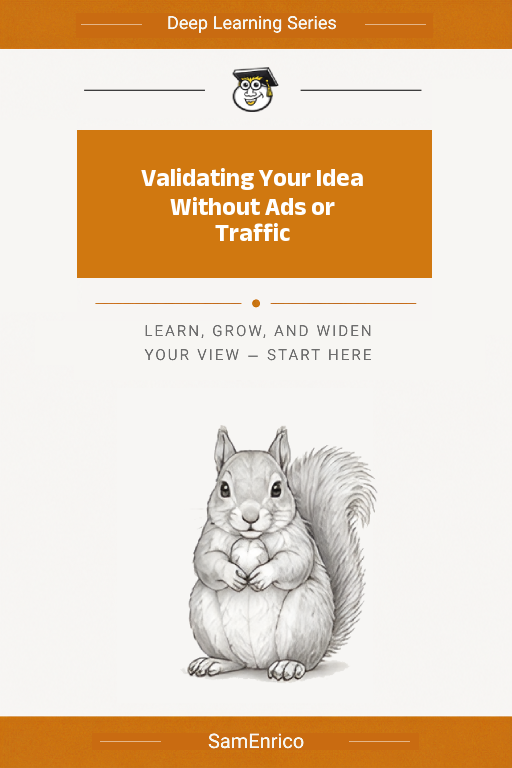
Non-FictionStartup GuideGrowth Hacking
Validating Your Idea Without Ads or Traffic eBook
Use social media groups, Reddit threads, and cold
Use social media groups, Reddit threads, and cold DMs to gauge demand and collect feedback without paying for clicks.
Formats
Free sample
Chapter 1: The Listening Loophole--The single most expensive mistake in entrepreneurship isn't building the wrong feature, hiring the wrong developer, or launching at the wrong time. It's building anything at all before you know, with absolute certainty, that someone will pay you for it.I've watched founders burn six-figure savings accounts on products that never made a dollar. I've seen teams of twenty engineers spend eighteen months building a platform that exactly zero people wanted. I've received hundreds of desperate emails that all say the same thing: "We built it. They didn't come.
What did we do wrong?"The answer is brutal and simple. You didn't listen before you built. And the excuse you gave yourself was almost certainly this: "I don't have a budget for Facebook ads."This book exists to destroy that excuse forever.The $50,000 Mistake I Made So You Don't Have To Let me tell you about my own Build Trap. I was twenty-four, flush with a small inheritance, and convinced I had discovered a billion-dollar idea. The concept was a project management tool specifically for video editors—something that would replace the chaotic combination of Google Sheets, Dropbox, and endless email threads.I did what every naive founder does.
I hired a developer. I paid for a logo. I bought a domain. I spent 6,000on Facebookadsbeforetheproductevenworked,justto"buildbuzz."Threemonthsand6,000 on Facebook ads before the product even worked, just to "build buzz." Three months and 6,000on Facebookadsbeforetheproductevenworked,justto"buildbuzz."Threemonthsand50,000 later, I had a beautiful, bug-free application with a login screen, a dashboard, and seventeen features I was incredibly proud of.I launched to exactly zero paying customers.I ran more ads. I tweaked the pricing.
I added two more features. Nothing. The few people who signed up for the free trial never came back after day three. I had built a Ferrari for a neighborhood that only wanted a bicycle—and didn't even know they wanted a bicycle.The shame wasn't the wasted money. The shame was realizing that I had spent three months avoiding the one thing that would have saved me: a conversation.
I never talked to a single video editor before I wrote the first line of code. I never asked what frustrated them. I never asked what workarounds they were already using. I just assumed I knew.I didn't. And that assumption cost me fifty thousand dollars.The 42% Reality That Changes Everything Here is the most important statistic in entrepreneurship.
According to CB Insights, which has analyzed thousands of startup post-mortems, 42% of startups fail because there is no market need for their product.Not because of bad marketing. Not because of poor execution. Not because of insufficient funding or the wrong team or a bad economy. Forty-two percent fail because they built something nobody wanted to buy.Let that land for a moment. Nearly half of all startups die from a self-inflicted wound: building before validating.
And the number one excuse founders give for skipping validation is the same one I used: "I don't have a budget for ads."This book argues that ads are not the solution to validation. Ads are a distraction. Paid traffic gives you data, yes—but it gives you the wrong data. Bots click your ads. Low-intent shoppers click because they're bored.
Facebook and Google optimize for clicks, not for truth. You are paying for lies dressed up as metrics.The only signal that actually matters is human conversation. A stranger telling you, in their own words, about a problem that keeps them up at night. A Reddit thread where someone says, "I hate that no one has solved this." A Facebook Group comment that reads, "Why doesn't someone just build X?"That data exists right now, for free, waiting for you to find it. You don't need a budget.
You need a method. And the method starts with the Listening Loophole.What This Book Is Not Before we go further, let me be clear about what you're holding.This is not a book about "hustle culture" or "grinding until you make it." You will not find advice about waking up at 4 AM or cold-calling five hundred people a day. Exhaustion is not a strategy.This is not a book about growth hacking or viral loops. You will not learn how to trick the algorithm or manufacture fake engagement. Those tactics work briefly, if at all, and they never tell you whether your idea has real legs.This is not a book about "spray and pray" marketing.
Sending your link to a hundred Facebook Groups and hoping someone clicks is not validation. It is spam dressed up as effort.This is a book about listening like a scientist, not a marketer. It is about gathering evidence before you invest. It is about killing bad ideas cheaply and doubling down on good ones with confidence.Every chapter in this book assumes you have exactly three things: an internet connection, a willingness to talk to strangers, and zero dollars for advertising. That's it.The Build Trap: How Smart People Waste Years The Build Trap is the gravitational pull that every entrepreneur feels.
It whispers: "Just build something. Anything. Action is better than inaction. You'll figure out the rest later."This is a lie.The Build Trap operates on a seductive loop that looks like this. First, you have an idea that feels urgent.
Second, you start building—a website, an app, a service, a physical product. Third, you launch to silence. Fourth, you assume the problem is that you didn't build enough features, so you build more. Fifth, you launch again to slightly less silence. Sixth, you run out of money and quit.I have watched this loop consume founders for a decade.
The smart ones, the hardworking ones, the ones who read all the books and attended all the conferences. They all fall into the same trap because building feels productive. Building feels like progress. Building allows you to avoid the terrifying vulnerability of asking a stranger, "Does this idea suck?"Here is the hard truth. Building is cheap.
Listening is expensive—not in money, but in ego. It is excruciating to discover that your brilliant idea is actually boring to everyone else. It is painful to hear that the feature you stayed up all night designing is irrelevant. It is humiliating to realize that you are not the genius you thought you were.But that pain is the tuition for success. The founders who survive are not the ones who built the most features.
They are the ones who killed the most bad ideas before they wrote a single line of code.The False God of Paid Traffic Let me dismantle the assumption that paid traffic is the path to validation. Most founders believe that running a small ad campaign to test demand is a smart, low-risk move. They are wrong for three reasons.First: Bots and click farms. The moment you run a Facebook or Google ad, you are competing with bots. Automated scripts click on ads to drain competitor budgets or to generate fake engagement for shady clients.
Depending on your industry, anywhere from 10% to 40% of your ad clicks may come from non-human sources. You are…
This is the end of the free sample. Get the eBook to keep going. Buy now
About this book
Details
- Author
- Cambell Julianna
- Publisher
- SamEnrico
- Language
- English
- Genre
- Non-Fiction, Startup Guide, Growth Hacking
- Released
- 2026-05-30
- Pages (approx.)
- 126
- Available as
- eBook, Audiobook

Read better in the ZLOADR app
Your eBooks on your phone or tablet. Sign in with your SamEnrico account and start reading.
More by Cambell Julianna
 Loving Kindness For ShameCambell Julianna$11.99
 Hybrid Memory SystemsCambell Julianna$11.99
 The Art Student Critique FearCambell Julianna$11.99
 Teen EQ Development CourseCambell Julianna$11.99
 Mindfulness for Restful SleepCambell Julianna$11.99
 Menopause Stress Relationship GuideCambell Julianna$11.99
 Lucid Dreaming for TraumaCambell Julianna$11.99
 Memory Palace TipsCambell Julianna$11.99Memory Palace TipsCambell Julianna$11.99
 Gates Of Arctic FrozenCambell Julianna$11.99
 The Siege of Barcelona: A City Held Hostage in the War of Spanish SuccessionCambell Julianna$11.99
 Titian and Charles V: The Emperor’s Portrait That Defined an EmpireCambell Julianna$11.99
You may also like
 Hong Kong Handover 1997Dunn Johnnie$11.99
 Zumba For Postnatal Recovery CourseNeal Christian$11.99
 Zumba for BeginnersLadner Nikia$11.99
 YouTube Comment Mining GuideHumes Pandora$12.99
 Worry Box MeditationCarlin Rudy$11.99
 Workplace Stress MeditationNguyen Lynn$11.99
 Workplace Stress and Sleep RepairHawley Ivory$11.99
 Workplace Perfectionism CureDelaney Jeffry$11.99
 Workplace Injustice Anger GuideWallen Isabelle$11.99
 Work Addiction and Burnout LinkGreenwood Ester$11.99
 Women in Yoga and WellnessBeattie Galina$11.99
 Women in Stand Up ComedyChun Evangeline$11.99