
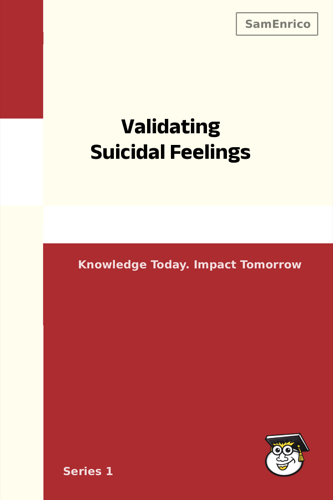
Non-FictionSelf-Help / Suicide Prevention
Validating Suicidal Feelings eBook
undefined
undefined
Formats
Free sample
Chapter 1: The Tteokbokki Paradox...--–- You are reading this book for one of three reasons. Either you have felt, at some point, that you no longer wanted to be alive. Or you are terrified that someone you love feels that way. Or you are a professional who sits beside suicidal pain every day and is looking for a better way to hold it. Regardless of which door you walked through, the same thing brought you here: the recognition that something about the way we usually talk about suicide is not working.The standard script goes something like this: "Suicide is permanent solution to a temporary problem." "You have so much to live for." "Think about your family." "It gets better." These statements are not wrong, exactly.
They are often true. But they land on a person in suicidal crisis the way a band-aid lands on a severed artery — technically correct placement, utterly useless in practice. Worse than useless, sometimes. Because when you are in enough pain to consider ending your life, and someone tells you to "look on the bright side," what you hear is not hope. What you hear is: You are not trying hard enough.
Your pain is not real. You are a burden for feeling this way.This book is going to do something different. It is not going to argue with your suicidal feelings. It is not going to shame you for having them. It is not going to pretend that life is always worth living or that every problem has a solution or that positive thinking cures despair.
What this book is going to do is validate your feelings — not by agreeing that you should die, but by acknowledging, fully and without flinching, that your pain is real, that it makes sense given what you have been through, and that you are not broken for feeling it.And then, from that place of validation, we are going to build something. Not a cure. Not a guarantee. Just a slightly wider path between you and the edge.The Question Nobody Knows How to Answer Let us start with a question that sounds ridiculous but is actually the most honest question in this entire book. Have you ever wanted to die and wanted a snack at the same time?Not metaphorically.
Literally. Have you ever been so deep in suicidal despair that you could not imagine surviving the next hour, and yet, somewhere in the background, you noticed that you were hungry? That you wanted something warm and salty and specific? That the thought of a particular food — maybe something from your childhood, maybe something from your favorite takeout place — crossed your mind right alongside the thought of dying?If you have experienced this, you already know the paradox. You already know that the human mind is capable of holding two completely opposite truths at the same time.
You can want to die and you can want dumplings. You can be planning your own death and you can be annoyed that your takeout is getting cold. These things do not cancel each other out. They coexist in the same messy, exhausted, still-alive body.I first encountered this paradox in a South Korean memoir that became an unexpected bestseller: I Want to Die but I Want to Eat Tteokbokki. The title alone stopped me cold.
Because here was someone saying, out loud, in public, the thing that I had always assumed was proof that I was faking my own despair. How could I be truly suicidal if I still craved comfort food? How could my pain be real if I could still taste things?The answer, it turns out, is that the part of your brain that wants to die and the part of your brain that wants rice cakes in spicy sauce are different systems. They are not the same voice. They do not run on the same fuel.
And the fact that one does not cancel the other is not a contradiction to resolve — it is a survival mechanism to understand.Reframing Suicide: From Moral Failure to Logical Response Before we go any further, we need to name something that most suicide prevention resources dance around. The way we talk about suicide in our culture is drenched in moral judgment. Even the well-intentioned language — "committed suicide" (as if it were a crime), "lost their battle" (as if they simply weren't brave enough), "suicide is selfish" (as if the person were thinking about anyone other than the people they believe they are burdening) — all of it carries an unspoken message: You should not feel this way. There is something wrong with you for feeling this way.That message is not just unhelpful. It is dangerous.
Because shame is not a deterrent to suicidal behavior. Shame is a fuel. The more ashamed you feel about having suicidal thoughts, the less likely you are to tell anyone. The less likely you are to reach out. The more alone you become.
And aloneness, as we will explore in later chapters, is one of the strongest predictors of death by suicide.So let us reframe. Let us set down the moral weight and pick up something more useful.Edwin Shneidman, the father of modern suicidology, coined the term psychache to describe the core experience of suicidal people. Psychache is not depression, though depression often accompanies it. Psychache is not hopelessness, though hopelessness is a close cousin. Psychache is unbearable psychological pain — the specific, crushing sensation of being trapped inside a mind that has turned against itself.
Shneidman argued that suicide is not a response to any specific problem (debt, heartbreak, illness) but to the pain those problems generate. When psychache exceeds a person's ability to cope, suicide becomes a logical, even rational, option within a narrowed field of view.Read that sentence again. A logical, even rational, option.This is not endorsement. This is not encouragement. This is simply the recognition that given enough pain and enough tunnel vision, the human brain will generate suicide as a solution.
That is not a character flaw. That is not a moral failing. That is neurobiology meeting suffering.The implications of this reframe are enormous. If suicidal feelings are not evidence of madness or selfishness, but rather a logical response to unbearable pain, then the appropriate response is not shame or punishment or forced positivity. The appropriate response is pain reduction.
The appropriate response is widening the tunnel. The appropriate response is connection.Validation vs. Endorsement: The Most Important Distinction You Will Ever Learn Because this book is titled Validating Suicidal Feelings, I need to be absolutely, painfully clear about what validation means and what it absolutely does not mean.Validation is the act of acknowledging that someone's feelings are real, understandable, and worthy of attention. When you validate a suicidal person, you are not agreeing that they should die. You are not giving them permission to harm themselves.
You are not "encouraging" suicide. What you are doing is saying: I see your pain. It makes sense that you are in this much pain given what you have been through. You do not need to pretend otherwise with me.Endorsement is the act of…
This is the end of the free sample. Get the eBook to keep going. Buy now
About this book
Details
- Author
- Soares Virgilio
- Publisher
- SamEnrico
- Language
- English
- Genre
- Non-Fiction, Self-Help / Suicide Prevention
- Released
- 2026-06-07
- Pages (approx.)
- 124
- Available as
- eBook, Audiobook

Read better in the ZLOADR app
Your eBooks on your phone or tablet. Sign in with your SamEnrico account and start reading.
More by Soares Virgilio
 NA Explained for BeginnersSoares Virgilio$11.99
 OCD Intrusive Thoughts SleepSoares Virgilio$11.99
 Design Thinking for TrainingSoares Virgilio$11.99
 DBT for Postpartum MoodSoares Virgilio$11.99
 Cigarette Craving Control StrategiesSoares Virgilio$11.99
 Observation vs EvaluationSoares Virgilio$11.99
 Remote Work for PoliceSoares Virgilio$11.99
 The Poisoned Lace: Canada's Deadly Prohibition-Era NurseSoares Virgilio$11.99
 Shadows Over the Aegean: The Silent War of Espionage in the Peloponnesian ConflictSoares Virgilio$11.99
 How to Produce Indoor and Outdoor PlantsSoares Virgilio$11.99
 A Collector's Handbook to the Hillman Minx Series IiiaSoares Virgilio$11.99
 ARIPO Opposition Monitoring ServiceSoares Virgilio$12.99
You may also like
 Hong Kong Handover 1997Dunn Johnnie$11.99
 Zumba For Postnatal Recovery CourseNeal Christian$11.99
 Zumba for BeginnersLadner Nikia$11.99
 YouTube Comment Mining GuideHumes Pandora$12.99
 Worry Box MeditationCarlin Rudy$11.99
 Workplace Stress MeditationNguyen Lynn$11.99
 Workplace Stress and Sleep RepairHawley Ivory$11.99
 Workplace Perfectionism CureDelaney Jeffry$11.99
 Workplace Injustice Anger GuideWallen Isabelle$11.99
 Work Addiction and Burnout LinkGreenwood Ester$11.99
 Women in Yoga and WellnessBeattie Galina$11.99
 Women in Stand Up ComedyChun Evangeline$11.99