
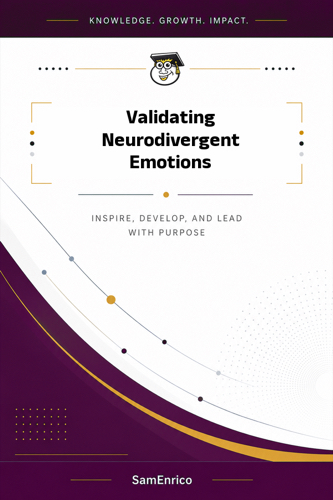
Non-FictionSelf-HelpNeurodiversity
Validating Neurodivergent Emotions
Supports autistic and ADHD individuals without jud
Supports autistic and ADHD individuals without judgment.
Formats
About this book
Free sample
Chapter 1: Beyond the Checklist--For most of your life, you have been handed a checklist. Not a literal one, perhaps, but an internalized scorecard that runs in the background of every emotional interaction you have ever witnessed or participated in. The checklist says: Is this person crying over something that warrants crying? Is their anger proportional to the offense? Are they too happy about something trivial?
Are they not sad enough about something serious? You run this checklist automatically, unconsciously, the way you breathe. And when the person standing in front of you fails the checklist—when their emotional display does not match the invisible, unspoken, neurotypical rulebook you were raised to trust—you feel a distinct discomfort. You might call it confusion. You might call it frustration.
But if you are honest, it is something closer to judgment. They are overreacting. They are underreacting. They are being manipulative. They are being dramatic.
They need to get over it.This chapter exists to burn that checklist.Not because emotions should not be understood. Not because behavior has no consequences. But because the checklist you have been using was not designed for the person you are trying to support. It was designed by and for neurotypical brains—brains that process sensory input at a standard volume, that register social cues at a predictable speed, that experience emotional cause and effect in a linear timeline. The person you love, live with, teach, or support does not have a neurotypical brain.
And yet you have been grading them on a neurotypical curve. The result is not accuracy. The result is a lifetime of the neurodivergent person being told, explicitly or implicitly, that their feelings are wrong, inappropriate, excessive, or insufficient.The goal of this chapter—and this entire book—is to replace one question with another. The question you have been asking is: Is this feeling appropriate? The question you will learn to ask is: Why does this feeling make sense for this brain?These are not the same question.
The first asks for a verdict. The second asks for a story. And once you understand the story, the verdict…
This is the end of the free sample. Get the eBook to keep going. Buy now
Contents
- Chapter 1
- Chapter 2
- Chapter 3
- Chapter 4
- Chapter 5
- Chapter 6
- Chapter 7
- Chapter 8
- Chapter 9
- Chapter 10
- Chapter 11
- Chapter 12
Details
- Author
- Dunlap Robert
- Publisher
- SamEnrico
- Language
- English
- Genre
- Non-Fiction, Self-Help, Neurodiversity
- Released
- 2026-06-06
- Pages (approx.)
- 132
- Available as
- eBook, Audiobook

Read better in the ZLOADR app
Your eBooks on your phone or tablet. Sign in with your SamEnrico account and start reading.
More by Dunlap Robert
 TM for Executives GuideDunlap Robert$11.99
 PCOS Post Pill Syndrome GuideDunlap Robert$11.99
 Sales Confidence AnchorDunlap Robert$11.99
 EV Market Capital ForecastDunlap Robert$11.99
 The Battle of Krzyzowa: The First Tank Clash of the Great WarDunlap Robert$11.99
 Quotation SpecialistDunlap Robert$11.99
 Pacific BiosciencesDunlap Robert$12.99
 Flutterwave vs Paystack GuideDunlap Robert$12.99
 How to Start a Hobby in Tesla CoilsDunlap Robert$11.99
 Understanding PentosuriaDunlap Robert$17.99
You may also like
 Hong Kong Handover 1997Dunn Johnnie$11.99
 Zumba For Postnatal Recovery CourseNeal Christian$11.99
 Zumba for BeginnersLadner Nikia$11.99
 YouTube Comment Mining GuideHumes Pandora$12.99
 Worry Box MeditationCarlin Rudy$11.99
 Workplace Stress MeditationNguyen Lynn$11.99
 Workplace Stress and Sleep RepairHawley Ivory$11.99
 Workplace Perfectionism CureDelaney Jeffry$11.99
 Workplace Injustice Anger GuideWallen Isabelle$11.99
 Work Addiction and Burnout LinkGreenwood Ester$11.99
 Women in Yoga and WellnessBeattie Galina$11.99
 Women in Stand Up ComedyChun Evangeline$11.99