
Non-FictionSelf-HelpEating Disorder Support
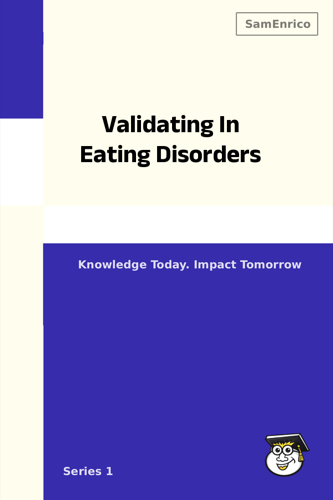
Validating In Eating Disorders eBook
Validate the function of disordered eating without
Validate the function of disordered eating without reinforcing behaviors, focusing on emotions.
Formats
Free sample
Chapter 1: The Survival Paradox--–- The first time you skipped a meal and felt proud instead of hungry, you weren't broken. You weren't vain. You weren't looking for attention. You were, in that moment, solving a problem that no one else could see and no one had given you the tools to solve. That is the central truth this book rests upon: your eating disorder is not a sign of weakness.
It is a sign of adaptation. It is a logical, biological, psychological, and social response to circumstances that felt unbearable. And until you understand what it is doing for you, you will never be able to stop what it is doing to you.This chapter reframes everything you think you know about disordered eating. We will set aside the shame-based question that has kept you stuck for years—"Why am I doing this?"—and replace it with a far more useful, far more compassionate question: "What is this doing for me?" That single shift transforms the eating disorder from an enemy to be destroyed into a language to be understood. From a pathology to be eradicated into a survival mechanism to be outgrown.Let us begin with a story that is not mine but belongs to every person who has ever counted a calorie, avoided a meal, or hidden food wrappers in the bottom of a trash can.The Story That Opens the Door Maya is twenty-four years old.
She is also, by any medical definition, severely anorexic. She weighs herself three times a day. She eats exactly six hundred calories before allowing herself to sleep. She has not had a period in two years. Her hair is thinning.
Her heart rate drops into the forties at night. Her parents have cried. Her therapist has pleaded. Her body has sent every signal it can send, from dizzy spells to fainting to the permanent chill in her fingers and toes.And yet, when you ask Maya why she cannot eat, she does not say she wants to be thin. She does not say she wants to look like a model.
She says, "When I restrict, the screaming in my head stops."The screaming. Not vanity. Not fashion. Not Instagram. The screaming.For Maya, the screaming is the sound of her mother's disappointment.
It is the memory of her father leaving when she was twelve. It is the terror of graduating college with no idea what she wants to do with her life. It is the voice that whispers, "You are not enough, you will never be enough, and everyone is about to find out."Restriction silences that voice. When Maya is hungry, truly hungry, her mind becomes sharp and clear. The emotional noise fades into the background.
She feels in control for the first time all day. She feels successful. She feels safe.This is the survival paradox: the very behavior that is killing Maya's body is also, in the short term, saving her mind. She is not crazy. She is not vain.
She is a person who found a solution to an intolerable emotional problem, and that solution worked so reliably that her brain encoded it as the answer to everything.If you have an eating disorder, you have your own version of Maya's story. It may not look exactly the same. Your behavior might be bingeing instead of restricting, purging instead of fasting, chewing and spitting instead of swallowing. But underneath the behavior is the same structure: a problem you could not solve, a solution you discovered by accident or design, and a brain that learned to reach for that solution every time the problem reappeared.This chapter will help you see that structure clearly for the first time. Not to judge it.
Not to shame it. But to understand it. Because you cannot replace a solution until you know what problem it was solving.The Bio-Psycho-Social Perfect Storm No one develops an eating disorder for a single reason. If it were that simple, we would have cured it decades ago. Instead, eating disorders emerge from the convergence of three distinct forces: biological predisposition, psychological history, and social environment.
When these three forces align, disordered eating does not feel like a choice. It feels like inevitability.The Biological Layer Research has consistently shown that certain temperamental traits are strongly heritable and strongly associated with eating disorders. These include high anxiety sensitivity (the tendency to perceive neutral situations as threatening), perfectionism (the relentless pursuit of impossibly high standards), harm avoidance (the urge to stay away from anything that might cause discomfort), and low distress tolerance (the inability to sit with difficult emotions without acting to escape them).None of these traits are character flaws. They are genetic givens, like eye color or height. But they set the stage.
A person with high anxiety sensitivity and low distress tolerance experiences the ordinary stresses of life—a critical comment, a failed test, a romantic rejection—as catastrophic. And a person who experiences ordinary stress as catastrophic is highly motivated to find relief. Any relief. Even relief that comes with a long-term cost.This is not weakness. This is biology.
The same brain circuits that make some people more vulnerable to substance use disorders make others more vulnerable to eating disorders. In both cases, the brain is doing exactly what it evolved to do: seeking predictable relief from predictable pain. The tragedy is not that the brain tries. The tragedy is that the solutions it finds damage the body that houses it.The Psychological Layer Biology loads the gun, but psychology pulls the trigger. The psychological histories of people with eating disorders are remarkably consistent, even when the surface details differ.First, there is almost always an early experience of emotional invalidation.
This does not have to be overt abuse. It can be as subtle as a parent who says "don't be sad" when you cry, or a teacher who tells you to "stop being so sensitive," or a culture that rewards stoicism in boys and compliance in girls. The message, repeated enough times, becomes internalized: What I feel does not matter. What I feel is wrong. What I feel is too much for other people to handle.Second, there is often a traumatic event or a chronic stressor that overwhelmed the person's existing coping skills.
This could be a single incident—sexual assault, a car accident, the sudden death of a loved one—or a prolonged condition—parental divorce, bullying, financial instability, a chronic illness. The content of the trauma matters less than the fact that when it happened, the person had no effective way to process it. The emotion had nowhere to go. So it went into the body.Third, and most critically, there is the acquisition of the eating disorder itself as a coping mechanism. This almost never happens consciously.
No one sits down at age fourteen and says, "I have decided to develop anorexia as a way to manage my emotions." Instead, the person stumbles upon the behavior by accident. They skip a meal because they are busy, and they notice they feel calmer. They binge after a stressful day, and they notice the dissociation offers a break…
This is the end of the free sample. Get the eBook to keep going. Buy now
About this book
Details
- Author
- Jeffrey Gayla
- Publisher
- SamEnrico
- Language
- English
- Genre
- Non-Fiction, Self-Help, Eating Disorder Support
- Released
- 2026-06-10
- Pages (approx.)
- 143
- Available as
- eBook, Audiobook

Read better in the ZLOADR app
Your eBooks on your phone or tablet. Sign in with your SamEnrico account and start reading.
More by Jeffrey Gayla
 Mayor of a Casino CityJeffrey Gayla$11.99
 Single Parent Self Care WorkbookJeffrey Gayla$11.99
 Dribbble Shot Envy GuideJeffrey Gayla$11.99
 The Scarcity Mindset Reset GuideJeffrey Gayla$11.99
 Obsidian Memory VaultJeffrey Gayla$11.99
 Bilevel PAP Therapy GuideJeffrey Gayla$11.99
 Sleep Deprivation Memory LossJeffrey Gayla$11.99
 Pomodoro For Note TakingJeffrey Gayla$11.99
 The Visionaries of Stone: The Architectural Genius of the Swahili CoastJeffrey Gayla$11.99
 The Medici Dynasty: Blood, Art, and the Birth of the Modern Family EmpireJeffrey Gayla$11.99
 The Last Voyage of the DemeterJeffrey Gayla$11.99
 Growing Ficus PumilaJeffrey Gayla$11.99
You may also like
 Hong Kong Handover 1997Dunn Johnnie$11.99
 Zumba For Postnatal Recovery CourseNeal Christian$11.99
 Zumba for BeginnersLadner Nikia$11.99
 YouTube Comment Mining GuideHumes Pandora$12.99
 Worry Box MeditationCarlin Rudy$11.99
 Workplace Stress MeditationNguyen Lynn$11.99
 Workplace Stress and Sleep RepairHawley Ivory$11.99
 Workplace Perfectionism CureDelaney Jeffry$11.99
 Workplace Injustice Anger GuideWallen Isabelle$11.99
 Work Addiction and Burnout LinkGreenwood Ester$11.99
 Women in Yoga and WellnessBeattie Galina$11.99
 Women in Stand Up ComedyChun Evangeline$11.99