
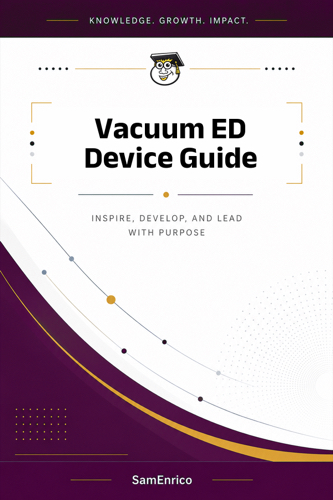
Vacuum ED Device Guide eBook
Use vacuum erection devices effectively and safely
Use vacuum erection devices effectively and safely.
Formats
Free sample
Chapter 1: The Farmer’s Secret...--–- On a humid Georgia morning in 1960, a retired farmer named Geddings Osbon Sr. walked into his barn, picked up a bicycle pump, and changed the future of men’s health forever. He wasn’t a doctor. He wasn’t a scientist. He was a man who had lost something he refused to accept as gone forever—his ability to achieve an erection.
And in that barn, surrounded by the smell of hay and rusting tools, he began a quiet revolution that would take twenty-two years to reach the public, and another six decades to earn the respect it deserves today.This chapter is not about anatomy or technique. It is about the astonishing journey of an invention that began as a desperation project and became an FDA-approved medical device—only to be nearly forgotten in the age of little blue pills. It is the story of how a bicycle pump outlived multibillion-dollar pharmaceuticals, why your doctor probably never mentioned it, and why a device invented by a farmer remains one of the most effective, safest, and most underutilized treatments for erectile dysfunction in existence.If you have ever felt that your only options are pills with uncomfortable side effects, intimidating injections, or drastic surgery, you need to understand the history of the vacuum erection device. Because buried in that history is a truth the pharmaceutical industry would prefer you not dwell on: sometimes the simplest solution is also the best.The Man Who Wouldn’t Give Up Geddings Osbon Sr. was not a wealthy man.
Born in 1910 in rural Georgia, he spent most of his life farming and running a small business. Like millions of men before and after him, he experienced erectile dysfunction as he aged. But unlike most men, who suffered in silence or resigned themselves to a sexless marriage, Osbon became angry. Not at his body—at the absence of any solution.In the 1950s and early 1960s, the medical establishment offered virtually nothing for ED. The prevailing psychoanalytic theory, popularized by Freud and his followers, held that impotence was almost always psychological—a result of unresolved Oedipal conflicts or repressed anxiety.
Men were referred to psychiatrists, not urologists. The few physical treatments that existed were primitive and dangerous: surgical implants made of acrylic or bone, testosterone injections that did nothing for vascular ED, and even electronic stimulators that delivered painful shocks to the pelvic floor.Osbon knew none of this. He only knew that his penis would not fill with blood the way it once did. And being a farmer—a man who fixed things with his hands—he decided to build a solution.His first prototype was exactly what you might imagine: a glass cylinder salvaged from an old laboratory, a bicycle pump, and a rubber seal cut from an inner tube. He placed the cylinder over his penis, pumped the handle, and watched in amazement as blood rushed in.
The erection was not quite normal—it was cooler, darker, and slightly different in shape—but it was firm enough for intercourse. He had, in a single afternoon, reinvented a principle that physiologists had known for centuries: negative pressure draws blood into erectile tissue.From Barn to Patent Office Osbon spent the next several years refining his device. He replaced the glass cylinder with acrylic, which was less likely to shatter. He added a pressure release valve to prevent excessive vacuum. He experimented with different rubber seals and learned that a snug fit was essential to prevent air leaks.
Most importantly, he developed a constriction ring—a thick rubber band that could be slid from the cylinder onto the base of the penis, trapping the blood and maintaining the erection after the cylinder was removed.In 1962, he filed for a patent. The application was simple, almost humble: "A device for the treatment of impotence by means of vacuum-induced engorgement." The patent was granted in 1964, and Osbon began manufacturing the device in a small workshop. He called it the "Youth Equivalent Device," a name that reflected his belief that the device restored not just function but a kind of vitality—a return to younger years.But selling it was another matter. In the 1960s, talking about impotence was taboo. Men would rather suffer than ask a doctor for help.
Osbon could not advertise in mainstream publications. He could not appear on television. He sold his device through word of mouth, discreet mail-order catalogs, and the occasional mention in men’s magazines that skirted the edges of decency.Still, demand grew. Men who had given up on sex entirely wrote him letters of gratitude. Wives called to thank him for saving their marriages.
Osbon was not a rich man, but he knew he had stumbled onto something important.The FDA and the Long Road to Approval In 1970, Osbon made a decision that would define his legacy: he approached the Food and Drug Administration (FDA) for formal approval as a medical device. This was uncharted territory. The FDA had only begun regulating medical devices in earnest after the 1962 Kefauver Harris Amendment, and there was no clear pathway for a mechanical treatment for impotence. The agency was skeptical. Could a simple pump really treat a condition that psychiatrists insisted was largely mental?
Was it safe? Could men be trusted not to injure themselves?The review process took twelve years.Twelve years of clinical trials, of documentation, of arguing with regulators who could not quite believe that a retired farmer had solved a problem that medicine had ignored. Osbon worked with urologists at major medical centers to gather data. They showed that the device was effective in over 90% of men with organic ED—men whose erectile dysfunction was caused by diabetes, vascular disease, or nerve damage from prostate surgery. They showed that the device had virtually no systemic side effects, unlike the psychiatric drugs and hormone therapies then in use.
They showed that men could be trained to use it safely in less than fifteen minutes.On August 17, 1982, the FDA finally approved the device. It was the first mechanical treatment for erectile dysfunction ever cleared for sale in the United States. The device, now rebranded as "Erec Aid," was manufactured by a company Osbon had founded, which would later become Osbon Medical Systems.The news made the evening broadcasts. For the first time, millions of Americans heard the word "impotence" spoken aloud on television. And for the first time, they heard that there was a solution that did not involve drugs, surgery, or psychotherapy.The Erec Aid Era and the Rise of a New Industry Between 1982 and 1998, the Erec Aid and its competitors—most notably Pos-T-Vac, which entered the market in 1985—dominated the treatment of erectile dysfunction.
Urologists prescribed them routinely. Insurance companies covered them as durable medical equipment. Men who had been told their ED was "all in their head" finally had physical proof that it was not.During this period, clinical research on vacuum erection devices flourished. Studies showed that VEDs were effective across nearly all etiologies of ED: vasculogenic (blood flow problems), neurogenic (nerve damage), endocrinologic (hormonal), and even psychogenic (anxiety-related). A landmark 1990 study in the Journal of Urology found…
This is the end of the free sample. Get the eBook to keep going. Buy now
About this book
Details
- Author
- Bankston Fonda
- Publisher
- SamEnrico
- Language
- English
- Genre
- Non-Fiction, Health & Wellness, Medical Devices
- Released
- 2026-06-07
- Pages (approx.)
- 156
- Available as
- eBook, Audiobook

Read better in the ZLOADR app
Your eBooks on your phone or tablet. Sign in with your SamEnrico account and start reading.
More by Bankston Fonda
 Empathy For LonelinessBankston Fonda$11.99
 Twelve Step for Chronic PainBankston Fonda$11.99
 The Stay at Home Parent AngerBankston Fonda$11.99
 The BTK Signature StudyBankston Fonda$11.99
 The Banker of Blood and Gold: How the Colombian Cartels Laundered Empire in Victorian LondonBankston Fonda$11.99
 The Breeder's Guide to Nankin ChickensBankston Fonda$11.99
 Making DioramasBankston Fonda$11.99
 PR for Tech StartupsBankston Fonda$12.99
 Minority Firm Bid Protest GuideBankston Fonda$12.99
 How to Start a Baths Made of Ceramic Business (Beginners Guide)Bankston Fonda$11.99
You may also like
 Shockwave ED TreatmentBanda Matilda$11.99
 Restless Leg Syndrome Compression TherapyMontoya Chelsey$11.99
 Hearing Aid Selection GuidePedersen Dusti$11.99
 The Vacuum Erection Device GuideZiegler Sirena$11.99
 Acupuncture Needle Types GuideRowley Errol$11.99
 Vacuum Erection Device GuideShull Phylicia$11.99
 The RLS Compression Therapy GuideBaumgartner Matha$11.99
 The RLS Foot Wrap Therapy HandbookMelvin Kennith$11.99