
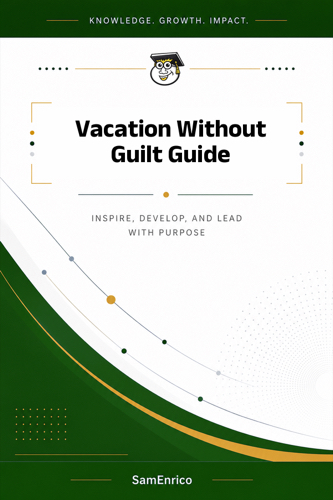
Non-FictionSelf-HelpVacation Recovery
Vacation Without Guilt Guide eBook
Teaches how to fully disconnect during time off an
Teaches how to fully disconnect during time off and avoid email checking.
Formats
Free sample
Chapter 1: The Inbox Hangover--–- The woman in seat 14B had the right idea. She was wearing a linen dress, sipping a tiny bottle of white wine, and reading a physical paperback book with no back cover—the kind you buy at an airport kiosk and abandon in a hotel lobby. Her phone was face-down on the tray table. It had been face-down for two hours. I know this because I counted.
I was in seat 14C, and I had checked my email seventeen times since takeoff. We were only forty minutes into the flight.The flight attendant hadn't even served the pretzels yet.Seventeen times. That is roughly one check every two minutes and twenty seconds. At that rate, I would check my email roughly 450 times before landing. I would spend more of my "vacation" looking at a screen than looking out the window.
And the cruelest part? Not one of those seventeen checks revealed anything urgent. There were no fires. No client meltdowns. No "if you don't reply in the next hour, the deal dies" messages.
There was a marketing newsletter. A calendar reminder for a meeting I had already declined. A message from IT about a password update that I had already ignored three times. And a long, cheerful thread from my team about where to order lunch, which I was not going to be present for anyway because I was, technically, on vacation.And yet I could not stop.This is not a confession of weakness. It is a diagnosis of a structural problem that affects nearly every knowledge worker in the modern economy.
The inability to disconnect during time off is not a personal failure. It is not a sign that you care too much or that you are too important to ignore. It is a neurological and environmental trap, and like all traps, it can be disarmed once you understand how it works.This chapter is called "The Inbox Hangover" because that is precisely what happens: you consume a small amount of digital poison—a glance, a scroll, a peek—and the next morning, even if you are sitting on a beach, you feel hungover. Not from alcohol. From attention residue.
From the lingering cognitive weight of work that you never actually left. Your body is on vacation. Your brain is still in the office. And until we fix that, you will return from every trip more exhausted than when you left.The Science of Attention Residue Let me introduce you to a phrase that will change how you think about vacations: attention residue. The term comes from organizational psychologist Sophie Leroy, who studied why people struggle to transition between tasks.
Her research, published in the Academy of Management Journal, revealed something counterintuitive. When you stop working on Task A and switch to Task B, your attention does not fully transfer. A portion of your cognitive resources remains stuck on Task A, lingering like smoke in a room after the fire is out. That lingering is attention residue.Leroy found that even when people intended to switch tasks—even when they wanted to focus on the new thing—their performance on Task B suffered measurably if Task A was incomplete or unresolved. The more ambiguous or unfinished the first task, the more residue remained.Now apply this to a vacation.You board the plane.
You have every intention of relaxing. But before takeoff, you glance at your inbox. You see a message from a client that says, "Quick question when you have a moment." You do not reply. You do not even open it fully. You just see the subject line.
That is enough. Because now your brain knows that somewhere out there, floating in the digital ether, is a question from a client. You do not know what the question is. You do not know if it requires action. You do not know if it can wait.
That ambiguity—the not-knowing—is exactly the kind of unresolved loop that creates attention residue.And so you spend the first three days of your vacation with a small, silent percentage of your brain scanning the horizon for that client's question. You are not consciously worrying. But you are not fully present either. You are somewhere between. You are on the beach, but you are also in the office.
And that hybrid state is exhausting.Leroy's research quantified this. In controlled experiments, people who switched between tasks with unresolved elements performed up to 20 percent worse on the second task. Twenty percent. That is the difference between remembering your child's question about the sandcastle and staring blankly at the horizon while your brain runs a background diagnostic on a work problem you cannot solve from 3,000 miles away.The Guilt Cycle: A Self-Reinforcing Trap Attention residue is the fuel. But the engine—the thing that keeps you checking, refreshing, and scrolling—is what I call the Guilt Cycle.
It works like this.Step one: You check your email. Maybe it is a conscious decision. Maybe it is a nervous tic. Maybe you are just waiting for your coffee and your thumb does the thing it always does. Either way, you open the inbox.Step two: You feel a brief, illusory sense of control.
For one second, you know what is happening. You have scanned the horizon. No pirates. No storms. You are safe.
That feeling of "at least I know" is chemically rewarding. Your brain releases a small pulse of dopamine. It feels like relief.Step three: You lose presence. That glance cost you something. While you were looking at your phone, your partner asked you a question.
Your kid built something and wanted to show you. The sunset shifted from orange to pink and you missed the transition. You were there, but you were not there. And you know it.Step four: You feel guilty. Not about the work.
About the people you are ignoring. About the vacation you are failing to have. About the money you spent to be somewhere beautiful while staring at a rectangle of glass and metal. The guilt is heavy and specific.Step five: You check your email again. This is the cruel twist.
The guilt itself becomes a trigger. You feel bad about not being present, so you seek relief. And the fastest source of relief—the only source available in that exact moment—is the same thing that caused the problem in the first place. You check your email to escape the guilt of having checked your email. It is a loop.
A perfect, terrible, self-reinforcing loop.Step six: Repeat until vacation ends.I have seen this cycle destroy weddings, anniversaries, birthdays, and once—memorably—a whale-watching tour off the coast of Massachusetts. A man in a yellow raincoat spent the entire two-hour tour with his phone held at chest level, angled so that he could watch the water and his inbox simultaneously. A humpback breached fifty feet from the boat. He missed it. His wife elbowed him.
He looked up, confused, and said, "What?" He had been reading a thread about quarterly projections. On a whale boat. In the rain.That is the Guilt Cycle. And it is not a…
This is the end of the free sample. Get the eBook to keep going. Buy now
About this book
Details
- Author
- Hobson Dulcie
- Publisher
- SamEnrico
- Language
- English
- Genre
- Non-Fiction, Self-Help, Vacation Recovery
- Released
- 2026-06-08
- Pages (approx.)
- 124
- Available as
- eBook, Audiobook

Read better in the ZLOADR app
Your eBooks on your phone or tablet. Sign in with your SamEnrico account and start reading.
More by Hobson Dulcie
 Mass Influence TechniquesHobson Dulcie$11.99
 Seasonal Morning AdjustmentHobson Dulcie$11.99
 Memory Athlete Training GuideHobson Dulcie$11.99
 HIIT for Diabetics GuideHobson Dulcie$11.99
 DBT Emotion RegulationHobson Dulcie$11.99
 Signs of Work Addiction GuideHobson Dulcie$11.99
 Burn First Aid KitHobson Dulcie$11.99
 The Compass and the Cosmos: Magellan's Daring VoyageHobson Dulcie$11.99
 The King of Killers: Canada's Most Notorious Prison EscapeeHobson Dulcie$11.99
 How to Produce Sauce PansHobson Dulcie$11.99
 A Collector's Handbook to the Austin 1300 RangeHobson Dulcie$11.99
 How to Start a Commercial Buildings Construction Business (Beginners Guide)Hobson Dulcie$11.99
You may also like
 Hong Kong Handover 1997Dunn Johnnie$11.99
 Zumba For Postnatal Recovery CourseNeal Christian$11.99
 Zumba for BeginnersLadner Nikia$11.99
 YouTube Comment Mining GuideHumes Pandora$12.99
 Worry Box MeditationCarlin Rudy$11.99
 Workplace Stress MeditationNguyen Lynn$11.99
 Workplace Stress and Sleep RepairHawley Ivory$11.99
 Workplace Perfectionism CureDelaney Jeffry$11.99
 Workplace Injustice Anger GuideWallen Isabelle$11.99
 Work Addiction and Burnout LinkGreenwood Ester$11.99
 Women in Yoga and WellnessBeattie Galina$11.99
 Women in Stand Up ComedyChun Evangeline$11.99