
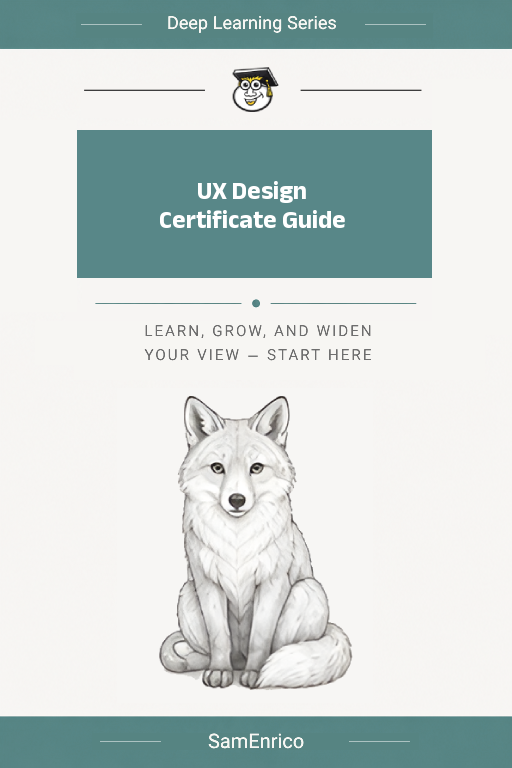
Non-FictionStudent's ShortcutUX
UX Design Certificate Guide eBook
Earn Google, CalArts, or University of Michigan UX
by Mccune Irwin
Earn Google, CalArts, or University of Michigan UX Design certificates for product design.
Formats
Free sample
Chapter 1: The 87% Lie--–- You have probably seen the ads. They slide across your Instagram feed between a recipe for sourdough and a sponsored post from a DTC mattress company. A cheerful designer with perfect lighting gestures at a laptop screen. "Become a UX designer in six months," the text reads. "No degree required.
Starting salary: $85,000." The comment section is a swamp of desperate questions: Is this real? Which certificate is best? Can I do this while working full-time?Here is what the ads do not tell you.Eighty-seven percent of people who enroll in a UX certificate program never finish. That is not a typo. For every hundred hopeful learners who click "Enroll Now," eighty-seven will drop out before the final project.
They will disappear somewhere between the empathy map and the high-fidelity prototype. Their unsubmitted assignments will sit on Coursera servers like digital tombstones, each one representing a dream that quietly died.The eight percent who finish? Most of them build portfolios that look identical to every other graduate's. The same food delivery app redesign. The same meditation app with calming colors.
The same travel booking flow that somehow never actually gets built. They submit these indistinguishable case studies to hundreds of job postings, receive form rejection emails, and eventually go back to their old careers wondering what went wrong.This book exists to put you in the remaining five percent.The five percent who finish their certificate, build a portfolio that hiring managers actually remember, and land their first product design role within ninety days of completing the program. Not because they were smarter or had more design talent. Because they understood something the other ninety-five percent never figured out: certificates do not teach strategy. They teach tactics.
And tactics without strategy is just random motion.The Certificate Graveyard: Why Most Students Quit Let us name the elephant in the room. The certificates you are considering—Google's UX Design Certificate, Cal Arts' UI/UX Design Specialization, and the University of Michigan's User Experience (UX) Research and Design Specialization—are all excellent programs. They are built by world-class teams, refined over years of student feedback, and constantly updated to reflect industry changes. The problem is not the content.The problem is how the content is delivered.Each program assumes you have something most people do not: unlimited time, existing support systems, and the emotional resilience to receive critical feedback on work you stayed up until 2 AM to complete. The reality is messier.
You have a full-time job. You have children who need attention. You have a partner who is already frustrated by the tuition payment. You have imposter syndrome that whispers you do not belong every time you open Figma.The dropouts are not quitters. They are people who were never given a realistic roadmap.Here is what the certificates do not provide: a survival guide.
They give you videos, readings, and quizzes. They give you discussion forums where strangers post questions you were too afraid to ask. They give you automated feedback on multiple-choice questions. What they do not give you is someone telling you, "Week three is where everyone wants to quit. Here is exactly how to push through it."This chapter is that someone.The Three Certificates: A No-BS Comparison Before you can stack certificates strategically, you need to know what you are stacking.
Each program has a distinct philosophy, curriculum structure, and job market positioning. Choosing the wrong starting point is like training for a marathon by swimming laps. You will work hard and get nowhere.Google UX Design Certificate The Google certificate is the populist choice, and that is both its greatest strength and its most significant weakness. Hosted exclusively on Coursera, it costs thirty-nine dollars per month after a seven-day free trial. Google claims the program takes six months at ten hours per week, but the real number for working adults is closer to eight to ten months.
You can accelerate if you treat it like a second job.What Google does exceptionally well is teach the mechanics of UX. You will learn to conduct user interviews (with script templates provided), build empathy maps (with Miro boards you can duplicate), create journey maps (with step-by-step video walkthroughs), and prototype in Figma (with downloadable exercise files). The production quality is outstanding. The instructors are genuine Google employees who speak with the calm authority of people who have shipped products used by billions.The weakness is depth. Google teaches you to follow a process without always teaching you why the process works.
You will learn to create a persona, but you may not learn the psychological research on why personas improve decision-making. You will learn to run a usability test, but you may not learn how to distinguish statistically significant findings from random noise. The program is vocational, not academic. That is fine for most entry-level roles, but it becomes a limitation when you compete against candidates with HCI degrees.Google's particular obsession is accessibility. You will spend more time on screen readers, keyboard navigation, and color contrast than in the other two programs combined.
This is not an accident. Google has been sued over accessibility failures and has learned expensive lessons. The company now trains its certificate students to a standard that exceeds what most agencies require. If you complete the Google certificate, you will genuinely understand WCAG 2.1 AA.Cal Arts UI/UX Design Specialization The California Institute of the Arts certificate is for people who secretly wish they had gone to art school but chose a practical major instead. It is also hosted on Coursera, costs the same thirty-nine dollars per month, and takes approximately four to six months at five to eight hours per week.
The program is self-paced, which sounds liberating and turns out to be a trap for anyone without self-discipline.Cal Arts teaches you to see like a designer. While Google teaches you to execute a process, Cal Arts teaches you to notice typography, spacing, color relationships, and motion. The program assumes you have no formal art training and builds from first principles. You will learn the sixty-thirty-ten color rule. You will learn why typefaces have personalities.
You will learn that a button does not just sit on a screen; it sits in relationship to everything around it.The weakness is structure. Cal Arts takes a narrative approach to UX, which means you will spend time thinking about emotional arcs and storytelling in ways that feel abstract compared to Google's concrete deliverables. Some students thrive on this. Others drown in ambiguity, producing beautiful case studies that do not actually solve real user problems. The program is better suited for people who already have some UX fundamentals and want to elevate their visual execution.Cal Arts' particular strength is journey mapping, but not the functional journey maps Google teaches.
Cal Arts wants you to find the emotional highs and lows—the moments of delight, frustration, confusion, and relief. These emotional maps become the raw material for visual design decisions. A high-emotion moment deserves a more dramatic visual treatment. A low-emotion utility task deserves efficiency, not ornament.University of Michigan User Experience (UX) Research and Design Specialization The Michigan certificate is the…
This is the end of the free sample. Get the eBook to keep going. Buy now
About this book
Details
- Author
- Mccune Irwin
- Publisher
- SamEnrico
- Language
- English
- Genre
- Non-Fiction, Student's Shortcut, UX
- Released
- 2026-05-26
- Pages (approx.)
- 146
- Available as
- eBook, Audiobook

Read better in the ZLOADR app
Your eBooks on your phone or tablet. Sign in with your SamEnrico account and start reading.
More by Mccune Irwin
 The Body Dysmorphia CalmMccune Irwin$11.99
 Lawyer Litigation Stress GuideMccune Irwin$11.99
 Bridge Phobia CrossingMccune Irwin$11.99
 Government Job Stability GuideMccune Irwin$11.99
 Exercise Replacement TherapyMccune Irwin$11.99
 The Ambulance HijackingMccune Irwin$11.99
 Muhammad Yunus BankMccune Irwin$11.99
 Mental Health Days from SchoolMccune Irwin$11.99
 Wings Over Vienna: The Commonwealth's Last Stand (1683)Mccune Irwin$11.99
 Three Arrows Capital: Leverage Until It SnappedMccune Irwin$11.99
 Bragi's Golden Lyre: The God Who Spoke in SongMccune Irwin$11.99
 Community-Led Governance ModelsMccune Irwin$11.99
You may also like
 Hong Kong Handover 1997Dunn Johnnie$11.99
 Zumba For Postnatal Recovery CourseNeal Christian$11.99
 Zumba for BeginnersLadner Nikia$11.99
 YouTube Comment Mining GuideHumes Pandora$12.99
 Worry Box MeditationCarlin Rudy$11.99
 Workplace Stress MeditationNguyen Lynn$11.99
 Workplace Stress and Sleep RepairHawley Ivory$11.99
 Workplace Perfectionism CureDelaney Jeffry$11.99
 Workplace Injustice Anger GuideWallen Isabelle$11.99
 Work Addiction and Burnout LinkGreenwood Ester$11.99
 Women in Yoga and WellnessBeattie Galina$11.99
 Women in Stand Up ComedyChun Evangeline$11.99