
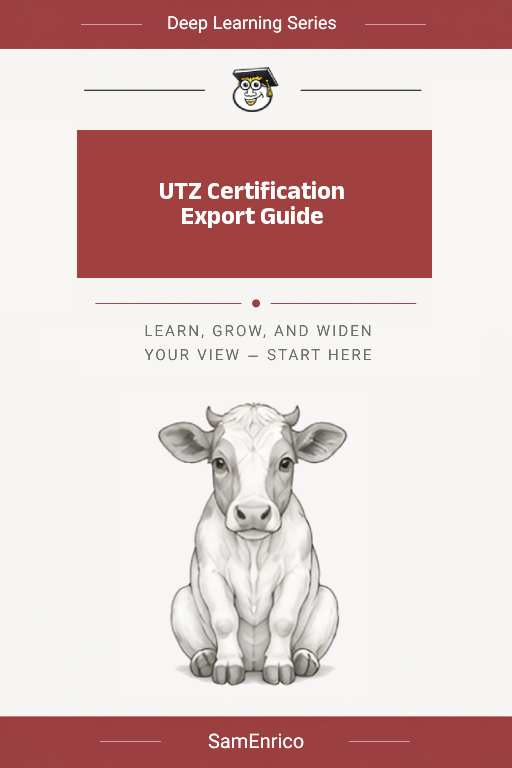
UTZ Certification Export Guide eBook
Get UTZ certification for sustainable agriculture
by Melvin Cami
Get UTZ certification for sustainable agriculture exports. Now part of Rainforest Alliance.
Formats
Free sample
Chapter 1: The Merger That Changed Everything--–- In 2002, a small foundation in the Netherlands launched a certification program called UTZ Kapeh, a Mayan phrase meaning “good coffee.” Few people at the time could have predicted that this initiative would, within two decades, become one of the most influential sustainability standards in global agriculture. Even fewer could have foreseen its dramatic transformation in 2018, when UTZ merged with the Rainforest Alliance, creating a single behemoth that now certifies over 2 million farmers across 70 countries. Yet today, in boardrooms and farm offices around the world, exporters are still asking the same bewildered question: “Do I have UTZ certification, Rainforest Alliance certification, or something in between?”The confusion is not merely academic. It is costing exporters real money, real shipments, and real market access.This chapter exists to kill that confusion forever.The merger between UTZ and the Rainforest Alliance was not a simple rebranding. It was not a cosmetic change of logos and letterheads.
It was a fundamental restructuring of how sustainable agriculture is verified, traced, and traded across international borders. If you are reading this book, you likely hold an old UTZ certificate, or you are considering applying for what you thought was UTZ certification, or you have received contradictory instructions from buyers about which standard they actually require. You are not alone. And you are not wrong to be frustrated.But frustration is not a strategy. Understanding is.By the end of this chapter, you will know exactly what the UTZ-Rainforest Alliance merger means for your export business.
You will understand the key differences between Legacy UTZ and the 2020 Rainforest Alliance Standards. You will have a clear decision matrix to determine whether you need to transition, maintain, or reapply. And you will walk away with a practical 90-day transition plan that runs in parallel with your audit process – not sequentially, not impossibly, but realistically and profitably.Let us begin by going back to the beginning.The Birth of UTZ: A Brief History In the late 1990s, the coffee industry faced a crisis. Roasters and retailers wanted proof that their beans were grown responsibly, but existing certifications were either too expensive, too bureaucratic, or too focused on single issues like fair pricing or organic inputs. A group of Dutch coffee roasters, Guatemalan farmers, and supply chain experts saw an opening.
They created UTZ Kapeh in 2002 as a “code of conduct” that emphasized traceability, good agricultural practices, and worker welfare – but without the rigid minimum price mechanisms of Fairtrade or the input restrictions of Organic.The name itself told a story. “UTZ” was a contraction of the Mayan word “utz” meaning “good,” and “Kapeh” meant “coffee.” Good coffee. The simplicity was intentional. UTZ positioned itself as the pragmatic certifier: you follow the rules, you keep meticulous records, you pass the audit, and you get access to premium markets. No ideology.
No political positioning. Just good business.Over the next sixteen years, UTZ expanded from coffee into cocoa, tea, and hazelnuts. It developed the world’s largest traceability system for certified agricultural products. Its chain of custody model – Identity Preserved, Segregated, and Mass Balance – became industry standard. By 2017, UTZ certified over 500,000 farmers and 2 billion kilograms of product annually.
It was, by almost any measure, a success.But success brought its own problems.Why the Merger Happened By the mid-2010s, the sustainability certification landscape had become a nightmare of duplication. A single coffee farmer might hold UTZ certification for traceability, Fairtrade certification for price guarantees, Organic certification for inputs, and Rainforest Alliance certification for biodiversity. Each came with its own audit, its own fee, its own paperwork, and its own logo. Buyers were drowning in competing claims. Farmers were exhausted by multiple inspections.
The system was not sustainable.The Rainforest Alliance, founded in 1987, had long focused on biodiversity and ecosystem protection. UTZ, founded in 2002, excelled at supply chain traceability and farm management. Together, they covered different parts of the sustainability puzzle. Separately, they created confusion.In 2018, the two organizations announced their merger. The new entity would operate under the Rainforest Alliance name, but it would inherit UTZ’s traceability infrastructure, its chain of custody models, and many of its training materials.
The transition would take several years. Legacy UTZ certificates would remain valid until their expiration dates, but all new certifications would eventually fall under the Rainforest Alliance 2020 Standard.That was the plan. The reality has been messier.The Great Confusion: Legacy UTZ vs. 2020 Rainforest Alliance Standards The single biggest source of errors in export documentation today is the assumption that Legacy UTZ and the 2020 Rainforest Alliance Standards are interchangeable. They are not.
They share DNA, but they have diverged in critical ways. Understanding these differences is not optional. It is the difference between a shipment that clears customs and one that sits in a bonded warehouse while your buyer demands answers.Let me walk you through the most important distinctions.First, deforestation rules. Legacy UTZ required that farms comply with local laws regarding forest conversion. The 2020 Rainforest Alliance Standard goes much further.
It establishes a global “cut-off date” of December 31, 2014. Any land that was converted from natural forest to agriculture after that date cannot be certified, regardless of local laws. This means that if your supplier cleared forest in 2015 – even legally, under national regulations – their product cannot carry the Rainforest Alliance seal. Legacy UTZ would have allowed it. The new standard does not.Second, pesticide restrictions.
Legacy UTZ maintained a list of prohibited and restricted pesticides, but it did not require complete elimination of the most hazardous chemicals. The 2020 Standard adopts the European Union’s list of banned pesticides as its baseline, plus additional restrictions on neonicotinoids and paraquat. If your farm still uses any pesticide on the EU’s “prohibited” list, you cannot achieve Rainforest Alliance certification. Legacy UTZ would have allowed some of these chemicals with proper protective equipment and record-keeping.Third, social requirements. Both standards prohibit child labor and forced labor.
But the 2020 Standard introduces a new requirement: living wage benchmarks. Under Legacy UTZ, you simply had to pay at least the legal minimum wage. Under the new standard, you must demonstrate progress toward a “living wage” – calculated regionally based on the actual cost of food, housing, healthcare, and education. This is a much higher bar, and it requires ongoing data collection and reporting, not just a one-time audit check.Fourth, traceability and digital infrastructure. Legacy UTZ used a system called the UTZ Good Inside Portal (GIP).
The Rainforest Alliance has migrated to a platform called Multi Trace. The two systems are not fully compatible. If you hold a Legacy UTZ certificate, you can still access the old GIP portal, but you cannot generate Rainforest Alliance Transaction Certificates from it. Conversely, if you have transitioned to the new standard, you must use Multi Trace, and you cannot issue Legacy UTZ certificates.Fifth, audit frequency and rigor. Legacy UTZ required annual audits for most supply chain actors.
The 2020 Standard introduces a risk-based approach: high-risk supply chains (e.g., smallholders in deforestation-sensitive regions) may face unannounced audits or additional verification visits. The audit checklists have also changed. Approximately 30% of the questions on a Legacy UTZ audit are now obsolete or modified under…
This is the end of the free sample. Get the eBook to keep going. Buy now
About this book
Details
- Author
- Melvin Cami
- Publisher
- SamEnrico
- Language
- English
- Genre
- Non-Fiction, Business Brief, Eco-Compliance
- Released
- 2026-05-30
- Pages (approx.)
- 155
- Available as
- eBook, Audiobook

Read better in the ZLOADR app
Your eBooks on your phone or tablet. Sign in with your SamEnrico account and start reading.
More by Melvin Cami
 Talent Sourcing Intelligence ReportMelvin Cami$11.99
 The Mr. Rogers KindnessMelvin Cami$11.99
 Beginner Mindfulness for ProcrastinationMelvin Cami$11.99
 The Complicated Grief Mindfulness GuideMelvin Cami$11.99
 UX Designer Non Artist GuideMelvin Cami$11.99
 The Wealthy Wisdom of the Wangara Traders: Africa's Financial PioneersMelvin Cami$11.99
 How to Start a Call Horns Business (Beginners Guide)Melvin Cami$11.99
 Corporate Housing SpecialistMelvin Cami$11.99
 Tech Adoption Generations GuideMelvin Cami$12.99
You may also like
 RSPO Certification ExportBeaty Hien$12.99
 Zero Deforestation ExportPeachey Alona$12.99
 WRAP Certification ExportBeaudoin Magen$12.99
 Water Neutral Export GuideEchols Seema$12.99
 UTZ Coffee Export GuideTimmons Tama$12.99
 Sprouts Certification ExportArroyo Denese$12.99
 SMETA Audit Export GuideHeath Elana$12.99
 SBTi Certification ExportMaclean Linnea$12.99
 Rainforest Alliance ExportHardin Madelyn$12.99
 Rainforest Alliance CoffeeWiseman Erasmo$12.99
 Plastic Neutral Export GuideHazel Lissa$12.99
 Organic Vegetable Export GuideRiddick Latasha$12.99