
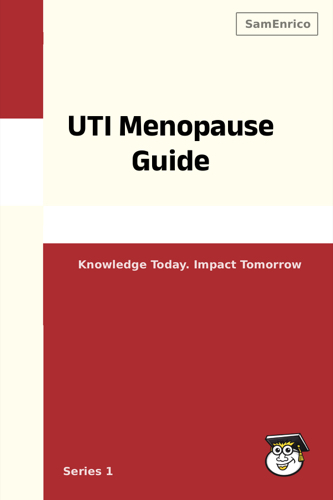
Non-FictionHealth & WellnessUrology
UTI Menopause Guide eBook
Prevent recurrent infections with vaginal estrogen
Prevent recurrent infections with vaginal estrogen.
Formats
Free sample
Chapter 1: The Broken Shield...-- The first time Susan woke up to that familiar burn, she thought it was a fluke. She was fifty-two, eighteen months past her last period, and had gone her entire adult life without a single urinary tract infection. She drank cranberry juice for three days, and the symptoms vanished. "Probably just dehydration," she told her husband.The second time came six weeks later. The burning was sharper, accompanied by an urgency that sent her sprinting to the bathroom every twenty minutes.
Her primary care doctor called in a prescription for nitrofurantoin without an office visit. Three days of antibiotics, and Susan felt fine again.The third time arrived like an ambush. She was on a road trip with friends, three hours from the nearest urgent care, when the familiar fire ignited. She spent the weekend drinking water, taking over-the-counter phenazopyridine for the pain, and excusing herself from every meal. Her friends were kind, but Susan could see the unspoken question in their eyes: What is wrong with you?The fourth, fifth, and sixth infections came over the next eight months.
Susan saw a urologist, who ordered a CT scan of her kidneys (normal), a cystoscopy (unremarkable), and a urine culture that grew the predictable culprit: Escherichia coli, or E. coli. She was prescribed a different antibiotic each time—ciprofloxacin, then trimethoprim-sulfamethoxazole, then a longer course of nitrofurantoin. Each course worked. And each infection returned within weeks.By the tenth month, Susan had developed what she called "the surveillance state" in her own home.
She mapped the location of every public restroom within a five-mile radius. She stopped drinking coffee because caffeine irritated her bladder. She stopped having sex with her husband because the morning after almost always brought burning. She started waking up at 2 AM to check if she felt the telltale twinge. Her sleep was fractured.
Her anxiety was constant. Her doctor, now visibly frustrated, suggested she might need to see a specialist at a university hospital. "Some women are just prone to these," he said.Susan cried in her car. She was fifty-three years old, otherwise healthy, and she felt like her body had turned against her.If you are reading this book, Susan is you. Or she could be your mother, your sister, your best friend.
Her story is not unusual. It is not rare. It is the lived reality of millions of postmenopausal women who suffer from recurrent urinary tract infections—and who have been told, explicitly or implicitly, that this is simply their new normal.It is not.The Numbers That Should Shock You Let us begin with a definition, because precision matters when you are drowning in symptoms. A recurrent urinary tract infection is not simply "a lot of UTIs." The clinical definition, used by the American Urological Association and the Infectious Diseases Society of America, is at least three culture-proven infections in twelve months, or at least two infections in six months.By that definition, Susan crossed the threshold after her fourth infection. She was not unlucky.
She was not dirty. She was not failing to wipe correctly or drink enough water. She was experiencing a predictable consequence of a biological process that her doctor should have recognized but, like many physicians, failed to identify.Here is what the data tells us about the scale of this problem. Before menopause, urinary tract infections are common but typically sporadic. A young woman might have one every few years, often triggered by sexual activity or a bout of constipation.
After menopause, the epidemiology changes dramatically. The rate of UTIs in women over fifty is nearly double that of younger women. Among women over sixty-five, UTIs are the most common bacterial infection requiring hospitalization. And among postmenopausal women who have had one UTI, the risk of a recurrence within six months is approximately twenty-five percent. After two infections, that risk rises to nearly seventy percent.But those numbers, stark as they are, do not capture the lived experience.
Consider instead the concept of quality-adjusted life years, a metric used by health economists to measure the burden of disease. One study calculated that recurrent UTIs in postmenopausal women cause a reduction in quality of life comparable to living with moderate chronic kidney disease or severe osteoarthritis. Women with r UTI report higher rates of anxiety, depression, and social isolation than age-matched controls. They are more likely to miss work, more likely to avoid travel, and more likely to experience sexual dysfunction.And then there is the antibiotic problem. Each course of antibiotics—especially the fluoroquinolones like ciprofloxacin, which are still overprescribed for uncomplicated UTIs—carries risks: C.
difficile colitis, tendon rupture, nerve damage, and the slow accumulation of bacterial resistance. Women with r UTI are cycled through antibiotic after antibiotic, each course slightly less effective than the last, until they are left with few options.Susan's doctor was not wrong to treat her infections with antibiotics. Antibiotics are excellent at killing bacteria. But they are terrible at solving the underlying problem that allowed those bacteria to take up residence in the first place. That underlying problem—the broken shield—is the subject of this chapter.The Broken Shield Hypothesis: A New Way of Seeing Imagine for a moment that your bladder and urethra are a castle.
For the first fifty years of your life, that castle was protected by a moat, a drawbridge, and stone walls. Invaders—E. coli bacteria from your own gut, hitching a ride on toilet paper or sexual activity—might occasionally breach the outer defenses, but the castle's immune system would typically clear them before they could establish a foothold. You might have a UTI once every few years, but your body's defenses were fundamentally intact.Now imagine that someone drained the moat, lowered the drawbridge permanently, and replaced the stone walls with tissue paper. That is what menopause does to the urogenital tract.
The protective structures do not simply weaken—they transform into something fundamentally less capable of defending against bacterial invasion.This is the "broken shield" hypothesis, and it is the central insight that transforms how we must think about recurrent UTIs after menopause. The problem is not that you are having more bad luck than other women. The problem is not that you are colonized with a particularly aggressive strain of E. coli. The problem is that the physical and chemical barriers that once protected your bladder have collapsed, and no amount of antibiotics can rebuild them.Let me be very specific about what breaks and why.The first line of defense is the urethral epithelium—the layer of cells lining the tube that carries urine from the bladder to the outside world.
In a premenopausal woman, this epithelium is thick, multilayered, and rich in a protein called glycogen. The thickness creates a physical barrier: bacteria cannot easily burrow through multiple layers of tightly packed cells to reach the underlying tissue. The glycogen serves a different purpose: it feeds beneficial bacteria.Those beneficial bacteria—primarily species of Lactobacillus—colonize the vagina and the lower urethra in a healthy premenopausal woman. They produce lactic acid, which keeps the local p H low (typically between 3.5 and 4.5). They produce…
This is the end of the free sample. Get the eBook to keep going. Buy now
About this book
Details
- Author
- Behrens Vonnie
- Publisher
- SamEnrico
- Language
- English
- Genre
- Non-Fiction, Health & Wellness, Urology
- Released
- 2026-06-09
- Pages (approx.)
- 147
- Available as
- eBook, Audiobook

Read better in the ZLOADR app
Your eBooks on your phone or tablet. Sign in with your SamEnrico account and start reading.
More by Behrens Vonnie
 Price Elasticity of DemandBehrens Vonnie$11.99
 Body Scan Stress ReductionBehrens Vonnie$11.99
 Food Addiction for LawyersBehrens Vonnie$11.99
 The Celestial Heist: Galileo’s Starry GambitBehrens Vonnie$11.99
 Zero Based Budgeting GuideBehrens Vonnie$12.99
 How to Become a Magazine KeeperBehrens Vonnie$11.99
 Profit Centre ManagerBehrens Vonnie$11.99
 How to Produce Accessibility Furniture and FixturesBehrens Vonnie$11.99
You may also like
 Hong Kong Handover 1997Dunn Johnnie$11.99
 Zumba For Postnatal Recovery CourseNeal Christian$11.99
 Zumba for BeginnersLadner Nikia$11.99
 YouTube Comment Mining GuideHumes Pandora$12.99
 Worry Box MeditationCarlin Rudy$11.99
 Workplace Stress MeditationNguyen Lynn$11.99
 Workplace Stress and Sleep RepairHawley Ivory$11.99
 Workplace Perfectionism CureDelaney Jeffry$11.99
 Workplace Injustice Anger GuideWallen Isabelle$11.99
 Work Addiction and Burnout LinkGreenwood Ester$11.99
 Women in Yoga and WellnessBeattie Galina$11.99
 Women in Stand Up ComedyChun Evangeline$11.99