
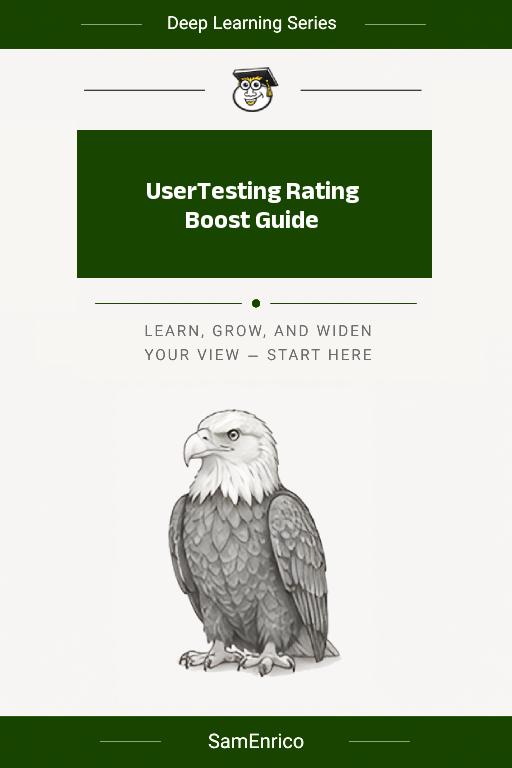
Non-FictionSide Hustle ArchitectRatings
UserTesting Rating Boost Guide eBook
Improves your UserTesting rating from 3 to 5 stars
Improves your UserTesting rating from 3 to 5 stars to receive 3x more test invites and higher-paying studies.
Formats
Free sample
Chapter 1: The Helpfulness Trap--–- Three stars. You stare at the rating on your User Testing dashboard, and something doesn't sit right. The test felt fine. You spoke clearly, you completed every task, you even remembered to say "uh-huh" at the right moments. And yet, three stars.
Not terrible. Not great. Just... somewhere in the middle. You tell yourself it's fine.
You'll do better next time. But next time never seems to come, because the invitations have slowed to a trickle. What was once a promising side income has become a ghost town of empty dashboards and expired screeners.This chapter exists because that experience is not your fault, but it is your problem to solve. The vast majority of User Testing contributors never break past the 3-star ceiling. They hover in the "Somewhat helpful" range, receiving just enough tests to stay active but never enough to earn real money.
They assume the platform is random, or oversaturated, or simply unfair. But the truth is far more specific—and far more fixable.The gap between a 3-star contributor and a 5-star contributor is not intelligence, experience, or even eloquence. It is a gap in understanding what the rating system actually measures. Most contributors think they are being judged on whether they finished the tasks. That is only the starting line.
The real judgment is about something researchers call "actionable empathy"—the ability to deliver feedback that another human being can immediately use to make a decision.This chapter will decode the User Testing rating system from the inside out. You will learn exactly what a customer sees when they click those stars, how the platform's algorithm uses ratings to determine who gets invited to high-paying tests, and why a single 3-star rating can damage your account for thirty days or more. More importantly, you will learn how to diagnose your own rating history, identify the specific gaps holding you back, and build a roadmap to consistent 5-star performance.By the end of this chapter, you will never look at a 3-star rating the same way again. You will see it not as a disappointment, but as a data point—one that tells you exactly what to fix.The Three-Star Illusion Let us start with the most dangerous belief on the User Testing platform: the idea that three stars is average, and average is acceptable. This belief is reinforced by almost every grading system we have ever encountered.
In school, a C is average. At work, meeting expectations is average. On most review platforms, three out of five stars means "fine, not great, not terrible."User Testing does not work that way.The official rating rubric, which every customer sees when they rate your test, defines each star level in very specific terms. Three stars means "Somewhat helpful." Four stars means "Helpful." Five stars means "Extremely helpful." These are not arbitrary labels. They are tied directly to how a researcher can use your feedback.When a researcher gives you three stars, they are saying: "This feedback helped a little, but I had to work to understand it.
I am not fully confident sharing it with my team." That hesitation is the killer. A researcher who is not fully confident will not quote you in their report. They will not invite you to future studies. And crucially, they will not rate you highly enough to boost your standing in the platform's algorithm.The difference between "Somewhat helpful" and "Extremely helpful" is not about quantity of feedback. It is about quality and clarity.
A five-star contributor might speak for eight minutes and deliver four quotable insights. A three-star contributor might speak for twelve minutes and deliver zero quotable insights, because the commentary was vague, unfocused, or buried in rambling.Consider this example from an actual test where a contributor was asked to review a checkout flow. The three-star version sounds like this: "Um, I guess it's okay. The button is there. I clicked it and it worked.
I don't know, it seems fine." The five-star version sounds like this: "The checkout button is located in the bottom right corner, which matches my expectation. However, I hesitated for about two seconds because the button is gray rather than green. In most e-commerce sites I use, green indicates confirmation while gray suggests disabled. If the goal is to encourage immediate checkout, I would recommend a green button with higher contrast."Both contributors completed the task. Both clicked the button.
But only one gave the researcher something they could paste directly into a presentation for their boss. That is the difference between three stars and five stars.What the Customer Actually Sees To understand how to earn five stars, you must first understand what the customer experiences when they rate you. Walk through the researcher's dashboard with me.After a contributor completes a test, the researcher receives a notification. They open the recording and watch your screen and hear your voice. They are almost always multitasking—checking email, taking notes, preparing for a meeting.
Their attention is divided. They are not listening for perfection. They are listening for signals: Is this person giving me useful information? Can I trust what they are saying? Do I need to rewatch any part of this?When the recording ends, the researcher sees a rating screen.
On that screen, each star level is accompanied by the official rubric descriptions. The researcher clicks a star, and if they choose four or five stars, they are asked to write a comment explaining why. That comment is optional for three stars or below.Here is what most contributors do not realize: researchers are under pressure. They are often junior employees trying to prove their value to a manager. They need data—clear, quotable, defensible data.
A five-star rating is not a gift. It is a signal that the researcher can defend to their boss. "I gave this contributor five stars because they gave me three direct quotes about the checkout friction, which I included in slide seven of my report."A three-star rating, by contrast, is often given with no comment. The researcher moves on quickly, not wanting to spend time explaining why the feedback was only somewhat helpful. This creates a silent trap: three-star ratings accumulate without explanation, leaving you with no clear path to improvement.The platform's algorithm watches these ratings closely.
User Testing does not publicly share the exact formula, but contributor data reveals clear patterns. A contributor with a 4.8-star average over thirty days sees approximately three to five times more test invitations than a contributor with a 3.5-star average. The difference is not linear. It is exponential. Small improvements in your average rating produce large gains in invitation volume.The Mathematics of Rating Suppression Let me share a number that should alarm you: a single three-star rating can suppress your dashboard visibility for thirty days or more.This is not speculation.
It is the observed pattern across hundreds of contributors who have tracked their invitation rates alongside their rating histories. The platform's algorithm appears to weight recent ratings heavily, with a rolling thirty-day window. A three-star rating today does not just reduce your average slightly. It flags your…
This is the end of the free sample. Get the eBook to keep going. Buy now
About this book
Details
- Author
- Arndt Conchita
- Publisher
- SamEnrico
- Language
- English
- Genre
- Non-Fiction, Side Hustle Architect, Ratings
- Released
- 2026-05-30
- Pages (approx.)
- 150
- Available as
- eBook, Audiobook

Read better in the ZLOADR app
Your eBooks on your phone or tablet. Sign in with your SamEnrico account and start reading.
More by Arndt Conchita
 Housing Nonprofit Fraud GuideArndt Conchita$11.99
 Navigating Exit InterviewsArndt Conchita$11.99
 Burnout Prevention for LeadersArndt Conchita$11.99
 The Bloodhound of Damascus: How a Dog Saved a Sultan's SonArndt Conchita$11.99
 Understanding Xanthine Oxydase DeficiencyArndt Conchita$17.99
 K-Pop: From Seoul to the WorldArndt Conchita$11.99
 CAC Forecasting MethodsArndt Conchita$12.99
 How to Start a Blenders for Domestic Use (electric) Business (Beginners Guide)Arndt Conchita$11.99
You may also like
 Hong Kong Handover 1997Dunn Johnnie$11.99
 Zumba For Postnatal Recovery CourseNeal Christian$11.99
 Zumba for BeginnersLadner Nikia$11.99
 YouTube Comment Mining GuideHumes Pandora$12.99
 Worry Box MeditationCarlin Rudy$11.99
 Workplace Stress MeditationNguyen Lynn$11.99
 Workplace Stress and Sleep RepairHawley Ivory$11.99
 Workplace Perfectionism CureDelaney Jeffry$11.99
 Workplace Injustice Anger GuideWallen Isabelle$11.99
 Work Addiction and Burnout LinkGreenwood Ester$11.99
 Women in Yoga and WellnessBeattie Galina$11.99
 Women in Stand Up ComedyChun Evangeline$11.99