
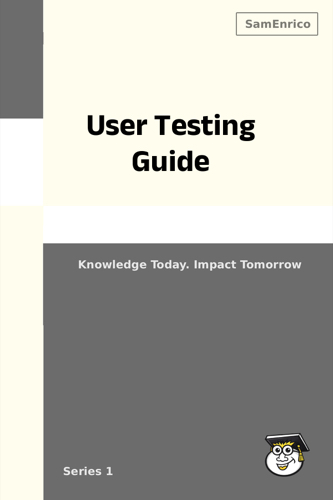
User Testing Guide eBook
Gather feedback and iterate solutions using this d
Gather feedback and iterate solutions using this design thinking workbook.
Formats
Free sample
Chapter 1: The Empathy Mandate--–- On a Tuesday afternoon in a cramped conference room, a product manager named Elena watched a recording of a first-time user trying to navigate her team’s carefully crafted mobile app. The user, a middle-aged father of two named Marcus, had been given a simple task: “Find out if this store carries a car seat for a three-year-old.” Within ninety seconds, Marcus had tapped the search icon, typed “car seat,” scrolled past three irrelevant results, tapped the back button, sighed audibly, tapped the menu icon, selected “Help,” read nothing, closed the help screen, and then said aloud, “I have no idea what this company wants me to do.” He then put his phone face-down on the table and folded his arms.Elena froze the video. Her team had spent six weeks designing that search experience. They had debated the shade of blue for the search bar for two hours. They had written the help content themselves, carefully, clearly.
And yet Marcus—a perfectly reasonable, intelligent human being—had been reduced to a posture of defeat in under two minutes. Elena looked around the room. Her lead designer was silent. Her engineer was staring at his shoes. “We are not the user,” Elena whispered.
“We have never been the user.” That moment—the moment the team realized that their expertise had become a liability rather than an asset—is the single most important inflection point in any product development cycle. This chapter is about how to manufacture that realization on demand, before you waste time, money, and trust building the wrong thing.The False Consensus Trap Every team suffers from a cognitive bias so pervasive and so invisible that it has ruined more products than bad code, tight deadlines, or budget cuts combined. It is called the false consensus effect: the tendency to overestimate how much other people share our own beliefs, preferences, and mental models. In plain language, you assume that other people think like you. And when you are building a product, that assumption is a lie.Research in behavioral economics has demonstrated that when asked to predict how others will behave, people consistently anchor on their own behavior.
If you would click the search bar first, you assume most users would. If you find the help content perfectly clear, you assume most users do. But your users do not have your training, your context, or your six weeks of arguing about shades of blue. They have their own lives, their own distractions, and their own mental models shaped by entirely different digital experiences. A user coming from Amazon expects search to work like Amazon.
A user coming from Craigslist expects something else entirely. Your carefully designed interface collides with a lifetime of learned patterns, and the collision is rarely graceful.The false consensus trap is particularly dangerous because it feels like empathy. When a designer says, “I think users will look for the search bar first,” they believe they are imagining the user’s perspective. But they are not. They are projecting their own perspective onto the user.
True empathy requires that you set aside your own mental model entirely and observe the user’s mental model as a separate, independent system. This is not a natural act. It is a disciplined skill, and it must be trained like a muscle.Consider the famous “jam study” conducted by Sheena Iyengar at Columbia University. Shoppers were presented with either six or twenty-four varieties of jam. The larger display attracted more attention, but shoppers who saw twenty-four jams were only one-tenth as likely to make a purchase as those who saw six.
The intuitive assumption—more choice is better—was false. But a product team operating under the false consensus trap would have assumed that they themselves would want more choice, and they would have built the larger display, harming conversion. The team that tests, that observes, that humbly admits it does not know, would have discovered the truth before launch.The Curse of Knowledge: Why Expertise Backfires There is a second bias that works in deadly partnership with false consensus. It is called the curse of knowledge. Once you know something, you cannot easily imagine what it is like to not know it.
This is not a character flaw; it is a neurological constraint. The brain literally rewires itself around new information, and the neural pathways that once represented “not knowing” become inaccessible.In a classic experiment, psychologists asked a group of participants to tap out the rhythm of a well-known song on a table. The tappers then predicted that listeners would identify the song fifty percent of the time. In reality, listeners identified the song correctly only two and a half percent of the time. The tappers, hearing the rhythm in their heads complete with lyrics and melody, could not imagine how it sounded to someone who did not already know the song.
They were cursed by their own knowledge.The same dynamic plays out every day in software development. You know that the settings icon is a gear in the upper right corner. You know that the search bar accepts natural language queries. You know that the help documentation is searchable by keyword. But your user does not know any of this.
To them, the gear icon is just a small gray shape. The search bar is a text field that might or might not work like Google. The help documentation is a wall of words they will never read. You are the tapper; they are the listener. And you are dramatically overestimating how clear your rhythm sounds.The curse of knowledge explains why user testing is not a “validation” step but a discovery step.
You are not testing to confirm that your design works. You are testing to discover where your knowledge has blinded you to confusion. Every moment of user confusion is not a failure of the user; it is a revelation of your own curse. The user is doing you a favor by showing you where your expertise has become a liability.Empathy vs. Sympathy: A Crucial Distinction In design thinking literature, the word “empathy” is used so frequently that it has begun to lose meaning.
Let us be precise. Empathy is the capacity to understand another person’s feelings and mental model from their perspective. Sympathy is the capacity to feel compassion for another person’s suffering. For user testing, empathy is useful; sympathy is useless, and sometimes even harmful.When you feel sympathy for a confused user—“Oh, poor thing, this interface is so hard for them”—you are still centering yourself. You are observing the user’s difficulty from a distance, feeling sorry for them, but not actually entering their mental model.
Sympathy keeps you separate. Empathy requires that you ask: What does the user believe is true about this interface? What have their past experiences taught them to expect? What would I do if I genuinely had no prior knowledge?A sympathetic observer says, “The user struggled with checkout.” An empathetic observer says, “The user expected the ‘Continue’ button to advance to payment, but it actually advanced to shipping, which they had already completed. Their mental…
This is the end of the free sample. Get the eBook to keep going. Buy now
About this book
Details
- Author
- Chastain Trinidad
- Publisher
- SamEnrico
- Language
- English
- Genre
- Non-Fiction, Self-Help, User Feedback
- Released
- 2026-06-06
- Pages (approx.)
- 139
- Available as
- eBook, Audiobook

Read better in the ZLOADR app
Your eBooks on your phone or tablet. Sign in with your SamEnrico account and start reading.
More by Chastain Trinidad
 Loneliness Recovery for Early RisersChastain Trinidad$11.99
 Crockpot Batch CookingChastain Trinidad$11.99
 The Immigrant Space StartupChastain Trinidad$11.99
 SAD Symptom Tracker WorkbookChastain Trinidad$11.99
 VA Benefits for VeteransChastain Trinidad$11.99
 Ultradian Rhythm FocusChastain Trinidad$11.99
 Grit for ScientistsChastain Trinidad$11.99
 Whispers in the Bazaar: The Djinn Who Sold TimeChastain Trinidad$11.99
 The Spice Lords: How the Dutch Built a Global EmpireChastain Trinidad$11.99
 How to Produce Video Camera BatteriesChastain Trinidad$11.99
 How to Produce Laundry Appliance AccessoriesChastain Trinidad$11.99
 A Collector's Handbook to the Marmon 79Chastain Trinidad$11.99