
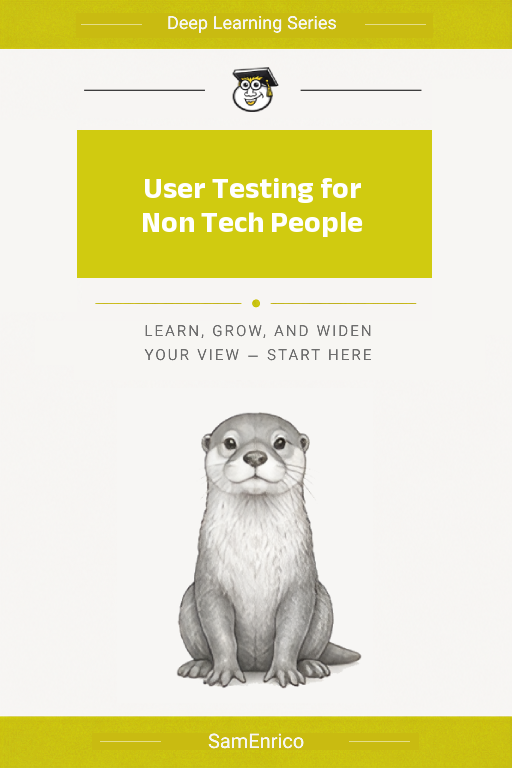
Non-FictionSide Hustle ArchitectNo Skills
User Testing for Non Tech People eBook
Tests websites without coding or technical skills,
Tests websites without coding or technical skills, just ability to share honest feedback and navigate common web interfaces.
Formats
Free sample
Chapter 1: The Curse of Certainty--– You are about to make a mistake. You will make it within the next hour, probably while reading this chapter. The mistake is not in the book. The mistake is believing that you already know what works on your website.Let me tell you about Sarah. Sarah ran marketing for a mid-sized online furniture store.
She had been there for four years. She knew every page, every button, every piece of copy. One morning, her CEO asked a seemingly simple question: “How long does it take a new customer to find our return policy?” Sarah opened the website. She clicked “Support” in the footer. She clicked “Returns.” Seven seconds, she thought.
She reported back: “About seven seconds.”The CEO, being a reasonable skeptic, asked her to watch a real customer try. Sarah recruited her neighbor, a retired schoolteacher named Diane who had never shopped at the store before. Sarah sat Diane in front of a laptop. She said, “Imagine you just received a damaged table. Where would you go to start a return?”Diane clicked “Contact Us.” She clicked “FAQ.” She clicked the search bar and typed “return.” Nothing helpful appeared.
She clicked “About Us” out of desperation. Three minutes and forty-two seconds later, Diane gave up and said, “I would just call the bank and dispute the charge.”Sarah was horrified. The return policy was there, on the site, clearly labeled—once you knew where to look. But Diane did not know where to look. The CEO did not fire Sarah.
But he did ask a more painful question: “How much money have we lost because other Dianes gave up?”That question is the reason you are holding this book.The Problem You Did Not Know You Had You have a curse. It is not a metaphor. Researchers have studied this phenomenon for decades, and they have given it a name that sounds like something from a fantasy novel: the Curse of Knowledge. It works like this. Once you know something, you cannot un-know it.
More dangerously, you cannot accurately imagine what it feels like not to know it.In 1990, a Stanford psychologist named Elizabeth Newton ran a simple experiment. She gave people a list of well-known songs, like “Happy Birthday” and “The Star-Spangled Banner.” One group of people—the “tappers”—had to tap out the rhythm of the song on a table. The other group—the “listeners”—had to guess the song based only on the tapping. Before the listeners guessed, the tappers were asked to predict how likely it was that the listeners would get it right. The tappers predicted 50 percent.
The listeners got it right 2.5 percent of the time.Here is what happened inside the tappers’ heads. When they tapped, they heard the song playing clearly in their minds. The melody, the lyrics, the emotion—it was all there. They could not understand why the listeners heard only random tapping. The listeners, of course, had none of that context.
They heard thumps.You are the tapper. Your website is the song. Your users are the listeners.Every time you look at your own homepage, you hear the full symphony. You know where you put the login button after that painful all-hands meeting. You know that the “Resources” dropdown contains the white paper your CEO loves.
You know that the tiny gray text in the footer is actually the legally required disclosure that saves the company from lawsuits. Your users see none of that. They see thumps.Why This Feels Like a Personal Attack (And Why That Is Good)I need you to feel a little defensive right now. That defensiveness is the proof that the Curse of Knowledge is operating inside your head. If you read the previous paragraphs and thought, “But my site is different—our navigation is clean,” then you are experiencing exactly the phenomenon this chapter exists to expose.Let me prove it to you with an exercise that takes less than two minutes.
I want you to open your website on your phone right now. Do not click anything yet. Just look at the screen. Now answer three questions without touching the screen:What is the third word on the page, starting from the top left corner?Where would you click to contact a real human being by phone?What is the name of the very last link in the footer?Most people cannot answer question one without scrolling and counting. Many people cannot answer question two because the phone number is buried.
Almost no one can answer question three without scrolling to the bottom and reading. But here is the terrifying part: you built this page. You approved it. You have looked at it hundreds of times. And you still cannot answer those three simple questions from memory.Now imagine a first-time visitor who has never seen your site before, who is slightly annoyed because they just spilled coffee on their keyboard, who is trying to complete a task before a meeting starts in four minutes.
That person is not going to patiently explore. That person is going to thump around randomly, get frustrated, and leave.The good news is that you are not stupid. You are not bad at your job. You are simply too close to the thing you built. The only cure for the Curse of Knowledge is not more knowledge.
It is humility, curiosity, and a willingness to watch people struggle without jumping in to rescue them.The One Distinction That Will Save You Thousands of Hours Before we go any further, we need to clear up a confusion that has wasted more time and money than almost any other misunderstanding in the world of websites. People confuse usability with user testing. They are not the same thing. Mistaking one for the other is like confusing a hammer with a house.Usability is a property of your website. It answers the question: is the site technically functional?
Does the button actually submit the form? Does the page load in under three seconds? Does the mobile layout break when someone rotates their phone? Usability can often be measured without any users at all. A developer can check load times.
A QA analyst can click every link. An accessibility scanner can find missing alt text. These are valuable activities. But they do not tell you what you actually need to know.User testing is a completely different animal. User testing answers the question: do real people understand the site intuitively?
Does a first-time visitor know where to click without being told? Does the checkout flow make sense to someone who has never seen it before? Does the error message actually explain what went wrong in plain English? You cannot answer these questions with a checklist or a scanner. You can only answer them by watching real humans try to use your site while you keep your mouth shut.Here is why the confusion matters.
I have watched teams spend weeks arguing about usability issues—button colors, font sizes, hover states—while the actual user testing would have revealed that the entire navigation structure was backwards. I have seen designers defend their work by saying “the usability…
This is the end of the free sample. Get the eBook to keep going. Buy now
About this book
Details
- Author
- Branham Shirly
- Publisher
- SamEnrico
- Language
- English
- Genre
- Non-Fiction, Side Hustle Architect, No Skills
- Released
- 2026-06-01
- Pages (approx.)
- 146
- Available as
- eBook, Audiobook

Read better in the ZLOADR app
Your eBooks on your phone or tablet. Sign in with your SamEnrico account and start reading.
More by Branham Shirly
 Robin Williams Voices InsideBranham Shirly$11.99
 The Difficult Talk Script BookBranham Shirly$11.99
 Teen Rejection Sensitivity GuideBranham Shirly$11.99
 Hypnic Jerk Reduction GuideBranham Shirly$11.99
 The Seizure Prevention WithdrawalBranham Shirly$11.99
 The Iron Fist of the Southern Cross: Australia's Forgotten Boxing LegendBranham Shirly$11.99
 Understanding XanthinuriaBranham Shirly$17.99
 Fintech CAC OptimizationBranham Shirly$12.99
 How to Start a Basic Slag (ground) Business (Beginners Guide)Branham Shirly$11.99
 K-pop Global Domination: BTS Military Service EraBranham Shirly$11.99
You may also like
 Hong Kong Handover 1997Dunn Johnnie$11.99
 Zumba For Postnatal Recovery CourseNeal Christian$11.99
 Zumba for BeginnersLadner Nikia$11.99
 YouTube Comment Mining GuideHumes Pandora$12.99
 Worry Box MeditationCarlin Rudy$11.99
 Workplace Stress MeditationNguyen Lynn$11.99
 Workplace Stress and Sleep RepairHawley Ivory$11.99
 Workplace Perfectionism CureDelaney Jeffry$11.99
 Workplace Injustice Anger GuideWallen Isabelle$11.99
 Work Addiction and Burnout LinkGreenwood Ester$11.99
 Women in Yoga and WellnessBeattie Galina$11.99
 Women in Stand Up ComedyChun Evangeline$11.99