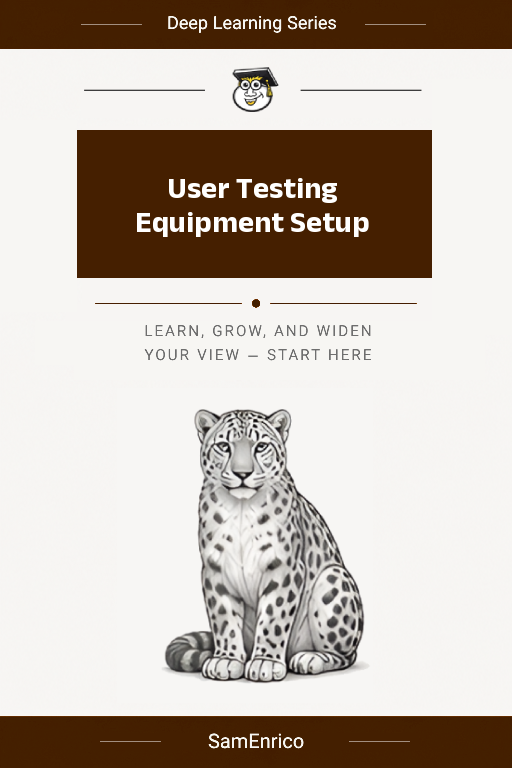
User Testing Equipment Setup eBook
Sets up microphone, screen recorder, and testing e
by Haslam Louis
Sets up microphone, screen recorder, and testing environment for 60/hour user testing with minimal investment.
Formats
Free sample
Chapter 1: The $60 Lie...--–- When I first started user testing, I believed I needed a one-way mirror, a broadcast-quality camera, and a soundproof room. I was wrong. That belief cost me three months of inaction and thousands of dollars I didn't have. The truth is simpler and far more disruptive: expensive labs don't just waste your money—they actively ruin your data. This chapter will dismantle everything you think you know about professional user testing equipment and replace it with a lean, authentic, and brutally effective approach that starts at 60perhourandscalesto60 per hour and scales to 60perhourandscalesto150 per hour within months.The Myth of the Perfect Lab Walk into any corporate usability lab and you will see the same theater: a sterile white room, a one-way mirror, cameras mounted on every wall, and a control room buzzing with observers.
It looks impressive. It feels scientific. And it produces garbage data.The Hawthorne Effect—first documented in the 1920s but largely ignored by modern UX—describes how people change their behavior when they know they are being watched. In a formal lab, users sit up straighter. They hesitate less.
They try to "perform" correctly. They stop swearing, stop slouching, and stop making the kinds of unfiltered comments that actually reveal design problems. A $50,000 lab doesn't capture reality; it captures a carefully edited performance.I learned this lesson the hard way. Early in my career, I spent two weeks recruiting participants for a study in a client's state-of-the-art lab. The users were polite.
They completed every task. They gave thoughtful, measured feedback. The client was thrilled. Then I ran the exact same test in the participants' own homes, using a $20 microphone and a smartphone camera. The results were unrecognizable.
Users swore at the interface. They clicked the wrong buttons repeatedly. They admitted they had no idea what half the icons meant. The client was horrified—until I explained that the home data was the truth and the lab data was a lie.That moment changed everything. I realized that "professional" equipment often acts as a barrier between you and the user.
A bulky camera makes people self-conscious. A quiet room amplifies every nervous swallow. A control room full of clients turns a simple usability test into a high-stakes performance. The solution is not better gear. It is less gear, positioned with intention.The Gig Economy Tester's Advantage You are not competing with Fortune 500 agencies on budget.
You are competing on authenticity. Your selling point is not "we have a lab" but "we test users where they actually use products." That is a premium differentiator, not a compromise.Consider the average user. They do not use websites in a soundproof room with perfect lighting. They use them at 11pm on a couch while a partner watches television. They use them on a crowded train with one thumb.
They use them during a work break with half their attention on Slack. If you test only in perfect conditions, you will ship a product that works perfectly only in perfect conditions—and fails everywhere else.The gig economy tester embraces imperfection. You will test in coffee shops with background hiss. You will test in home offices with barking dogs. You will test on laptops with dying batteries and slow Wi-Fi.
And every time you do, you will find bugs that expensive labs miss. That is not a weakness. It is your superpower.Position yourself accordingly. When a potential client asks about your equipment, do not apologize for its simplicity. Say this: "I test users in their natural environments because that's where your product will actually be used.
My setup is portable, unobtrusive, and designed to make users forget they're being recorded. That's how I get honest data." The client will not ask for a gear list. They will ask for your availability.Why Audio Matters More Than Video Most beginners obsess over video quality. They buy 4K cameras, ring lights, and color calibration tools. They spend hours adjusting their setup to capture every pore on the user's face.
This is a mistake. Audio is where the insight lives.A user muttering "I don't know where to click" under their breath contains more information than a crystal-clear close-up of their confused expression. A sharp inhale of frustration tells you exactly when the interface fails. A long, silent pause followed by a quiet "um" reveals the exact moment of cognitive friction. All of this is captured by a $20 lapel microphone.
None of it requires 4K video.Here is the hierarchy of user testing data, ranked by value:Verbalized confusion ("Wait, where did the button go?") – Highest value Non-verbal audio cues (sighs, sharp inhales, frustrated exhales) – Very high value Mouse movement and clicks – Medium value Facial expressions – Medium value (and often misleading)High-resolution video – Lowest value Notice where video sits. A user can look calm while their cursor dances in panic. They can smile while silently hating your interface. Video lies. Audio rarely does.Spend your limited budget accordingly.
Buy a decent lapel microphone before you buy anything else. Use your existing smartphone for video—it is more than adequate at 720p. And never, ever record without a backup audio track. The most painful lesson I learned was a two-hour session with perfect video and a dead microphone. The footage was useless.
I paid the participant from my own pocket and learned to always, always check my audio levels.The Real Cost of Inaction You are reading this book because you want to start a user testing business or add testing to your existing UX services. Every day you delay is costing you money. Let me be specific.A single user test at 60perhourgenerates60 per hour generates 60perhourgenerates60. Five tests per week (easily achievable with the setup in this book) generates 300perweek.Fifteentestsperweek(full−time)generates300 per week. Fifteen tests per week (full-time) generates 300perweek.Fifteentestsperweek(full−time)generates900 per week, or 3,600permonth.Thatisleanstartupterritory.By Chapter12,youwilllearnhowtoscalethatto3,600 per month.
That is lean startup territory. By Chapter 12, you will learn how to scale that to 3,600permonth.Thatisleanstartupterritory.By Chapter12,youwilllearnhowtoscalethatto150 per hour, or $9,000 per week at full capacity.Every week you spend worrying about gear, learning complex software, or waiting for the "perfect" time to start is a week you are not earning. The gear you need costs less than a dinner for two. The software is free. The skills are in this book.
The only missing ingredient is action.I have trained dozens of testers who delayed their launch because they thought they needed better equipment. One woman spent six months saving for a 2,000camera.Whenshefinallystartedtesting,shediscoveredthatherclientscaredonlyabouttheinsights,nottheresolution.Anothermanboughtaprofessionallightingkitheneverusedbecauseusersfoundittoobrightanddistracting.Bothofthemcouldhavebeenearningmoneysixmonthsearlierwithnothingmorethana2,000 camera. When she finally started testing, she discovered that her clients cared only about the insights, not the resolution. Another man bought a professional lighting kit he never used because users found it too bright and distracting. Both of them could have been earning money six months earlier with nothing more than a 2,000camera.Whenshefinallystartedtesting,shediscoveredthatherclientscaredonlyabouttheinsights,nottheresolution.Anothermanboughtaprofessionallightingkitheneverusedbecauseusersfoundittoobrightanddistracting.Bothofthemcouldhavebeenearningmoneysixmonthsearlierwithnothingmorethana20 microphone and a smartphone.Do not make their mistake.
Start with what you have. Upgrade only when you have data proving you need to.What "Good Enough" Actually Looks Like Let me define "good enough" concretely so you have…
This is the end of the free sample. Get the eBook to keep going. Buy now
About this book
Details
- Author
- Haslam Louis
- Publisher
- SamEnrico
- Language
- English
- Genre
- Non-Fiction, Side Hustle Architect, Equipment
- Released
- 2026-06-01
- Pages (approx.)
- 131
- Available as
- eBook, Audiobook

Read better in the ZLOADR app
Your eBooks on your phone or tablet. Sign in with your SamEnrico account and start reading.
More by Haslam Louis
 Email Mobile Efficiency GuideHaslam Louis$11.99
 The Nonviolent Communication PrimerHaslam Louis$11.99
 Sleep Apnea CPAP HygieneHaslam Louis$11.99
 Mindfulness Based Burnout RecoveryHaslam Louis$11.99
 The Cannabis Withdrawal GuideHaslam Louis$11.99
 The Phantom Callers: The Global Telephone Swindle of the 1970sHaslam Louis$11.99
 GlimmerHaslam Louis$11.99
 CAC Success StoriesHaslam Louis$12.99
 Understanding X Chromosome, Trisomy Xpter Xq13Haslam Louis$17.99
 Ultimate Handbook Guide to Benxi : (China) Travel GuideHaslam Louis$11.99