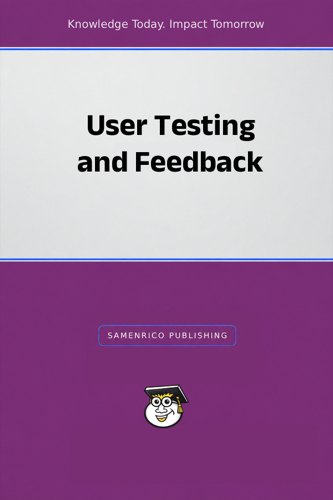
User Testing and Feedback Audiobook
Gathers insights to improve solutions.
Gathers insights to improve solutions.
Formats
Free sample
Chapter 1: The $2 Million Button--On a Tuesday morning in 2016, a mid-sized e-commerce company did something unusual. They stopped their weekly feature sprint and instead ran a 90-minute user test with five strangers. The results were not subtle. Users could not find the checkout button. Not because it was hidden, but because it was grey on a grey background—a design choice that had seemed "clean and modern" to the internal team.
After the test, the company changed the button to bright green and added simple copy that said "Complete Purchase." Conversion on that page increased by 37% within two weeks. Annualized, that single button change was worth $2 million.The button had been grey for eighteen months. For eighteen months, users had been abandoning their carts because no one had bothered to watch them struggle.This is not an outlier story. This is the norm. For every $2 million button, there are thousands of grey buttons costing companies millions in silent, invisible losses.
And the worst part? Most teams never know. They blame the user ("Users just don't read"), or the market ("Competition is fierce"), or the economy ("It's just a bad quarter"). They never look at the five-second hesitation before a click. They never watch the confused frown.
They never hear the sigh.This book exists because that ignorance is expensive, and because fixing it is surprisingly cheap. You do not need a lab. You do not need a Ph D in psychology. You do not need a six-figure budget. You need a method, a notebook, and the willingness to shut up and watch.Welcome to the business case for user testing.
It is not about making things "pretty" or "intuitive" as abstract virtues. It is about removing friction that costs you money, every single day, whether you measure it or not.The Cognitive Tax You Are Currently Paying Let us define a term that will appear throughout this book: cognitive load. Cognitive load is the amount of mental effort required to use your product. When cognitive load is low, users glide. They do not think about the interface; they think about their goal.
When cognitive load is high, users grind. Every button requires a decision. Every label requires interpretation. Every step requires a mental map.Here is the problem: you cannot feel your users' cognitive load. You are the expert.
You have used your product thousands of times. What seems obvious to you is often opaque to a first-time user.…
This is the end of the free sample. Get the Audiobook to keep going. Buy now
About this book
Details
- Author
- Waterman Deanne
- Publisher
- SamEnrico
- Language
- English
- Genre
- Non-Fiction, Self-Help, User Research
- Released
- 2026-06-05
- Pages (approx.)
- 137
- Available as
- eBook, Audiobook

Listen in the VoxFlicks app
Audiobooks and audio dramas wherever you go. Sign in with your SamEnrico account and press play.
More by Waterman Deanne
 Remote Work Insurance GuideWaterman Deanne$11.99
 Self Hypnosis for Menstrual CrampsWaterman Deanne$11.99
 Osborn Parnes CPS GuideWaterman Deanne$11.99
 Parental Anger at Foster ChildWaterman Deanne$11.99
 Self Esteem for Young WorkersWaterman Deanne$11.99
 Mouth Covering SignalWaterman Deanne$11.99
 Small Talk for Sporting EventsWaterman Deanne$11.99
 The First Lady and the Monster: Argentina's Darkest SecretWaterman Deanne$11.99
 The Last Oracle of Delphi: When the Gods Spoke Through FireWaterman Deanne$11.99
 How to Produce Coffee FiltersWaterman Deanne$11.99
 Launching A Youtube Channel For Your Brand BreakthroughWaterman Deanne$12.99
 Italian Government ScholarshipsWaterman Deanne$12.99