
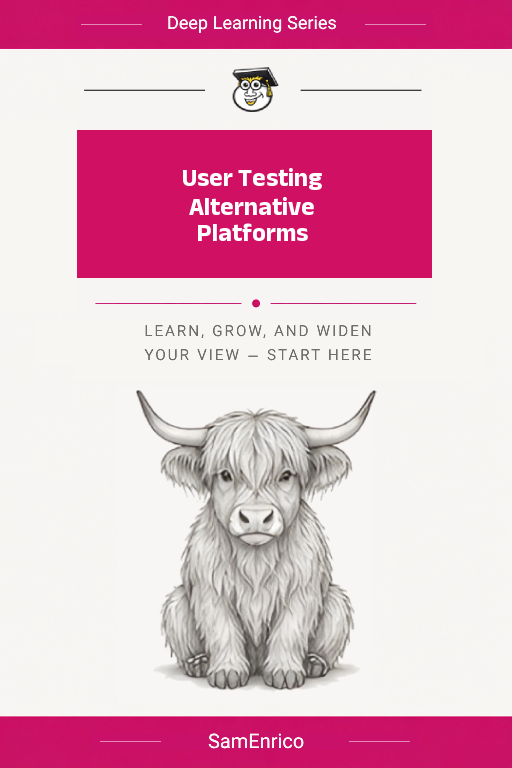
Non-FictionSide Hustle ArchitectAlternatives
User Testing Alternative Platforms eBook
Explores lesser-known user testing platforms like
Explores lesser-known user testing platforms like UserCrowd, Feedback Army, and UserFeel that also pay 60-120/hour.
Formats
Free sample
Chapter 1: Beyond the Cartel--–- In 2017, a freelance graphic designer in Ohio named Mariana opened her laptop at 6:00 AM, as she did every Tuesday. She had exactly ninety minutes before her first client call. She needed to make 40tocoverherdaughter’sorthodontistpayment.Sheopened Upwork.Nothing.Sheopened Fiverr.One40 to cover her daughter’s orthodontist payment. She opened Upwork. Nothing.
She opened Fiverr. One 40tocoverherdaughter’sorthodontistpayment.Sheopened Upwork.Nothing.Sheopened Fiverr.One5 logo request. She opened a new tab and typed “user testing get paid” into Google—a desperate, last-resort search she’d ignored for months because it sounded too good to be true.What she found changed everything.The first result was User Testing.com, promising 10fortwentyminutes.Sheclicked.Sheapplied.Shewasrejectedwithinanhourforhaving“insufficientdemographicprofile.”Thesecondresultwas User Crowd.Shesignedup,completedafive−questionscreener,andwithinfourminuteswaslookingata10 for twenty minutes. She clicked. She applied.
She was rejected within an hour for having “insufficient demographic profile.” The second result was User Crowd. She signed up, completed a five-question screener, and within four minutes was looking at a 10fortwentyminutes.Sheclicked.Sheapplied.Shewasrejectedwithinanhourforhaving“insufficientdemographicprofile.”Thesecondresultwas User Crowd.Shesignedup,completedafive−questionscreener,andwithinfourminuteswaslookingata0.80 test. She rolled her eyes. Eighty cents. But she had ninety minutes and a 40goal.Shedidthetest.Thenanother.Thenanother.By7:15AM,shehadcompletedtwenty−twotestsandearned40 goal.
She did the test. Then another. Then another. By 7:15 AM, she had completed twenty-two tests and earned 40goal.Shedidthetest.Thenanother.Thenanother.By7:15AM,shehadcompletedtwenty−twotestsandearned18.40. Not $40.
But she noticed something strange: the last five tests went faster than the first five. She was getting quicker. She was learning what they wanted.By the end of that week, Mariana had earned $187 from User Crowd alone. By the end of the month, she had added User Feel and Feedback Army, stacking tests between client work. By the end of the year, she had replaced her freelance design income entirely.
She wasn’t designing logos anymore. She was getting paid to complain, to click, to talk out loud, and to tell companies exactly why their websites were broken.This book is not about Mariana. It is about you. And it is about a truth that the usability testing industry does not want you to know: you do not need a degree in human-computer interaction, a portfolio of case studies, or a network of Silicon Valley contacts to earn 60to60 to 60to120 per hour testing websites. You need only three things: a device with an internet connection, the ability to speak or write in complete sentences, and the willingness to see yourself not as a tester but as a hired consultant.The $36,000 Lie Let us start with a number that should make you angry: $36,000.That is approximately how much a mid-sized company pays annually for an enterprise license on User Testing, the most well-known platform in the industry.
For that 36,000,theyreceiveacertainnumberoftests,adashboardofresults,andaccesstoapooloftesterslikeyou—exceptyouseealmostnoneofthatmoney.Whenaclientpays36,000, they receive a certain number of tests, a dashboard of results, and access to a pool of testers like you—except you see almost none of that money. When a client pays 36,000,theyreceiveacertainnumberoftests,adashboardofresults,andaccesstoapooloftesterslikeyou—exceptyouseealmostnoneofthatmoney.Whenaclientpays36,000 for a block of tests, the individual tester might receive 10to10 to 10to30 per completed session. The platform keeps the rest. This is not unique to User Testing. It is the business model of the entire enterprise usability testing industry.But here is the lie: most people believe that User Testing, User Zoom, and Userlytics are the only games in town.
They are not. They are simply the loudest. They have the largest sales teams. They send the most emails. They sponsor the most UX conferences.
And because of that, they have convinced both clients and testers that they are the only legitimate option.The alternative platforms—User Crowd, User Feel, Feedback Army, Testing Time, Inamo, and a dozen others—operate on a completely different model. They do not charge clients 36,000peryear.Theychargepertest,often36,000 per year. They charge per test, often 36,000peryear.Theychargepertest,often15 to 60percompletedsession.Andbecausetheiroverheadislower,theycanpaytestersamuchlargerpercentageofthatfee.On User Feel,atestermightearn60 per completed session. And because their overhead is lower, they can pay testers a much larger percentage of that fee. On User Feel, a tester might earn 60percompletedsession.Andbecausetheiroverheadislower,theycanpaytestersamuchlargerpercentageofthatfee.On User Feel,atestermightearn20 for a ten-minute test—120perhour.On User Crowd,atestermightearn120 per hour.
On User Crowd, a tester might earn 120perhour.On User Crowd,atestermightearn0.80 for a ninety-second test—$32 per hour. On Inamo, a tester might earn €45 for a thirty-minute moderated session—€90 per hour.The catch, and there is always a catch, is that these alternative platforms do not advertise to testers. They advertise to clients. They want the people paying for tests, not the people taking them. That is why you have probably never heard of them.
That is why your Google searches for “work from home” and “side hustle” showed you survey sites that pay 2perhourinsteadofusabilityplatformsthatpay2 per hour instead of usability platforms that pay 2perhourinsteadofusabilityplatformsthatpay60. And that is why this book exists: to pull back the curtain on the hidden economy of user feedback.Why the Top UX Books Ignore You If you walk into a bookstore or search Amazon for “usability testing,” you will find dozens of excellent books. Steve Krug’s Don’t Make Me Think. Jakob Nielsen’s Usability Engineering. Erika Hall’s Just Enough Research.
Indi Young’s Mental Models. These are foundational texts. They have shaped the field of user experience for decades. And they are completely useless to you as a tester.Why? Because they are written for researchers.
They teach you how to design a test, how to recruit participants, how to analyze results, how to present findings to stakeholders. They assume you are on the payroll of a company or agency. They assume you have a budget, a timeline, and a team. They assume you are the person asking the questions, not the person answering them.No book has ever been written for the person on the other side of the screen. The person who wakes up at 6:00 AM, opens a laptop, and has ninety minutes to make 40.Thepersonwhoknowsnothingaboutmentalmodelsorinformationarchitecturebutknowsexactlywhenabuttonfeelswrong.Thepersonwhohasbeentoldtheirwholelifethattheiropinionsarenotvaluable—untilacompanypays40.
The person who knows nothing about mental models or information architecture but knows exactly when a button feels wrong. The person who has been told their whole life that their opinions are not valuable—until a company pays 40.Thepersonwhoknowsnothingaboutmentalmodelsorinformationarchitecturebutknowsexactlywhenabuttonfeelswrong.Thepersonwhohasbeentoldtheirwholelifethattheiropinionsarenotvaluable—untilacompanypays15 to hear them.This book is that book.The Quick Opinion Gap To understand why alternative platforms exist and why they pay so well, you need to understand a concept I call the “Quick Opinion Gap.”Here is the problem that every company faces: they have a website or app that is not working as well as they hoped. People are not clicking the button. They are abandoning their cart. They are calling customer support with questions that should be answered on the homepage.
The company knows something is wrong, but they do not know what. They have two options.Option one: hire a full-service UX agency. This costs 50,000to50,000 to 50,000to150,000 for a single study. The agency will recruit participants, conduct moderated interviews, analyze the data, and deliver a beautiful slide deck. This is excellent work, but it is slow (four to eight weeks) and expensive (out of reach for most small and medium businesses).Option two: use an enterprise platform like User Testing.
This costs $36,000 per year for a limited number of tests. The company gets video recordings of testers thinking aloud…
This is the end of the free sample. Get the eBook to keep going. Buy now
About this book
Details
- Author
- Willoughby Bernarda
- Publisher
- SamEnrico
- Language
- English
- Genre
- Non-Fiction, Side Hustle Architect, Alternatives
- Released
- 2026-06-01
- Pages (approx.)
- 139
- Available as
- eBook, Audiobook

Read better in the ZLOADR app
Your eBooks on your phone or tablet. Sign in with your SamEnrico account and start reading.
More by Willoughby Bernarda
 The Difficult Conversation TrackerWilloughby Bernarda$11.99
 Email Folder Structure GuideWilloughby Bernarda$11.99
 Recovery From Burnout JournalWilloughby Bernarda$11.99
 Bidis and Kretek Cessation GuideWilloughby Bernarda$11.99
 The Lucid Mask Device GuideWilloughby Bernarda$11.99
 The Silk and Scalpel Dynasty: The Healers of the Kingdom of KongoWilloughby Bernarda$11.99
 Taylor Swift: The Eras of a Global PhenomenonWilloughby Bernarda$11.99
 Understanding X-linked Mental Retardation and MacroorchidismWilloughby Bernarda$17.99
 Delaware C Corp AdvantagesWilloughby Bernarda$12.99
 How to Become a Loading-shovel OilerWilloughby Bernarda$11.99
You may also like
 Hong Kong Handover 1997Dunn Johnnie$11.99
 Zumba For Postnatal Recovery CourseNeal Christian$11.99
 Zumba for BeginnersLadner Nikia$11.99
 YouTube Comment Mining GuideHumes Pandora$12.99
 Worry Box MeditationCarlin Rudy$11.99
 Workplace Stress MeditationNguyen Lynn$11.99
 Workplace Stress and Sleep RepairHawley Ivory$11.99
 Workplace Perfectionism CureDelaney Jeffry$11.99
 Workplace Injustice Anger GuideWallen Isabelle$11.99
 Work Addiction and Burnout LinkGreenwood Ester$11.99
 Women in Yoga and WellnessBeattie Galina$11.99
 Women in Stand Up ComedyChun Evangeline$11.99