
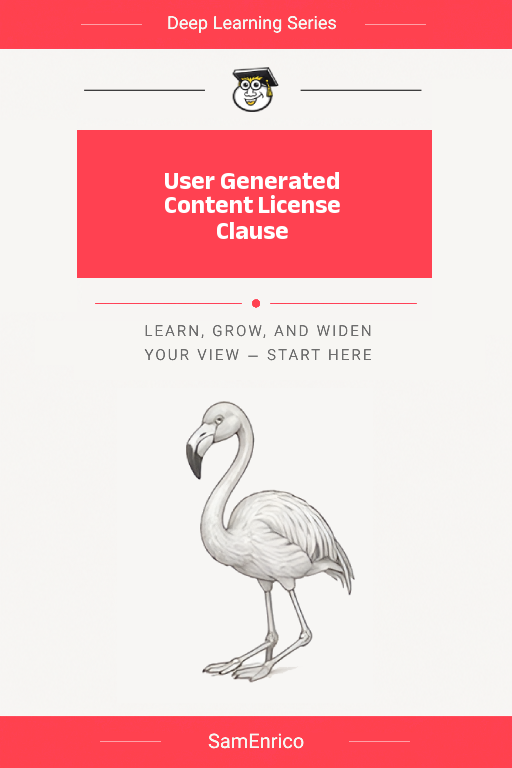
User Generated Content License Clause eBook
Obtain worldwide license to display and promote us
Obtain worldwide license to display and promote user posts while keeping their ownership rights.
Formats
Free sample
Chapter 1: The Billion-Dollar Button--–- On March 15, 2022, a wildlife photographer named Elena Vasquez woke up to a notification that would change how she understood the internet forever. Her phone buzzed at 6:43 AM with a direct message from a stranger. The message contained a single screenshot: a billboard in downtown Los Angeles featuring a photograph she had taken of a mountain lion in Montana's Bob Marshall Wilderness. Elena had never sold that image. She had never licensed it to anyone.
She had never even uploaded it to a commercial platform. What she had done, eighteen months earlier, was post it to her Instagram account with a caption that read, "Wild at heart. #naturelovers." The billboard was for a luxury SUV brand. The image had been cropped, filtered, and stripped of her name. Below the photograph, in small type, were two words: "Used by permission." Elena had never given permission.
But she had clicked "I agree." And in the fine print of that agreement, she had signed away more than she ever knew.This is not a story about a single photographer in Montana. This is a story about every person who has ever posted a selfie, a vacation photo, a video of their child's first steps, or a comment that went unexpectedly viral. It is a story about the single most misunderstood sentence in the digital economy: the User Generated Content License Clause. It is hidden inside every social media platform, every mobile app, every forum, and every website that allows users to post content. It is typically between one and three paragraphs long.
It is written in language that would make a medieval tax collector blush. And it quietly, legally, and permanently transfers an astonishing set of rights from you to the platform.The Myth of "I Posted It, So I Own It"Let us begin with a simple exercise. Ask yourself: when you post a photo to Instagram, who owns it? Most people answer correctly: you do. Instagram's own Terms of Service state this explicitly.
"We do not claim ownership of your content," they write. This sounds reassuring. It sounds like the platform respects your rights. It sounds like the story ends there.It does not.The story actually begins there. Because ownership is not the same as control.
And control is not the same as the ability to say no. You can own a house and still be bound by a lease that gives a tenant the right to stay for thirty years. You can own a car and still be legally prohibited from driving it in certain zones. You can own a song and still have signed a record deal that gives the label the right to distribute it without your further permission. Ownership is a title.
License is a set of permissions. And in the world of user-generated content, the license you grant to the platform is almost always far broader, far longer, and far more profitable for them than you ever intended.Here is what a typical UGC license clause actually gives the platform, in plain English stripped of the legalese:The right to display your content anywhere in the world, not just on their platform The right to keep using your content forever, even after you delete your account The right to modify your content—to crop it, edit it, combine it with other content, or alter it in ways you might find objectionable The right to sublicense your content to third parties, meaning they can give your rights to someone else without asking you The right to use your content for any purpose, including commercial advertising, without paying you Read that list again. Then ask yourself: if you had been presented with that list as a separate contract, with a signature line next to each item, would you have signed it? Would you have agreed to let a platform sell your vacation photo to a car company? Would you have agreed to let them crop your face out of a family portrait and use it in a political ad?
Would you have agreed to let them keep using your child's video forever, even after you deleted your account?Of course not. No rational person would sign that contract. But you did sign it. You signed it the moment you created an account and clicked "I agree." You signed it without reading it. You signed it because the button was blue and the only alternative was not using the platform at all.
And that, precisely, is the billion-dollar trick.The Relational Trap: You Are Not the Customer To understand why platforms write these clauses the way they do, we have to understand a deeper truth about the internet economy. You are not the customer. You are the product. This phrase has become something of a cliché, but its legal implications are rarely explored. In the world of UGC licensing, you are not a sovereign author whose work the platform politely borrows.
You are a raw material supplier. Your posts are the inventory. Your engagement is the labor. And the license clause is the supply contract that transfers value from you to the platform.James Meese, a legal scholar at RMIT University in Melbourne, has written extensively on what he calls the "relational triad" of user-generated content. In his book Authors, Users, and Pirates, Meese argues that the UGC license clause is not a simple two-party contract between a creator and a platform.
It is a three-way negotiation involving the Author (who wants control and credit), the User (who wants sharing and community), and the Pirate (who ignores all rules and takes without permission). The platform positions itself as the mediator, but the license clause is designed to benefit the platform first, the pirate second, and the author last.Let us walk through how this works in practice. When you post a photograph to a platform, the license clause gives the platform the right to "display and promote" your work. That sounds harmless. But "promote" is a chameleon word.
In the context of a social media app, "promote" can mean featuring your post on the explore page. It can also mean including your image in a targeted advertisement. It can mean selling your image to a brand that wants to run a sponsored post using your face. It can mean creating a compilation video of "best user content" and licensing that compilation to television networks. The word "promote" does not distinguish between these uses.
It covers all of them.Meanwhile, the Pirate—the third party who scrapes your image from the platform and reposts it on their own website, or prints it on a t-shirt, or includes it in a meme—can claim that the platform's license clause grants them some protection as well. After all, if the platform has the right to sublicense your content, and the Pirate obtained it from the platform, the Pirate can argue they are a sublicensee. The platform rarely stops them. The platform rarely tries. Because the platform's business model does not depend on protecting your rights.
It depends on the free flow of content, regardless of who benefits.The Flickr Lesson: How One Company Got It Right (And Why…
This is the end of the free sample. Get the eBook to keep going. Buy now
About this book
Details
- Author
- Block Lyndsey
- Publisher
- SamEnrico
- Language
- English
- Genre
- Non-Fiction, First 30 Days
- Released
- 2026-05-29
- Pages (approx.)
- 142
- Available as
- eBook, Audiobook

Read better in the ZLOADR app
Your eBooks on your phone or tablet. Sign in with your SamEnrico account and start reading.
More by Block Lyndsey
 B-29 Superfortress and the Pacific WarBlock Lyndsey$11.99
 Child Star Tell All Books GuideBlock Lyndsey$11.99
 Career Transition App ToolkitBlock Lyndsey$11.99
 Decision Fatigue SolutionsBlock Lyndsey$11.99
 Treatment Resistant Depression GuideBlock Lyndsey$11.99
 Upwork Connects Budgeting GuideBlock Lyndsey$11.99
 Upwork Profile Optimization GuideBlock Lyndsey$12.99
 Citation Rules for Multiple Authors GuideBlock Lyndsey$11.99
 Vietnam Thud PilotBlock Lyndsey$11.99
 Carnegie RetirementBlock Lyndsey$11.99
 The Silk Road Stargazers: Ancient Women Who Charted the CosmosBlock Lyndsey$11.99
 The Oxford Circle: Where the Renaissance Met the EnlightenmentBlock Lyndsey$11.99
You may also like
 Hong Kong Handover 1997Dunn Johnnie$11.99
 Zumba For Postnatal Recovery CourseNeal Christian$11.99
 Zumba for BeginnersLadner Nikia$11.99
 YouTube Comment Mining GuideHumes Pandora$12.99
 Worry Box MeditationCarlin Rudy$11.99
 Workplace Stress MeditationNguyen Lynn$11.99
 Workplace Stress and Sleep RepairHawley Ivory$11.99
 Workplace Perfectionism CureDelaney Jeffry$11.99
 Workplace Injustice Anger GuideWallen Isabelle$11.99
 Work Addiction and Burnout LinkGreenwood Ester$11.99
 Women in Yoga and WellnessBeattie Galina$11.99
 Women in Stand Up ComedyChun Evangeline$11.99