
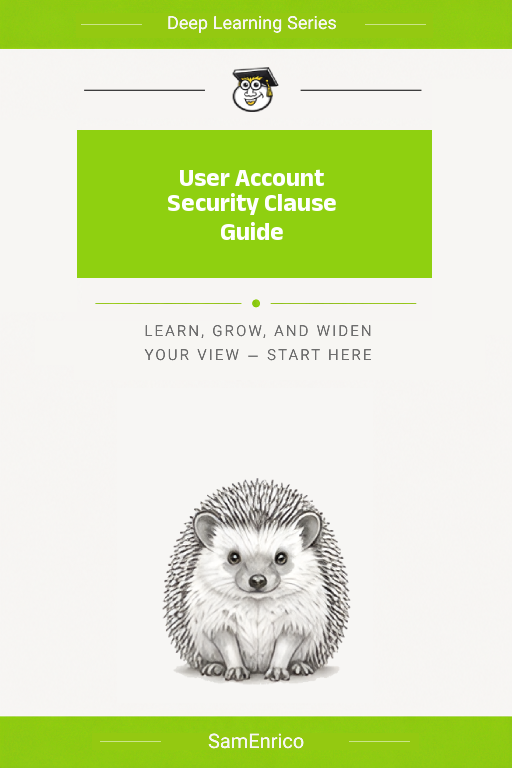
User Account Security Clause Guide eBook
Hold users responsible for keeping passwords secre
Hold users responsible for keeping passwords secret and notify you of any unauthorized access.
Formats
Free sample
Chapter 1: The Liability Handshake--It was 2:47 AM on a Sunday when the first alert fired.The on-call engineer for a mid-sized logistics company, let’s call it Trans Logix, glanced at his phone. A single line of text: “Unusual login from IP 185.xx.xx.xx.” He rolled over and went back to sleep. He assumed the vendor’s security systems would handle it. After all, they had promised “enterprise-grade protection” in the sales deck. They had displayed SOC 2 badges on their website.
They had assured Trans Logix during the procurement process that security was “their top priority.”By 6:12 AM, the attacker had used those stolen credentials to access Trans Logix’s routing engine. By 9:30 AM, 147 trucks had been redirected to empty parking lots instead of their scheduled warehouses. By noon, three major retail customers had announced they would be suing Trans Logix for breach of contract. The total loss, when calculated months later, exceeded $12 million.The vendor? They responded to the breach notification email—sent at 4:01 PM on Sunday—by quoting Section 7.3(c) of their standard terms of service.
The section was titled “Customer Security Obligations.” It read, in part: “Customer is solely responsible for maintaining the confidentiality of its account credentials and for any and all activities that occur under such credentials. Customer shall notify Vendor immediately of any unauthorized use of its account.”Trans Logix’s legal team argued that “immediately” was unreasonable—who could be expected to respond at 2:47 AM on a Sunday? The vendor’s lawyers pointed to the clause. The judge pointed to the clause. The jury pointed to the clause.
Trans Logix paid $12 million.The security clause did not cause the breach. The employee who clicked a phishing link two weeks earlier caused the breach. But the security clause determined who paid for it. And in the cold arithmetic of contract law, the handshake between vendor and user—the moment the user clicked “I Agree”—was a handshake that transferred millions of dollars of liability from the vendor to the user.This chapter is about that handshake. Not the technical handshake between servers, but the legal handshake between two parties: one that controls the platform, and one that holds the keys.
You cannot understand the User Account Security Clause without understanding the fundamental exchange at its core. And you cannot protect your business without recognizing that the moment you sign, you are making promises that can cost you everything if broken.The Handshake That Changed Everything The concept of a legal “handshake” dates back centuries. In common law, a handshake was not merely a greeting. It was a ritual that signified agreement. Two parties extended their hands, grasped, and in that moment, a bargain was struck.
No paper required. No witness necessary. The handshake itself was the contract.Modern digital commerce has no handshake. It has click-through agreements, terms of service buried behind hyperlinks, and ninety-page Saa S contracts that no human being ever reads in full. But the underlying principle remains.
When you create an account, when you check the box, when you sign the electronic signature line, you are extending your hand to the vendor. And the vendor is extending theirs back. In that moment, you agree to a set of promises that will determine who pays when something goes wrong.The User Account Security Clause is the most important handshake you will ever make. More important than the service level agreement. More important than the data processing addendum.
More important than the pricing schedule. Because when a breach happens—not if, but when—the security clause decides whether you walk away with a bruised reputation or a bankrupt company.Yet almost no one reads it. A study by the University of Michigan found that fewer than 1 percent of users read any terms of service before accepting. Among business users who are signing contracts worth tens of thousands of dollars annually, the number is only slightly higher. Legal departments review the indemnification clauses.
Procurement reviews the pricing. IT reviews the technical specifications. But the security clause—the clause that says “you are responsible for your passwords and you must notify us immediately”—is treated as boilerplate. Standard language. Nothing to see here.That treatment is a catastrophic error.The Three Promises You Make When You Sign Every user account security clause, regardless of vendor or industry, contains three core promises.
They are phrased differently. They are buried in different sections. But they are always present in any well-drafted agreement. Understanding these three promises is the first step to managing your risk.Promise One: The Secrecy Promise. You promise to keep your credentials secret.
Not just your password, but your API keys, your OAuth tokens, your biometric templates, your hardware certificates—anything that authenticates you to the vendor’s system. You promise not to share them with unauthorized parties. You promise not to write them down in insecure locations. You promise not to reuse them across services. You promise to treat them as the sensitive assets they are.This promise sounds obvious.
Of course you will keep your password secret. But the legal standard is higher than common sense. “Secret” in contract law means “known only to authorized parties.” If an employee shares a password with a colleague to cover a sick day, that password is no longer secret. If a contractor emails an API key to a vendor support representative, that key is no longer secret. If an administrator stores the master password in an unencrypted spreadsheet on a shared drive, that password is no longer secret.
The promise is absolute. Any disclosure to any unauthorized party, no matter how well-intentioned, is a breach.Promise Two: The Attribution Promise. You agree that the vendor may treat any transaction that comes from your account—using your credentials—as if you authorized it. This is the non-repudiation principle introduced in the previous chapter. You cannot later claim “that wasn’t me” unless you can prove that (a) your credentials were compromised, (b) you notified the vendor of the compromise, and (c) the transaction occurred after the notification.This promise is what makes digital commerce possible.
Without it, every transaction would be disputable. Every transfer could be reversed. Every database deletion could be blamed on a phantom hacker. The vendor relies on this promise to run their business. They do not have the resources to investigate whether every login was truly authorized.
They rely on your promise that you will protect your credentials and notify them when you fail.Promise Three: The Notification Promise. You promise to tell the vendor immediately—or within a specified timeframe—if you know or suspect that your credentials have been compromised. This promise is the escape hatch from the attribution promise. Notification stops the clock. After you notify, the vendor can no longer assume that transactions are authorized.
Before you notify, every transaction is your responsibility.The notification promise is the most violated provision in all of Saa S contracting. Companies discover potential breaches and then spend hours or days investigating internally before telling the vendor. They want to be sure. They do not want to cry wolf. They worry about looking foolish if it turns out to be a false…
This is the end of the free sample. Get the eBook to keep going. Buy now
About this book
Details
- Author
- Blodgett Loise
- Publisher
- SamEnrico
- Language
- English
- Genre
- Non-Fiction, First 30 Days
- Released
- 2026-06-01
- Pages (approx.)
- 143
- Available as
- eBook, Audiobook

Read better in the ZLOADR app
Your eBooks on your phone or tablet. Sign in with your SamEnrico account and start reading.
More by Blodgett Loise
 Note Taking Systems GuideBlodgett Loise$11.99
 Slot Machine Addiction ScienceBlodgett Loise$11.99
 Cognitive Restructuring GuideBlodgett Loise$11.99
 Relapse Prevention Motivation InterviewingBlodgett Loise$11.99
 Financial Neglect Childhood GuideBlodgett Loise$11.99
 B-17 Flying Fortress Defensive ArmamentBlodgett Loise$11.99
 Meth Overdose Survivor's TaleBlodgett Loise$11.99
 Delayed Sleep Phase Disorder GuideBlodgett Loise$11.99
 Resentment Toward WealthyBlodgett Loise$11.99
 The Timbuktu Timekeepers: Mathematicians Who Calculated the CosmosBlodgett Loise$11.99
 The Amber Road: Prehistoric Resin and the Birth of Trade in the AmazonBlodgett Loise$11.99
 The Silk and the Spy: A Love That Defied EmpiresBlodgett Loise$11.99
You may also like
 Hong Kong Handover 1997Dunn Johnnie$11.99
 Zumba For Postnatal Recovery CourseNeal Christian$11.99
 Zumba for BeginnersLadner Nikia$11.99
 YouTube Comment Mining GuideHumes Pandora$12.99
 Worry Box MeditationCarlin Rudy$11.99
 Workplace Stress MeditationNguyen Lynn$11.99
 Workplace Stress and Sleep RepairHawley Ivory$11.99
 Workplace Perfectionism CureDelaney Jeffry$11.99
 Workplace Injustice Anger GuideWallen Isabelle$11.99
 Work Addiction and Burnout LinkGreenwood Ester$11.99
 Women in Yoga and WellnessBeattie Galina$11.99
 Women in Stand Up ComedyChun Evangeline$11.99