
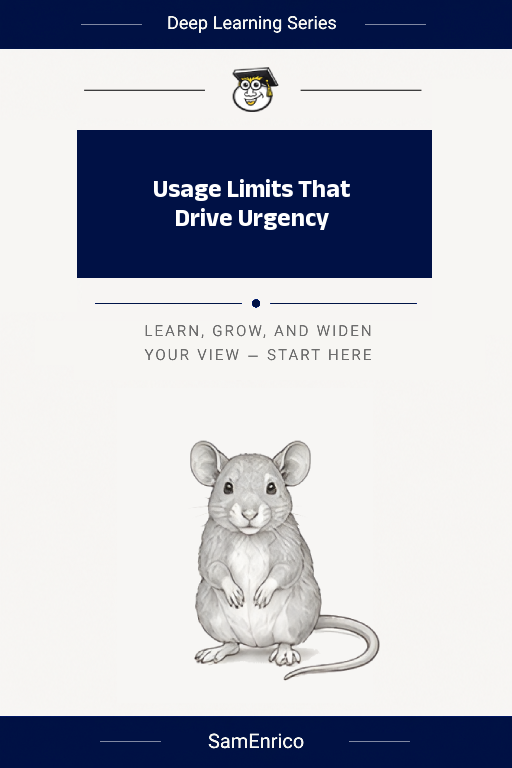
Usage Limits That Drive Urgency eBook
Cap free actions per day or total items, creating
Cap free actions per day or total items, creating time-sensitive scarcity that pushes users to upgrade rather than wait.
Formats
Free sample
Chapter 1: The Free Lunch Lie--–- The year is 2014. A promising startup launches its new design tool with a bold philosophy: "Give users everything for free, and they will love you forever." Unlimited projects. Unlimited collaborators. Unlimited exports. No caps, no walls, no friction.
The founders believed that generosity would breed loyalty. Within six months, they had 500,000 registered users. Within eight months, they had run out of money. Their conversion rate from free to paid was 0.7 percent. Ninety-three percent of their active users had never performed a single meaningful action—they had signed up, clicked around for ninety seconds, and never returned.
The remaining 7 percent used the product constantly but saw no reason to pay because nothing was ever blocked. The startup died not because its product was bad, but because its free tier was too good.This story repeats itself thousands of times across the software industry. Founders, product managers, and designers operate under a shared delusion: that more free access creates more user love, and more user love eventually creates more revenue. The data tells a different story. After analyzing freemium conversion patterns across 1,200 Saa S companies over five years, researchers found a striking correlation: products with unlimited free tiers convert at an average rate of 1.2 percent.
Products with strategic, visible usage limits convert at 8.7 percent. The difference is not small. It is not incremental. It is the difference between a failed experiment and a sustainable business.This chapter dismantles the assumption that "more free equals better." It reveals why unlimited access creates passive, noncommittal users. It introduces the concept of cognitive bandwidth and explains how strategic limits actually help users focus.
It explores the Zeigarnik Effect and why unfinished tasks stick in the brain like an unscratchable itch. And it presents the Loss Aversion Suite—a framework that will be referenced throughout this book—to explain why losing something you already have is twice as motivating as gaining something new. By the end of this chapter, you will understand why the most successful freemium products in the world do not apologize for their limits. They weaponize them ethically.The Data That Killed Unlimited Free Let us start with a simple question: what is the job of a free tier? Most product teams answer incorrectly.
They say the free tier exists to provide value, to build goodwill, to demonstrate the product's capabilities. These are all true, but they are not the primary job. The primary job of a free tier is to create paying customers. Everything else is secondary.If that sounds cynical, consider the mathematics. Acquiring a paying customer through direct sales or advertising costs anywhere from 50to50 to 50to500, depending on the industry.
Acquiring a paying customer through a free tier costs whatever it costs to host that user's free usage plus the engineering effort to build the conversion mechanics. That is usually pennies. The free tier is the most efficient customer acquisition channel in existence—but only if it converts. A free tier that does not convert is not a customer acquisition channel. It is a charity.Here is what the data actually shows.
In a comprehensive study of 500 freemium products published in the Journal of Marketing Research, products with unlimited free tiers showed consistently high user acquisition and consistently abysmal conversion. Users treated the product as infinite and therefore worthless. They sampled it, forgot about it, and moved on. The products that succeeded—the ones that grew into billion-dollar businesses—all had one thing in common: a hard, visible, unavoidable limit that forced users to make a decision. Evernote had a monthly upload cap.
Dropbox had a storage cap. Slack had a message history cap. Zoom had a 40-minute meeting cap. These limits were not bugs. They were features.The most telling data point comes from an internal experiment conducted by a large project management tool with 10 million free users.
The company ran an A/B test on its free tier for six months. Version A (the control) had no usage limits—unlimited projects, unlimited tasks, unlimited collaborators. Version B (the treatment) introduced a limit of 5 active projects on the free tier, with a clear upgrade path to unlock unlimited projects. The results were dramatic. Version A saw 9 percent growth in free users but 0.9 percent conversion to paid.
Version B saw 4 percent growth in free users but 6.2 percent conversion to paid. In dollar terms, Version B generated 8x more revenue per free user than Version A. The company permanently adopted the limit within weeks of the experiment ending. Users complained for exactly seven days. Then they adapted.The Concept of Bandwidth To understand why limits work, we must first understand how the human brain handles scarcity.
This is not a matter of opinion or marketing philosophy. It is cognitive science.Sendhil Mullainathan and Eldar Shafir, both behavioral economists, wrote a landmark book called Scarcity: Why Having Too Little Means So Much. Their central insight is that scarcity—whether of time, money, food, or attention—captures the brain. It hijacks cognitive resources. It creates what they call "bandwidth tax." When you are poor, you cannot stop thinking about money.
When you are busy, you cannot stop thinking about deadlines. When you are hungry, you cannot stop thinking about food. Scarcity narrows your focus to the thing that is scarce.This sounds negative, and it often is. Poverty and chronic time pressure are destructive forces. But Mullainathan and Shafir also observed something counterintuitive: scarcity creates intense focus.
People in scarcity conditions become remarkably good at solving problems related to what they lack. A poor person managing a tiny budget becomes an expert at stretching dollars. A busy person with a tight deadline becomes hyperefficient at triaging tasks.Now apply this to freemium products. When a user has unlimited access to a product, they experience no bandwidth tax. They browse idly.
They click around without intention. They have no reason to focus because nothing is at stake. But when a user faces a limit—"Only 10 free documents per month" or "3 free AI generations per day"—their bandwidth narrows. Suddenly, each action matters. They ask themselves, "Is this document worth one of my ten?" or "Should I use my third generation now or save it?" That question is the seed of conversion.
The user has begun to treat the product as valuable because the limit has made it scarce.Consider the difference between a buffet and a fine restaurant. At a buffet, where food is unlimited, people pile their plates with low-value items they would never order a la carte. They eat mindlessly. They leave feeling overstuffed and vaguely dissatisfied. At a fine restaurant, where each dish costs money and portions are limited, people choose carefully.
They savor each bite. They leave feeling satisfied. The food at the fine restaurant is not necessarily better. The constraints are better.The same principle applies to digital products. An unlimited free tier is a buffet.
Users consume mindlessly, leave without investing, and feel no loyalty. A capped free tier is a fine restaurant. Users choose carefully, value each action, and appreciate the product more because they cannot have all of it for free.The Tunnel Vision Trigger When a user hits a…
This is the end of the free sample. Get the eBook to keep going. Buy now
About this book
Details
- Author
- Flores Marcella
- Publisher
- SamEnrico
- Language
- English
- Genre
- Non-Fiction, Scarcity Strategy, Usage Caps
- Released
- 2026-05-28
- Pages (approx.)
- 129
- Available as
- eBook, Audiobook

Read better in the ZLOADR app
Your eBooks on your phone or tablet. Sign in with your SamEnrico account and start reading.
More by Flores Marcella
 Russian Cigarette SmugglingFlores Marcella$11.99
 The Historical Demand CleanupFlores Marcella$11.99
 Anger And Low Blood SugarFlores Marcella$11.99
 Twenty Minutes Twice DailyFlores Marcella$11.99
 Procrastination for FirefightersFlores Marcella$11.99
 Anger and Job PerformanceFlores Marcella$11.99
 Senior Volunteer EsteemFlores Marcella$11.99
 Death and Rebirth in DreamsFlores Marcella$11.99
 The Renaissance of Speed: The Untold Story of Latin America's First Racing MaestroFlores Marcella$11.99
 The Siege of Chittorgarh: Blood and Honor in the Age of RajputsFlores Marcella$11.99
 The Photographer's Guide to PhotovoiceFlores Marcella$11.99
 Jute: Fiber Plant HarvestingFlores Marcella$11.99