
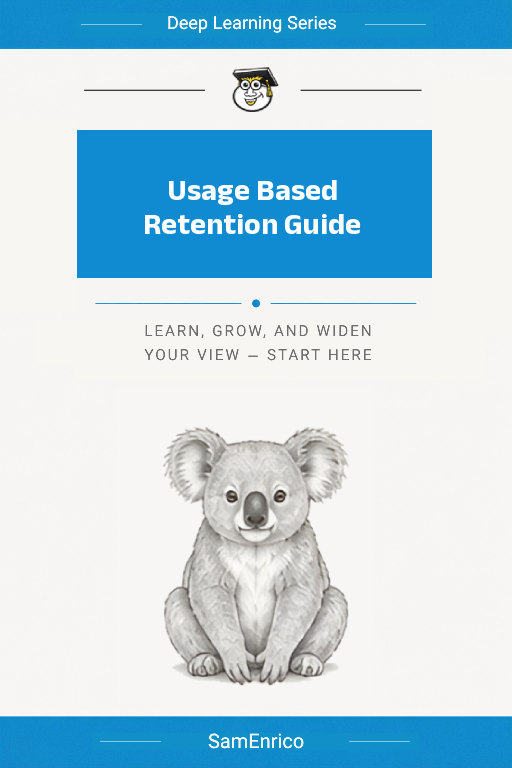
Non-FictionStrategic AtlasUsage
Usage Based Retention Guide eBook
Studies how top performers increase product usage
Studies how top performers increase product usage through feature education, usage alerts, and habit-forming triggers.
Formats
Free sample
Chapter 1: The Retention Lie--–- Alex had just presented his quarterly results to the board. Fifty thousand new users. A successful feature launch. Acquisition up 40 percent year over year. The CEO shook his hand.
The head of marketing gave him a nod. Then the data lead pulled him aside after the meeting and said three words that made his stomach drop: “Look at retention.”Alex pulled up the cohort report. Of the fifty thousand users who signed up in January, fewer than seven thousand were still active in April. Eighty-six percent churn within ninety days. Two hundred thousand dollars in acquisition spend.
Almost no one came back.He was fired six weeks later.Not because he couldn’t acquire users. He could. Not because the product was broken. It worked fine. Alex was fired because he confused activity with loyalty.
He optimized for the wrong thing. And somewhere in a venture capital boardroom, a partner wrote a note that said: “Great product. No retention. Pass.”This book is for every Alex. For every product manager, founder, and growth lead who has ever looked at a retention curve that looks like a ski slope and wondered what they missed.
The answer is not more features. It is not better onboarding. It is not more notifications. The answer is simpler and harder at the same time: you have been measuring the wrong thing, designing for the wrong moment, and optimizing for the wrong behavior.Let me tell you why eighty percent of apps fail the retention test. Let me tell you what the top one percent of products do differently.
And let me tell you why “build it and they will come” is the most expensive lie in technology.The Graveyard of Good Intentions Every week, thousands of product managers run the same experiment. They build a feature. They launch it. They watch the adoption curve go up. They celebrate.
Then they watch the retention curve go down. And they are genuinely confused.Here is what they miss: acquisition is a math problem. Retention is a psychology problem. You can buy acquisition. You cannot buy retention.
You can hack growth. You cannot hack habit.The data is relentless. Across thousands of apps studied by companies like Amplitude, Mixpanel, and Localytics, the numbers tell the same story. Within ninety days of download, eighty percent of users abandon most apps. For consumer apps, the number is often higher—some categories see ninety-five percent churn within ninety days.
For B2B Saa S, the numbers are slightly better but still brutal: sixty to seventy percent of new users stop using the product within ninety days.But here is what those averages hide. The top ten percent of products do something completely different. They keep fifty percent or more of their users after ninety days. They turn new users into habitual users. They build products that users don’t just try—they adopt, integrate, and depend on.What do those products have in common?
They are not necessarily better designed. They are not necessarily better funded. They are not necessarily in better markets. They have discovered something that the other ninety percent have not: retention is not a metric you measure at the end of the month. It is a behavior you design at the beginning of the user journey.The Vitamin vs.
Painkiller Framework Every product falls into one of two categories. You are either a vitamin or a painkiller. And if you want to retain users, you need to be a painkiller.Vitamins are nice to have. They are interesting. They are pleasant.
They might even be useful. But when a user stops taking a vitamin, nothing happens. No acute pain. No immediate consequence. No reason to come back.
Most productivity apps are vitamins. Most news apps are vitamins. Most “lifestyle” features are vitamins. Users try them, feel slightly better, and then forget they exist.Painkillers solve acute, recurring pain. When a user stops using a painkiller, something bad happens immediately.
They feel the absence. They experience negative consequences. They have a reason to come back. Slack is a painkiller for team communication chaos. Dropbox is a painkiller for file sync anxiety.
Uber is a painkiller for the frustration of waiting for a taxi. Duolingo is a painkiller for the fear of losing language skills.The distinction matters because retention follows pain. Users do not form habits around vitamins. They form habits around pain relief. This is not manipulation.
This is alignment. Your product either solves a problem that keeps coming back, or it doesn’t. If it doesn’t, no amount of onboarding, notifications, or engagement hacks will save you.Here is the diagnostic test. Ask yourself three questions about your product:First, does your user feel a specific negative emotion before using your product? Not a vague sense of “this might be useful.” A real, identifiable negative emotion.
Frustration. Boredom. Loneliness. Uncertainty. Anxiety.
Fear of missing out. Fatigue. If you cannot name the negative emotion, you do not have a painkiller. You have a vitamin.Second, does that negative emotion reliably disappear during or after use? The relief must be consistent.
It must be predictable. The user must know that when they open your app, the bad feeling will go away. If the relief is inconsistent, the user will not trust the product. They will not return.Third, would the user notice within seven days if your product disappeared? Not intellectually.
Not after reading an email about a shutdown. Immediately, viscerally. Would they feel the absence? Would their work get harder? Would their day get worse?
If the answer is no, you do not have a retention problem. You have a product problem.I have run this diagnostic with dozens of product teams. The reaction is always the same. First, denial. “But our users love us.” Then, realization.
“Wait, would they actually notice if we shut down?” Then, silence. Most products are vitamins pretending to be painkillers. The marketing says “essential.” The data says “optional.”The Engagement Hack Delusion When retention numbers look bad, most teams do the same thing. They add engagement hacks. Points.
Badges. Leaderboards. Streaks. Achievements. Notifications.
Emails. Popups. They turn the product into a game of meaningless rewards.Here is the truth about engagement hacks: they work temporarily and fail permanently. Predictable rewards—the kind you get every time you complete an action—train users to expect a payoff. Then the payoff becomes the baseline.
Then the baseline becomes boring. Then the user chases the next reward. Then they realize the rewards are empty. Then they leave.The research is clear. In a study published in the Journal of Marketing Research, researchers found that points and badges increased short-term engagement but had no effect on long-term retention.
Worse, when the rewards stopped, engagement dropped below baseline. Users had been trained to expect a reward. When the reward disappeared, so did they.But here is the nuance that most teams miss. The problem is not badges. The problem is predictable badges.
The problem is not points. The problem is points that arrive on a fixed schedule. The problem is not leaderboards. The problem is leaderboards that never change.What works…
This is the end of the free sample. Get the eBook to keep going. Buy now
About this book
Details
- Author
- Miranda Athena
- Publisher
- SamEnrico
- Language
- English
- Genre
- Non-Fiction, Strategic Atlas, Usage
- Released
- 2026-06-01
- Pages (approx.)
- 136
- Available as
- eBook, Audiobook

Read better in the ZLOADR app
Your eBooks on your phone or tablet. Sign in with your SamEnrico account and start reading.
More by Miranda Athena
 Orchestral Manager Behind ScenesMiranda Athena$11.99
 HIIT Nutrition Fueling GuideMiranda Athena$11.99
 Empathetic Listening Skills GuideMiranda Athena$11.99
 Narcotics Anonymous Step WorkbookMiranda Athena$11.99
 The OCD Medication GuideMiranda Athena$11.99
 The Blood of Sedan: Love and Valor in the Franco-Prussian WarMiranda Athena$11.99
 How to Become a Oxygen-furnace OperatorMiranda Athena$11.99
 Cloud Storage Free to PaidMiranda Athena$12.99
 The Breeder's Guide to Holland ChickensMiranda Athena$11.99
 Hanksite MiningMiranda Athena$11.99
You may also like
 Hong Kong Handover 1997Dunn Johnnie$11.99
 Zumba For Postnatal Recovery CourseNeal Christian$11.99
 Zumba for BeginnersLadner Nikia$11.99
 YouTube Comment Mining GuideHumes Pandora$12.99
 Worry Box MeditationCarlin Rudy$11.99
 Workplace Stress MeditationNguyen Lynn$11.99
 Workplace Stress and Sleep RepairHawley Ivory$11.99
 Workplace Perfectionism CureDelaney Jeffry$11.99
 Workplace Injustice Anger GuideWallen Isabelle$11.99
 Work Addiction and Burnout LinkGreenwood Ester$11.99
 Women in Yoga and WellnessBeattie Galina$11.99
 Women in Stand Up ComedyChun Evangeline$11.99