
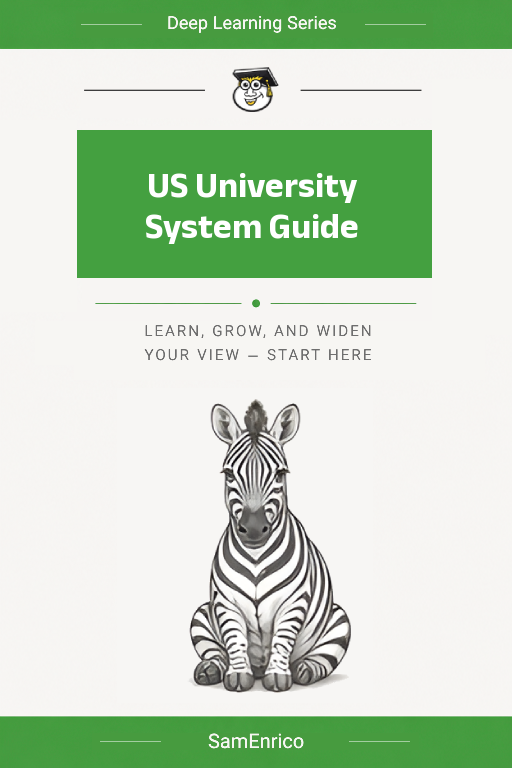
Non-FictionStudent's ShortcutUS Education
US University System Guide eBook
Navigate liberal arts, four-year degrees, major de
Navigate liberal arts, four-year degrees, major declaration, and Ivy League vs state schools.
Formats
Free sample
Chapter 1: The Unspoken Betrayal--–- The first lie you will hear about college is also the kindest: "Follow your passion, and the money will follow." The second lie is crueler, though it arrives wrapped in good intentions: "Any accredited university will give you a solid education. You can't go wrong." Both statements are false. Both have ruined millions of lives. And both are told to you by parents, teachers, and guidance counselors who genuinely believe they are helping.The truth—the one that will get this book thrown out of high school career centers if administrators actually read it—is that the United States university system is not designed for your success. It never was.
It was designed for the success of the institution: its endowment, its faculty research output, its football stadium revenue, its US News ranking, and its alumni donation rate. You are not the customer. You are the raw material. You arrive hopeful, malleable, and uninformed. You leave four, five, or six years later with a piece of paper and, on average, 38,000indebt(ifyouarelucky)or38,000 in debt (if you are lucky) or 38,000indebt(ifyouarelucky)or100,000 (if you are normal) or $200,000 (if you made the mistake of believing that "sticker price" means anything at all).This chapter is not about how to pick a college.
That comes later. This chapter is about why almost everything you have been told about the American university system is backwards. It is about the structural incentives that turn eighteen-year-olds into revenue streams, the psychological traps that keep students enrolled in the wrong majors for the wrong reasons, and the single most important frame shift you must make before you read another page of this book.Because here is the third lie, and this one is the most dangerous of all: "College is an investment in yourself."No. College is an investment. Period.
You do not invest in yourself the way you invest in a gym membership or a meditation app. You invest in a financial asset. The asset is your future earning potential, discounted by the probability that you will graduate, multiplied by the likelihood that your chosen field actually pays a living wage, and subtracted by the opportunity cost of four years of lost wages and compounding interest on borrowed money. That is cold. That is clinical.
That is also the only way to look at this decision without ending up forty years old, divorced, and crying into a mortgage payment you cannot afford because you majored in something that felt meaningful at nineteen but meant nothing to any employer who ever saw your resume.The good news—and there is good news, or this book would be a very short, very depressing pamphlet—is that the system is not random. It is not even particularly complicated once you understand its incentives. It is exploitable. It is hackable. And you are about to learn exactly how.The $1.7 Trillion Hole in the Ground Let us start with a number so large that the human brain struggles to comprehend it: $1.7 trillion.
That is the total outstanding student loan debt in the United States as of 2025. To put that number in perspective, it is larger than the entire GDP of Australia, Spain, or Mexico. It is roughly seven times the total amount of credit card debt in the country. It is more than Americans owe on car loans, personal loans, and medical debt combined.And here is the part that should make you angry: approximately 40 percent of that debt belongs to people who never finished their degrees. They borrowed money, attended for two or three years, and then dropped out—often because of the very weeder courses we will discuss in Chapter 9, or because they could not declare the competitive major they wanted, or because a family emergency drained their savings, or because they simply realized they were on the wrong path but felt too ashamed to leave earlier.The system has no skin in the game.
When you drop out, the university does not refund your tuition. When you cannot find a job in your major, the career center does not cut you a check. When you default on your loans, the school's credit rating remains pristine. The only entity that suffers is you. And the only entity that profits—whether you succeed or fail, whether you graduate or drop out, whether you love your classes or hate them—is the university.This is not a bug.
It is a feature.Consider the economics of a typical large public university. The marginal cost of admitting one additional student is astonishingly low: a few thousand dollars for advising, utilities, and maybe an adjunct professor's salary. The marginal revenue of that same student is 15,000to15,000 to 15,000to30,000 per year in tuition and fees. That is a profit margin that would make a pharmaceutical executive blush. And unlike a pharmaceutical company, which at least has to pretend its products cure something, a university does not even have to guarantee that you learn anything.
It only has to keep you enrolled for four years and process your graduation paperwork.This is why universities spend millions on marketing, branding, and campus amenities (rock climbing walls, lazy rivers, dining halls that look like shopping malls). It is why admissions brochures feature happy, diverse groups of students laughing on a quad somewhere, never a single image of a student crying in the library at 3 AM before an organic chemistry exam. It is why every tour guide will tell you about the "vibrant community" and "world-class faculty" and never mention that your introductory biology class has 800 students, is taught by a graduate student who does not speak English as a first language, and has a failure rate of 35 percent.They are selling you a dream. You are buying it with borrowed money. And when the dream dies—as it does for nearly half of all students who start college—the debt remains.The Four-Year Myth The single most destructive assumption in American higher education is that a bachelor's degree takes four years.
It does not. It takes four years only if everything goes perfectly: you enter with the right prerequisites, you declare the right major at the right time, you never fail or withdraw from a course, you never switch majors, you never need to work more than fifteen hours per week, and you never have a mental health crisis, a family emergency, or a financial catastrophe.How many students does that describe? According to the National Center for Education Statistics, approximately 41 percent of students at public universities graduate in four years. At private universities, the number rises to 59 percent. At elite institutions, it can exceed 80 percent—because elite institutions have the resources to provide advising, tutoring, and mental health support, and because their students are disproportionately wealthy enough not to need full-time jobs.For everyone else—first-generation students, low-income students, students with disabilities, students who work more than twenty hours per week, students who are the first in their families to attend college—the four-year degree is a cruel joke.
The average time to graduation for these students is 5.2 years. And every additional year costs another 20,000to20,000 to 20,000to60,000…
This is the end of the free sample. Get the eBook to keep going. Buy now
About this book
Details
- Author
- Rowell Nickole
- Publisher
- SamEnrico
- Language
- English
- Genre
- Non-Fiction, Student's Shortcut, US Education
- Released
- 2026-05-29
- Pages (approx.)
- 124
- Available as
- eBook, Audiobook

Read better in the ZLOADR app
Your eBooks on your phone or tablet. Sign in with your SamEnrico account and start reading.
More by Rowell Nickole
 Thief In Law Hierarchy RulesRowell Nickole$11.99
 Breast Cancer ChemopreventionRowell Nickole$11.99
 Sugar Addiction in Children GuideRowell Nickole$11.99
 Pinterest VA Trello Board SetupRowell Nickole$11.99
 Mindfulness for Burning Mouth SyndromeRowell Nickole$11.99
 The Silent Killer of K2: The Deadliest Mountain's Unseen ThreatRowell Nickole$11.99
 The Last Dance: How a Ballerina Defied the Soviet RegimeRowell Nickole$11.99
 How to Start a Moulding Machines for Dairies Business (Beginners Guide)Rowell Nickole$11.99
 Fluidics EngineerRowell Nickole$11.99
 Pre Seed Hiring StrategyRowell Nickole$12.99
 Understanding Common ColdRowell Nickole$17.99
You may also like
 Hong Kong Handover 1997Dunn Johnnie$11.99
 Zumba For Postnatal Recovery CourseNeal Christian$11.99
 Zumba for BeginnersLadner Nikia$11.99
 YouTube Comment Mining GuideHumes Pandora$12.99
 Worry Box MeditationCarlin Rudy$11.99
 Workplace Stress MeditationNguyen Lynn$11.99
 Workplace Stress and Sleep RepairHawley Ivory$11.99
 Workplace Perfectionism CureDelaney Jeffry$11.99
 Workplace Injustice Anger GuideWallen Isabelle$11.99
 Work Addiction and Burnout LinkGreenwood Ester$11.99
 Women in Yoga and WellnessBeattie Galina$11.99
 Women in Stand Up ComedyChun Evangeline$11.99