
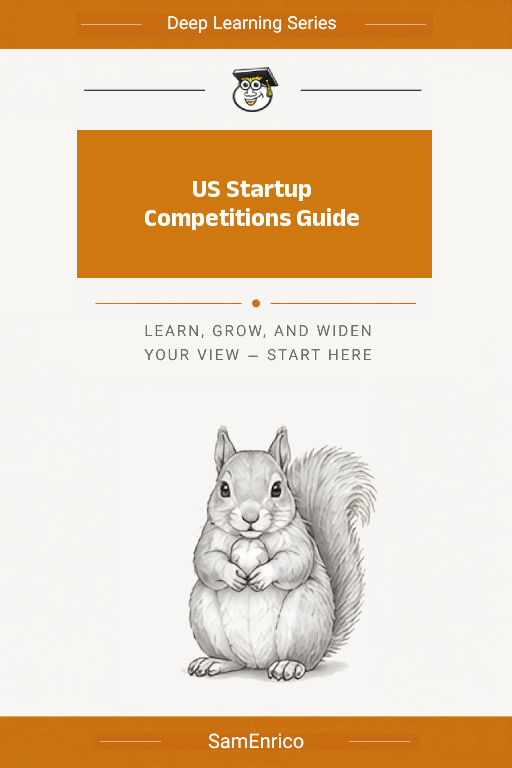
Non-FictionStartup GuideNon-Dilutive Grants
US Startup Competitions Guide eBook
Find startup competitions across United States. Re
by Carl Jessi
Find startup competitions across United States. Regional and national pitch events with prizes.
Formats
Free sample
Chapter 1: Free Money Exists--–- Let me tell you something most founders will never hear: there is over $50 million in cash prizes awarded to startups across the United States every single year, and ninety-four percent of it goes to people who knew a secret you are about to learn.The secret is not about having a better product. It is not about being smarter, more connected, or luckier. The secret is that most founders do not even know these competitions exist, and of those who do, ninety percent never apply because they assume they cannot win. That assumption is wrong. It is expensively wrong.
It is the difference between bootstrapping for three years and getting paid to build your company.This chapter exists to shatter that assumption permanently.The Lie You Have Been Told Let me start with a confession. I have judged forty-seven startup competitions across twenty-three states. I have sat at tables with venture capitalists, city council members, corporate sponsors, and economic development directors. I have watched hundreds of founders walk onto stages, shake through their pitches, and walk off with checks ranging from five hundred dollars to one million dollars.And here is what I learned: the winners were almost never the best companies.They were the best players.They understood something the losers did not. They understood that startup competitions are not meritocracies in the way you think.
They are games with rules, rubrics, and hidden incentives. Once you learn those rules, your odds of winning increase by a factor of ten—not because your company gets better overnight, but because you stop wasting energy on things that do not matter and start focusing on what judges actually reward.The lie you have been told is that fundraising follows a single path: build a product, get traction, pitch to venture capitalists, give away twenty percent of your company, and pray. That path works for approximately 0.05 percent of startups. The other 99.95 percent are left scrambling for angel investors, friends and family, or credit cards.But there is another path. It is hiding in plain sight.
And it has paid out more than three hundred million dollars to founders over the past five years alone.The Three Types of Free Money Before we go any further, we need to get precise about what we mean by "free money." Because not all competition prizes are created equal, and confusing one type for another can cost you everything.Type One: Non-Dilutive Grant Money This is the holy grail. Non-dilutive means exactly what it sounds like: you receive cash, and you give up nothing in return. No equity. No repayment. No interest.
No board seats. No investor meetings. Just money in your bank account that you spend to build your company.The most famous example in the United States is America's Startup, which awards 25,000grantstostudent−ledventures.Buttherearedozensofothers.The SBAPatriot Pitchawards25,000 grants to student-led ventures. But there are dozens of others. The SBA Patriot Pitch awards 25,000grantstostudent−ledventures.Buttherearedozensofothers.The SBAPatriot Pitchawards1 million in total prizes across its national competition.
Regional economic development organizations give away thousands more. Corporate innovation programs sponsor competitions specifically to find startups they can partner with or acquire later.Non-dilutive grants are the purest form of competition funding. Your only cost is the time you spend applying and pitching.Type Two: Taxable Prize Money Most regional and national competitions award cash prizes that are functionally identical to grant money, with one crucial difference: the IRS considers them taxable income.If you win 100,000,youwilloweapproximately100,000, you will owe approximately 100,000,youwilloweapproximately30,000 in federal and state taxes (depending on where you live). Many first-time winners discover this the hard way when April 15th arrives and they have already spent the entire check on hiring developers or buying inventory.This does not mean taxable prize money is bad. It means you need to plan for it.
The chapter on taxes later in this book will show you exactly how to set up an escrow account and avoid the tax trap that bankrupts one in twenty winners. For now, just understand that "free money" is not quite free, but it is still dramatically better than giving away twenty percent of your company.Type Three: Equity Investments Disguised as Prizes This is where things get dangerous.Some competitions, most notably the Startup World Cup, advertise prizes of $1 million or more. But read the fine print, and you will discover that the "prize" is actually an equity investment. You receive cash, yes. But you give up a percentage of your company in exchange.Is this bad?
Not necessarily. If the valuation is fair, an equity investment from a reputable competition can be a great deal. The problem is that many founders do not realize they are entering an investment negotiation rather than a prize competition. They show up expecting to win grant money, and they leave having accidentally sold shares below market rate.The chapter on equity traps later in this book will teach you how to read term sheets, calculate effective valuations, and decide whether an equity-based competition is worth your time. For now, remember this rule: if a competition asks for a percentage of your company, it is not a prize.
It is a funding round with a different name.The Dry Run Effect: Why Losing Is Winning Here is a concept that will change how you think about competitions entirely.Most founders believe the goal of entering a competition is to win. That is wrong. The goal of entering your first five competitions is to learn. Winning is a bonus. The real value is something I call the Dry Run Effect.Here is how it works.
You are building a startup. You have a hypothesis about your customers, your solution, and your market. You believe that hypothesis is correct. But belief is not data. The only way to test your hypothesis is to expose it to real pressure.Competitions provide that pressure for free.When you stand on a stage in front of three judges and forty audience members and try to explain why your company matters, something happens.
Your assumptions get tested. Your weak points get exposed. Your jargon gets called out. And most importantly, you discover what parts of your story actually resonate with human beings.You could spend six months building a product in stealth mode, only to launch and discover that nobody cares. That is the traditional startup path, and it is devastating.Or you could spend six weeks entering three competitions, losing all of them, but receiving specific, actionable feedback from every judge.
You then incorporate that feedback into your product, your pitch, and your positioning. When you finally launch, you are not guessing. You know.I have watched founders spend twelve months building in silence, only to realize on launch day that they solved the wrong problem. I have also watched founders spend ninety days in the competition circuit, losing repeatedly, but emerging with a pitch that investors describe as "the best I have ever seen."The difference is not intelligence or talent. The difference is feedback velocity.
Competitions give you the fastest feedback loop in the startup world.Why VCs Secretly Love Competition Winners If you still think…
This is the end of the free sample. Get the eBook to keep going. Buy now
About this book
Details
- Author
- Carl Jessi
- Publisher
- SamEnrico
- Language
- English
- Genre
- Non-Fiction, Startup Guide, Non-Dilutive Grants
- Released
- 2026-06-01
- Pages (approx.)
- 142
- Available as
- eBook, Audiobook

Read better in the ZLOADR app
Your eBooks on your phone or tablet. Sign in with your SamEnrico account and start reading.
More by Carl Jessi
 Remote Social Time GuideCarl Jessi$11.99
 Purposeful Living For Brain HealthCarl Jessi$11.99
 African Great Lakes ExpeditionCarl Jessi$11.99
 Lonely Actor Audition LifeCarl Jessi$11.99
 The Sleep Adrenal Reset GuideCarl Jessi$11.99
 Skateboarding in the Holy City: How Ramallah's Underground Scene Defied ExpectationsCarl Jessi$11.99
 EE for Healthcare GraduatesCarl Jessi$12.99
 Learn to Play the Basset ClarinetCarl Jessi$11.99
 Beacons Creator Monetization ToolsCarl Jessi$11.99
 How to Start a Cleaning Service for Computer Rooms Business (Beginners Guide)Carl Jessi$11.99
You may also like
 Hong Kong Handover 1997Dunn Johnnie$11.99
 Zumba For Postnatal Recovery CourseNeal Christian$11.99
 Zumba for BeginnersLadner Nikia$11.99
 YouTube Comment Mining GuideHumes Pandora$12.99
 Worry Box MeditationCarlin Rudy$11.99
 Workplace Stress MeditationNguyen Lynn$11.99
 Workplace Stress and Sleep RepairHawley Ivory$11.99
 Workplace Perfectionism CureDelaney Jeffry$11.99
 Workplace Injustice Anger GuideWallen Isabelle$11.99
 Work Addiction and Burnout LinkGreenwood Ester$11.99
 Women in Yoga and WellnessBeattie Galina$11.99
 Women in Stand Up ComedyChun Evangeline$11.99