
Non-FictionBusiness BriefUS Immigration
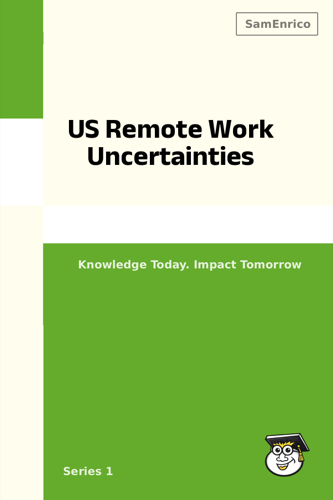
US Remote Work Uncertainties eBook
No dedicated nomad visa, understanding visa runs a
No dedicated nomad visa, understanding visa runs and tourist stays.
Formats
Free sample
Chapter 1: The Invisible Expat--The woman sitting in the CBP secondary inspection room at Dallas/Fort Worth International Airport had done everything right.She was a 34-year-old software architect from São Paulo, earning $9,000 per month working remotely for a German fintech company. She had no intention of staying in the United States permanently. She loved her apartment in Florianópolis, her elderly mother needed her nearby, and she had a return ticket booked for eighty-nine days after her arrival. She had savings. She had a clean criminal record.
She had visited the United States three times before, always leaving on time, always spending money at American businesses, never causing trouble.And yet, at 11:47 PM on a Tuesday night, a Customs and Border Protection officer slid a piece of paper across the metal table. "Ms. Rocha," the officer said, "I am denying your entry and canceling your ESTA. You have been found inadmissible under INA 212(a)(6)(C)(i) for misrepresentation. You will be placed on the next flight back to Brazil.
You are barred from re-entering the United States for five years."The reason? During her primary inspection, the officer had asked: "What do you do for work?" She had answered honestly: "I am a software engineer. I work remotely for a German company."That honesty cost her five years.This book exists because of that woman. And thousands like her.The central paradox of modern remote work is this: you can be a productive, law-abiding, economically valuable person, and the United States immigration system will treat you exactly the same as it treats someone smuggling contraband in a suitcase. Not because the law is evil or the officers are cruel, but because the law was written in a different century, for a different kind of work, and Congress has never bothered to update it.This chapter introduces the landscape you are about to navigate.
It explains why the United States remains a global outlier on digital nomad visas, why so many remote workers desperately want to come here anyway, and what "uncertainty" actually means when the written law collides with lived reality. By the end of this chapter, you will understand the fundamental tension that drives every page of this book: the gap between what is technically legal and what is practically possible, and the price of falling into that gap.The Global Digital Nomad Revolution (That Excludes America)Let us start with some context. As of 2025, more than forty countries have created some form of Digital Nomad Visa or remote work permit. The list includes heavyweights like Spain, Portugal, Germany, and Japan. It includes lifestyle havens like Costa Rica, Croatia, and Greece.
It includes pragmatic destinations like the United Arab Emirates, Malaysia, and Estonia. Even countries with historically restrictive immigration policies—think Iceland, Norway, and South Korea—have carved out pathways for remote workers to stay for six months, twelve months, or even longer.These visas share common features. Typically, they require proof of remote employment or self-employment, a minimum income threshold (often $2,000 to $5,000 per month), health insurance, and a clean criminal record. In exchange, the remote worker receives one to two years of legal residence, the right to rent an apartment, open a bank account, and live like a temporary citizen. Some countries offer tax incentives.
Others offer pathways to permanent residence after repeated renewals.The underlying logic is simple and sound: digital nomads are economic unicorns. They earn money from outside the host country, spend that money inside the host country, do not compete for local jobs, pay consumption taxes (VAT, sales tax) on everything they buy, and leave after a finite period. They are the ideal short-term immigrant: high economic contribution, low social service consumption, zero long-term obligation.Now notice what is missing from that list of forty-plus countries.The United States.Not because the United States lacks the administrative capacity to create such a visa. Not because the United States has no interest in attracting high-earning remote workers. Not even because Congress has debated the idea and rejected it.
The United States has no Digital Nomad Visa for the simplest and most frustrating reason: the immigration system is so outdated and so politically paralyzed that the concept has never seriously been considered.The U.S. Foreign Affairs Manual—the internal guidebook that State Department officers use to interpret immigration law—still defines work primarily in terms of physical labor. 9 FAM 402.2-5(A) states that a B-1 business visitor may engage in "commercial transactions which do not involve productive labor." The manual gives examples like negotiating contracts, consulting with business associates, and attending conventions. It does not mention coding. It does not mention graphic design.
It does not mention client calls, data analysis, content creation, or any of the other ways millions of people actually earn a living in 2025.The manual was last substantially updated in 2009. In internet years, that is several eternities ago.The Demand Gap: Why Everyone Wants What America Won't Offer Given the lack of a legal pathway, you might expect that remote workers simply avoid the United States. You would be wrong.The demand to work from the United States—even temporarily, even without a proper visa—is enormous. Let me quantify that. A 2024 survey of five thousand digital nomads found that the United States was the second-most-desired destination globally, trailing only Spain and beating Portugal, Thailand, and Japan.
When asked why, respondents gave three consistent answers.First, income arbitrage. A remote worker earning a German salary (high) or an Indian salary (low) cannot easily access U.S. clients. But a remote worker who already has U.S. clients or a U.S.-based employer can earn significantly more by being in the same or similar time zone.
The ability to hop on a video call with a New York client during East Coast business hours—while physically in Miami or Austin—is a career accelerant. Some remote workers report a thirty to fifty percent increase in billable work simply from being visible during U.S. daytime hours.Second, networking and opportunity. The United States remains the global center of technology, finance, media, and entrepreneurship. A remote worker who spends six months in San Francisco, New York, or Seattle can attend meetups, coffees, and conferences that simply do not exist elsewhere.
These serendipitous connections lead to jobs, investments, and collaborations. One digital nomad I interviewed—a product manager from London—put it bluntly: "I made more professional connections in three months in Austin than I made in three years in London. The U.S. is where the action is."Third, lifestyle and infrastructure. For all its flaws, the United States offers a combination of natural beauty (national parks, coastlines, mountains), urban energy (restaurants, arts, nightlife), and practical infrastructure (reliable electricity, fast internet, English as the default language) that is hard to beat.
A remote worker choosing between a beach town in Costa Rica and a beach town in Florida faces a real trade-off. Costa Rica offers lower cost and simpler visa rules. Florida offers better infrastructure, easier travel connections, and the ability to drive to Orlando or Miami for a weekend. Many choose Florida, despite the visa headaches.The result is a massive…
This is the end of the free sample. Get the eBook to keep going. Buy now
About this book
Details
- Author
- Fournier Nubia
- Publisher
- SamEnrico
- Language
- English
- Genre
- Non-Fiction, Business Brief, US Immigration
- Released
- 2026-06-11
- Pages (approx.)
- 156
- Available as
- eBook, Audiobook

Read better in the ZLOADR app
Your eBooks on your phone or tablet. Sign in with your SamEnrico account and start reading.
More by Fournier Nubia
 Lateral Thinking for ManagersFournier Nubia$11.99
 Accounting Firm Multiples ManualFournier Nubia$11.99
 Phil Mickelson Lefty LegacyFournier Nubia$11.99
 PCSK9 Inhibitors GuideFournier Nubia$11.99
 OCD Symptom GuideFournier Nubia$11.99
 False Memory implantation by PoliceFournier Nubia$11.99
 Alcohol and Heart HealthFournier Nubia$11.99
 The Rolling Pioneers: How Skateboarding Ignited a Middle Eastern RevolutionFournier Nubia$11.99
 The Eagle and the Fox: Liman von Sanders and Mustafa Kemal at GallipoliFournier Nubia$11.99
 How to Produce ThermosesFournier Nubia$11.99
 How to Produce Hot Dog RollersFournier Nubia$11.99
 How to Become a Grader MarkerFournier Nubia$11.99
You may also like
 Hong Kong Handover 1997Dunn Johnnie$11.99
 Zumba For Postnatal Recovery CourseNeal Christian$11.99
 Zumba for BeginnersLadner Nikia$11.99
 YouTube Comment Mining GuideHumes Pandora$12.99
 Worry Box MeditationCarlin Rudy$11.99
 Workplace Stress MeditationNguyen Lynn$11.99
 Workplace Stress and Sleep RepairHawley Ivory$11.99
 Workplace Perfectionism CureDelaney Jeffry$11.99
 Workplace Injustice Anger GuideWallen Isabelle$11.99
 Work Addiction and Burnout LinkGreenwood Ester$11.99
 Women in Yoga and WellnessBeattie Galina$11.99
 Women in Stand Up ComedyChun Evangeline$11.99