
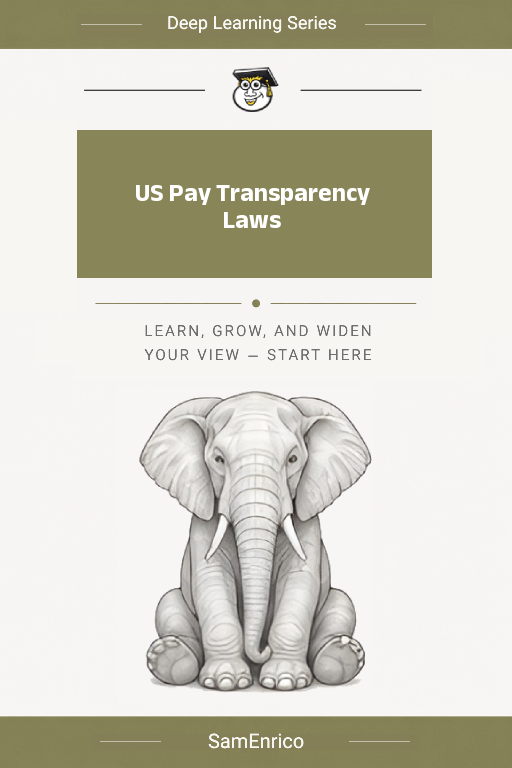
Non-FictionProfessional's Cheat SheetTransparency
US Pay Transparency Laws eBook
Use state pay range disclosure laws to benchmark y
by Joiner Nell
Use state pay range disclosure laws to benchmark your salary. Request ranges before interviews and during annual reviews for data driven raises.
Formats
Free sample
Chapter 1: The $7,500 Lie--–- Every year, an invisible tax is deducted from your paycheck. No legislator voted for it. No employer admits to collecting it. And yet, it flows silently from your bank account to your employer's bottom line, line by line, month by month, year by year. The average American worker loses $7,500 annually simply because they do not know what their peers earn.
This is not a conspiracy theory. It is not a labor union talking point. It is the cold, mathematical consequence of a system designed to keep you in the dark while your employer profits from your silence.This chapter is called "The $7,500 Lie" because that is the precise amount—based on data from the Economic Policy Institute and confirmed by a decade of salary transparency research—that the average worker leaves on the table due to pay secrecy. For some, the number is smaller. For many, especially women and people of color, it is significantly larger.
But the lie itself is universal: the belief that discussing your salary is rude, dangerous, or somehow "unprofessional."That belief is not an accident. It was engineered.The Secret History of Pay Secrecy To understand why you are almost certainly underpaid, you must first understand how pay secrecy became the default setting of American employment. The story begins not with human resources departments or corporate policies, but with the labor unrest of the 1930s and 1940s.During the Great Depression, union membership exploded. The National Labor Relations Act of 1935 guaranteed workers the right to "concerted activities" —including discussing wages and working conditions. In factories and shipyards across America, workers openly compared pay stubs, discovered disparities, and demanded equal treatment.
Employers watched in horror as wage gaps became public knowledge and then became bargaining chips.After World War II, corporate America fought back—not by banning wage discussions outright (that would be illegal), but by creating a culture where such discussions were considered taboo. Personnel manuals began including vague warnings about "maintaining confidentiality." Managers pulled employees aside to say that discussing pay was "not a team behavior." By the 1950s, a powerful social norm had taken root: polite people don't talk about money.The most insidious part of this campaign was that it worked because employees enforced it on themselves. You didn't need a manager to tell you not to share your salary. You already knew—or thought you knew—that doing so would make you look petty, jealous, or ungrateful. Your coworkers would resent you.
Your boss would label you a troublemaker. Better to keep your head down and trust that you were being paid fairly.But you weren't. And you aren't.The Three Forces That Killed Pay Secrecy Every social norm eventually meets its reckoning, and pay secrecy has faced three converging forces that have all but destroyed it as a sustainable practice. Understanding these forces is essential because they provide the legal, economic, and cultural foundation for everything that follows in this book.Force One: The Data Revolution In 2013, a software engineer named Anonymous created a spreadsheet. He worked at Google, and he was curious whether his colleagues with similar titles and experience were earning the same as he was.
He invited a few friends to contribute their salaries anonymously. Within weeks, thousands of Google employees had added their data. The spreadsheet revealed what Google had never admitted: significant pay disparities across gender and racial lines, with women and minorities earning systematically less than their white male peers for identical roles.That spreadsheet became the template for Blind, Levels.fyi, Fishbowl, and a dozen other platforms where workers now share salary data by the millions. Today, you can look up the exact compensation bands for software engineers at almost any major tech company, down to the dollar. You can see how much a product manager at Amazon makes in Seattle versus New York versus Austin.
You can compare your own salary to anonymized peers at competing firms without ever speaking to another human being.The platforms have their limitations—self-reported data can be inaccurate or biased—but they shattered the foundational premise of pay secrecy: that you had no way of knowing what others earned. Once that premise collapsed, the entire system began to follow.Force Two: The Remote Work Revolution Before 2020, your salary was largely determined by your zip code. A marketing manager in San Francisco earned 120,000;thesamepersondoingthesamejobin Clevelandearned120,000; the same person doing the same job in Cleveland earned 120,000;thesamepersondoingthesamejobin Clevelandearned65,000. Employers justified these disparities with something called "geographic differentials"—a polite term for paying people less because they had fewer options.Then the pandemic forced millions of workers into remote roles, and the geographic differentials became impossible to defend. If a software engineer in Boise, Idaho, could do the same job as a software engineer in Boston, Massachusetts, why should the Boston engineer earn twice as much?
More importantly, why should the Boise engineer not know what the Boston engineer made?Employers tried to maintain the fiction by posting different salary ranges for different locations. But remote work made those ranges public. A job posting for a "remote-first" company might list four different pay bands depending on where the employee lived. Workers in low-cost areas saw exactly what workers in high-cost areas were offered. The secrecy was gone.Today, remote work has made geographic pay disparities transparent by default.
If your company hires remote workers in Colorado, they must post Colorado pay ranges for every role—including the one you do, even if you live in Texas. That data is now available to you, whether your employer likes it or not.Force Three: The Legislative Avalanche The final force is the one this book is named for: a wave of state laws that have turned voluntary transparency into mandatory disclosure. Between 2021 and 2026, more than fifteen states passed legislation requiring employers to do what they had always refused to do voluntarily: share their pay ranges.Colorado led the way in 2021 with the Equal Pay for Equal Work Act, requiring pay ranges in all job postings. New York and Washington followed in 2022. California, Maryland, and New Jersey enacted their own versions in 2023.
By mid-2026, laws are active or pending in over twenty states, covering more than half the American workforce.These laws vary in their specifics—some require posting, others only disclosure upon request, some include internal transparency for current employees—but they share a common effect: they have made salary data a matter of public record for millions of workers. The information that employers spent decades hiding is now legally required disclosure.And here is the most important thing to understand: even if you do not live in a transparency state, you can still use these laws to your advantage. If you apply for a remote job with a company that has employees in Colorado or New York, that company must provide you with a pay range. If you work for a company that operates in California, you can request your own internal pay scale. The laws apply to employers, not just to residents.
If the employer touches a transparency state, the transparency follows.Why Your Silence Costs You $7,500Let us return to that number: $7,500. Where does…
This is the end of the free sample. Get the eBook to keep going. Buy now
About this book
Details
- Author
- Joiner Nell
- Publisher
- SamEnrico
- Language
- English
- Genre
- Non-Fiction, Professional's Cheat Sheet, Transparency
- Released
- 2026-06-01
- Pages (approx.)
- 133
- Available as
- eBook, Audiobook

Read better in the ZLOADR app
Your eBooks on your phone or tablet. Sign in with your SamEnrico account and start reading.
More by Joiner Nell
 Forgiveness Letter MethodJoiner Nell$11.99
 Validating Sibling RivalryJoiner Nell$11.99
 The Workaholic Weekend Recovery GuideJoiner Nell$11.99
 Birth Control Transition GuideJoiner Nell$11.99
 The Golden Brews of Meroë: Kush’s Royal Ale and the Art of FermentationJoiner Nell$11.99
 How to Produce Barcode Scanner StandsJoiner Nell$11.99
 Cisco Certified Network SpecialistJoiner Nell$11.99
 How to Become a Gin ClerkJoiner Nell$11.99
You may also like
 Hong Kong Handover 1997Dunn Johnnie$11.99
 Zumba For Postnatal Recovery CourseNeal Christian$11.99
 Zumba for BeginnersLadner Nikia$11.99
 YouTube Comment Mining GuideHumes Pandora$12.99
 Worry Box MeditationCarlin Rudy$11.99
 Workplace Stress MeditationNguyen Lynn$11.99
 Workplace Stress and Sleep RepairHawley Ivory$11.99
 Workplace Perfectionism CureDelaney Jeffry$11.99
 Workplace Injustice Anger GuideWallen Isabelle$11.99
 Work Addiction and Burnout LinkGreenwood Ester$11.99
 Women in Yoga and WellnessBeattie Galina$11.99
 Women in Stand Up ComedyChun Evangeline$11.99